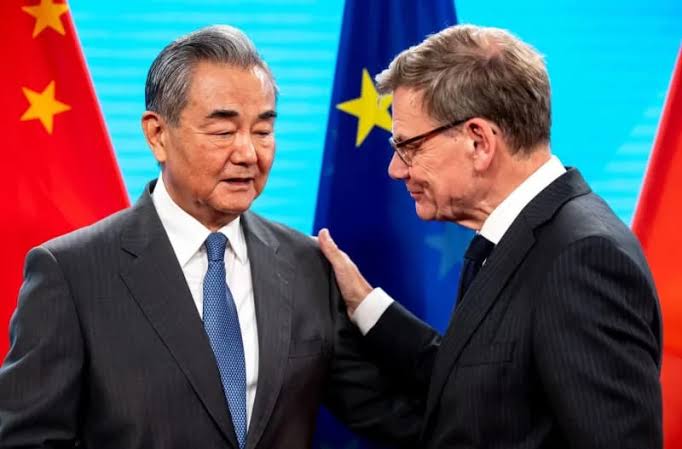
MUNICH — China’s top diplomat, Wang Yi, expressed a desire to strengthen ties with Germany during a meeting with Chancellor Friedrich Merz on the sidelines of the Munich Security Conference, signaling Beijing’s intent to expand its strategic partnership with Berlin.
According to a statement from China’s Ministry of Foreign Affairs, Wang said the two countries should aim to elevate their “all-round strategic partnership to a new level” and prepare for “the next stage of high-level exchanges.”
He added that Beijing hoped Germany could serve as a “stabilising anchor” in China-Europe relations and act as a “driving force” for broader cooperation across the continent.
The meeting comes amid efforts by Beijing to portray itself as a dependable partner to the European Union at a time when the bloc is seeking to reduce reliance on both China and an unpredictable United States.
Wang emphasized support for Germany to enhance its “strategic autonomy and self-reliance,” suggesting that Berlin could play a central role in shaping Europe’s engagement with China.
Merz, who is reportedly planning his first official visit to China later this month, faces a complex agenda, with economic and commercial issues high on the list.
German-Chinese economic ties, historically robust, have experienced strains in recent years due to disagreements over trade practices, market access, and protectionist policies. Wang’s comments appear aimed at reassuring Berlin of Beijing’s commitment to stabilising bilateral relations despite these tensions.
Read Also: Taiwan Hits Back At China’s Munich Conference Speech
The diplomatic exchange in Munich follows recent high-level engagements between German and Chinese officials.
In December, Germany’s Foreign Minister Johann Wadephul travelled to Beijing to press Chinese authorities on using their influence to help end Russia’s ongoing war in Ukraine.
Wadephul met with Wang and other senior officials to discuss the conflict and Europe’s security concerns. The trip came after an earlier planned visit had been abruptly cancelled, with German authorities citing difficulties in arranging meetings with key Chinese officials.
During the Munich meeting, Wang highlighted China’s expectation that Germany play a more proactive role in fostering dialogue between China and Europe.
“China also expects Germany to become a stabilising anchor for China-Europe strategic relations,” the ministry’s readout quoted him as saying. Wang added that Beijing looked forward to Germany contributing to the broader stability and cooperation of the continent.
China’s engagement with Germany reflects a broader diplomatic push across Europe. With EU leaders seeking to diversify economic partnerships and mitigate dependence on major powers, Beijing has been highlighting its willingness to act as a steady partner while simultaneously pursuing strategic economic interests.
German officials, meanwhile, have signalled caution, balancing commercial opportunities with concerns over human rights, trade imbalances, and geopolitical risks.
The economic relationship between Germany and China has been shaped by decades of trade and investment.
Germany is China’s largest trading partner in Europe, and Chinese investment has played a role in sectors ranging from automotive manufacturing to technology.
However, tensions have escalated in recent years. Berlin has criticised Beijing over market access restrictions, subsidies for Chinese companies, and alleged industrial espionage, while Chinese officials have expressed frustration with what they see as European protectionism.
Read Also:
Merz’s upcoming visit is expected to test whether bilateral dialogue can translate into concrete agreements or coordinated initiatives.
Sources familiar with planning for the trip indicate that commercial ties, investment frameworks, and technology cooperation will dominate discussions.
Read Also: U.S. Defense Strategy Shifts Focus to China, Than Allies
The German government is reportedly keen to avoid abrupt policy shifts while maintaining leverage in negotiations with Beijing.
Observers note that China’s diplomatic messaging often emphasises continuity and mutual benefit, framing Germany as a central partner in European affairs. By presenting Berlin as a stabilising influence, Chinese officials aim to reinforce their broader goal of strengthening strategic partnerships across the EU while navigating growing scrutiny over Beijing’s role in global politics.
Wadephul’s December visit had underscored the German government’s intent to engage Beijing on global security challenges, particularly the war in Ukraine.
German officials had pressed Chinese counterparts to leverage their ties with Moscow to promote conflict resolution, reflecting Berlin’s dual-track approach of maintaining economic relations while pursuing diplomatic influence.
Wang’s reiteration of support for German strategic autonomy can be interpreted as an acknowledgement of Germany’s growing independent role within Europe, both economically and politically.
The next steps for the bilateral relationship will likely be determined during Merz’s upcoming trip.
Officials from both sides have signalled an interest in expanding high-level exchanges, but the precise agenda and potential agreements remain under preparation.
China and Germany have maintained a pattern of intermittent high-level diplomacy in recent years, punctuated by both engagement and tension.
Wang’s statements in Munich suggest that Beijing is keen to stabilise the partnership and signal readiness for sustained, structured engagement with Berlin.