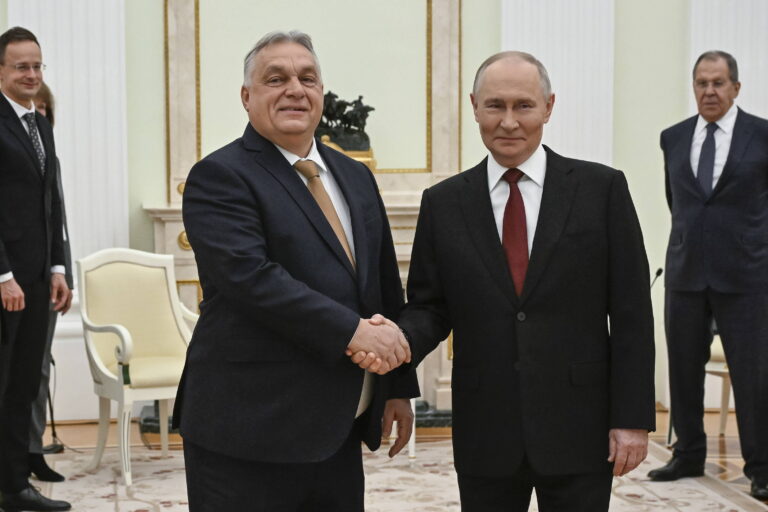
Hungary has continued importing large volumes of discounted Russian crude oil despite having access to alternative supply routes, with financial benefits largely accruing to its dominant energy company rather than consumers.
The report, published by the Center for the Study of Democracy (CSD), argues that fuel price data across Central Europe shows Hungarian motorists have not enjoyed lower prices even though the country purchases cheaper Russian supplies.
Researchers said the pricing gap raises questions about the economic rationale cited by Prime Minister Viktor Orbán for resisting broader European efforts to phase out Russian fossil fuels following Moscow’s 2022 invasion of Ukraine.
Hungary remains one of the European Union’s most significant buyers of Russian crude.
According to the CSD analysis, Russian oil accounted for more than 92% of Hungary’s crude imports last year, a sharp increase from roughly 61% before the war.
The continued reliance comes despite exemptions granted by the European Union in 2022 to landlocked member states heavily dependent on Russian energy, including Slovakia and the Czech Republic, allowing them time to diversify supply.
While Prague has since eliminated Russian oil imports, Hungary and Slovakia have maintained or expanded purchases under the exemption framework.
Read Also: Rubio Heads To Slovakia And Hungary After Munich Summit
The CSD report contends that Hungary’s continued dependence reflects policy choices rather than unavoidable logistical constraints.
Hungary receives Russian crude primarily via the Druzhba pipeline, a Soviet-era network that crosses Ukrainian territory before entering Central Europe.
However, researchers said the country is also connected to the Adria pipeline, which transports non-Russian oil from Croatia’s Adriatic coast.
According to the report, the Adria route has sufficient capacity to meet Hungarian and Slovak demand and carries lower transit fees than the Druzhba system, despite the latter running through an active conflict zone.
Russian crude has nevertheless remained financially attractive. Between January 2024 and August 2025, it traded at an average discount of about 20% compared with alternative supplies, the researchers said.
That price difference has formed the core of Budapest’s argument that maintaining Russian imports shields households from higher fuel costs.
The CSD analysis disputes that claim. Examining regional pricing trends, the institute found that Hungary’s average weekly pre-tax fuel prices in 2025 were about 18% higher than those in the Czech Republic, which relies on non-Russian oil.
Diesel prices showed a similar pattern, exceeding Czech levels by roughly 10% despite Hungary’s cheaper crude input costs.
Read Also: Oil Flows Resume To Hungary And Slovakia After Strike
Researchers attributed the discrepancy to pricing practices by MOL Group, Hungary’s largest oil and gas company and the country’s dominant fuel supplier.
The report said MOL continued selling refined products at market-aligned regional prices rather than passing on savings from discounted Russian imports to domestic consumers.
According to the study, MOL’s operating income has risen about 30% above pre-invasion levels since 2022.
The authors argued that the company’s profitability increased as it processed discounted crude while maintaining retail prices comparable to neighboring markets.
“The dependence on discounted Russian oil has not trickled down to consumers,” Martin Vladimirov, director of CSD’s energy and climate program, said in comments accompanying the report. He added that excess profits generated through the price differential primarily benefited the dominant supplier.
The report also highlighted ownership structures surrounding MOL. It said foundations linked to Orbán’s political and institutional network collectively control roughly 30.49% of the company’s shares.
Among them is the Mathias Corvinus Collegium, a prominent educational organization with close ties to the government.
The study alleged that surplus revenues flowing through these structures strengthened what it described as entrenched domestic influence networks, though it did not present evidence of wrongdoing under Hungarian law.
CNN reported that requests for comment were sent to both the Hungarian government and MOL but that responses had not been received at the time of publication.
Hungarian officials have consistently defended the country’s energy policy, arguing that geography and infrastructure limit rapid diversification and that affordable fuel remains a priority for households and industry.
Energy policy has been a persistent source of friction between Budapest and its Western allies since Russia launched its full-scale invasion of Ukraine in February 2022.
European governments moved quickly to reduce reliance on Russian oil and gas, imposing sanctions and restructuring supply chains. Hungary negotiated carve-outs during sanctions talks, citing its landlocked position and refinery configurations designed for Russian crude.
The issue resurfaced in late 2025 when the United States imposed sanctions on two Russian oil companies. Orbán subsequently traveled to Washington seeking relief measures, and U.S. President Donald Trump granted Hungary a one-year exemption, stating that transitioning away from Russian fossil fuels posed particular challenges for the country.
CSD researchers said infrastructure constraints alone do not explain Hungary’s continued purchasing patterns. Their analysis concludes that available alternatives and lower transport costs through the Adria pipeline weaken the argument that Russian imports are unavoidable.
The findings arrive as European policymakers continue debating enforcement gaps in sanctions regimes and the pace at which remaining exemptions should be phased out.
EU officials have repeatedly urged member states benefiting from temporary waivers to accelerate diversification efforts, though no unified deadline has been imposed.