
Two people were killed and hundreds of thousands of homes remained without electricity in southern France on Friday after Storm Nils swept across parts of western Europe, bringing destructive winds, heavy rain and widespread disruption to transport and infrastructure, authorities said.
Power distribution operator Enedis reported that about 450,000 households in southern France were still without electricity early Friday, a day after the storm damaged power lines, uprooted trees and flooded roads across several regions.
The company said it had restored service to roughly half of the 900,000 customers initially affected but warned that difficult conditions were slowing repair efforts.
Emergency services confirmed two fatalities in France linked to the storm. A truck driver died when a tree fell onto his vehicle, smashing through the windscreen, according to local officials. In a separate incident in the Tarn-et-Garonne department, a person died after falling from a ladder while working in a garden during the severe weather, government spokesperson Maud Bregeon said.
Read Also: France Urges EU To Prepare For Renewed U.S. Confrontation
Storm Nils moved across southwestern Europe on Thursday, affecting large areas of Spain and Portugal as well as southern France.
Authorities across the region reported casualties, infrastructure damage and transport cancellations as strong winds and intense rainfall battered coastal and inland areas.
Spanish officials said a woman was killed when the roof of an industrial warehouse collapsed during the storm. Dozens of people in Spain were also injured in weather-related incidents, emergency services said, though details of the injuries were not immediately released.
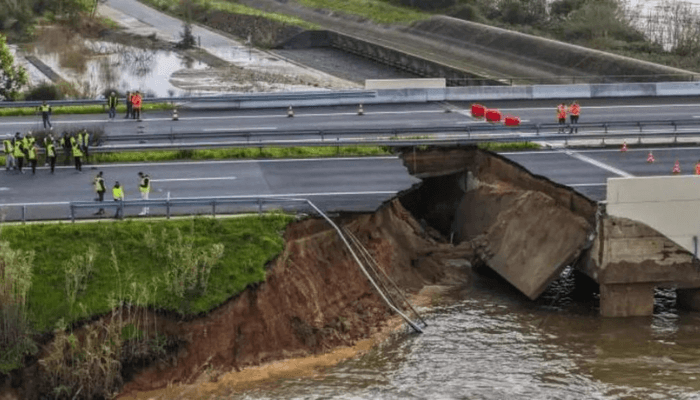
In Portugal, flooding weakened infrastructure, leading to the partial collapse of a viaduct, authorities confirmed, though no deaths were immediately reported there.
French meteorological services described Nils as unusually powerful for the season, noting wind gusts strong enough to topple trees and tear roofing materials from buildings. Rail services, flights and ferry crossings across parts of southwestern Europe were cancelled or delayed as operators responded to hazardous conditions.
Read Also: France: Launches National Service Amid Rising Russia Tension
Several regional road networks were temporarily closed because of fallen debris and rising water levels.
The storm caused extensive damage to electricity networks in rural areas, where repair crews faced particular difficulty reaching affected sites.
Enedis crisis director Hervé Champenois told reporters that flooding had left fields waterlogged and blocked access routes, complicating restoration work. Around 3,000 personnel were mobilized nationwide to reconnect customers and secure damaged infrastructure, the company said.
Residents in hard-hit communities described a night marked by powerful winds and continuous noise as the storm passed. Eugénie Ferrier, a resident of Roaillan, a village near Bordeaux, said the intensity of the storm caught many by surprise. “During the night, you could hear tiles lifting, rubbish bins rolling down the street – it was crazy,” she said.
Local authorities urged residents to remain cautious as cleanup operations continued, warning of unstable trees, damaged structures and flooded areas.
Although forecasters said the storm system had largely moved eastward away from French territory by late Thursday, some regions remained under alerts for potential flooding due to saturated ground and swollen rivers.
Storm Nils followed a series of recent severe weather episodes that have affected the Iberian Peninsula in recent weeks. Earlier storms brought heavy flooding to parts of Spain and Portugal, forcing evacuations and causing multiple deaths.
Emergency planners across the region have faced repeated demands on rescue and recovery resources as successive weather systems struck within a short period.
Scientists and climate researchers have increasingly linked the growing frequency and intensity of extreme weather events in Europe to rising global temperatures associated with greenhouse gas emissions. While individual storms cannot be attributed solely to climate change, researchers say warmer atmospheric conditions can increase the likelihood of heavier rainfall and more powerful storm systems.
French authorities said assessments of the full economic and infrastructural impact of Storm Nils were still under way.
Insurance claims and damage surveys are expected to continue in the coming days as local governments evaluate losses to homes, agriculture and public infrastructure.
Transport operators were gradually restoring services Friday, though delays persisted in several regions due to ongoing safety inspections and debris clearance.
Energy crews said priority would remain on reconnecting isolated rural communities and critical facilities such as hospitals and emergency centers.
Officials said weather monitoring would continue as rivers remain elevated following the storm, with civil protection agencies maintaining heightened vigilance in flood-prone areas.
Further updates on restoration progress and damage assessments are expected from regional authorities as recovery operations proceed over the weekend.