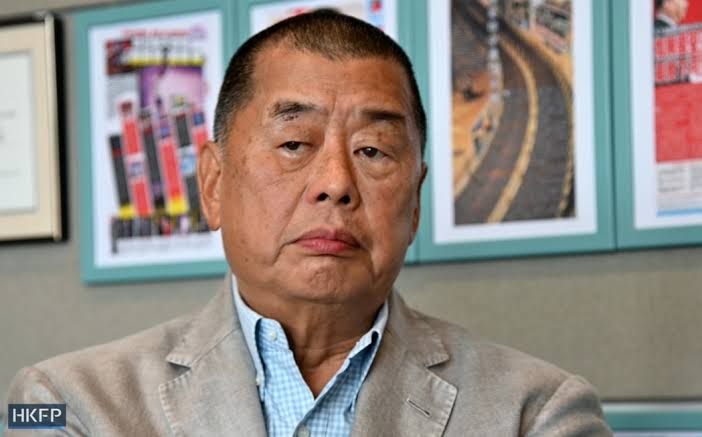
Jimmy Lai, the founder of the now-defunct Apple Daily newspaper and one of Hong Kong’s most prominent democracy advocates, was sentenced to 20 years in prison on Monday after being convicted under the city’s sweeping national security law, according to China’s state-run Xinhua News Agency.
The ruling was handed down by the High Court of the Hong Kong Special Administrative Region (HKSAR), marking one of the heaviest sentences imposed since Beijing overhauled the territory’s legal landscape in 2020.
The court found Lai guilty in December on two counts of conspiring to collude with external forces and one count of conspiracy to publish seditious materials. Judges said the offenses posed a serious threat to national security, a conclusion prosecutors have repeatedly emphasized throughout the long-running case. Sentencing followed a mitigation hearing held in mid-January, after months of arguments from both the prosecution and defense.
The verdict and sentence deepen concerns among Western governments and press freedom groups, who argue that the prosecution of Jimmy Lai reflects a broader crackdown on dissent and independent media in Hong Kong. Authorities in Beijing and Hong Kong, however, insist the case demonstrates that no individual is above the law and that national security offenses must be dealt with firmly.
Jimmy Lai’s case has been closely watched both inside and outside Hong Kong because of his high profile and the symbolic weight of Apple Daily, once one of the city’s most widely read pro-democracy tabloids. Lai, a self-made billionaire who fled mainland China decades ago, became an outspoken critic of the Chinese Communist Party and a vocal supporter of Hong Kong’s protest movement.
According to Xinhua, Lai was convicted of conspiring with foreign forces, a charge tied to allegations that he sought international sanctions and support aimed at pressuring Beijing and Hong Kong authorities. Prosecutors also accused him of using Apple Daily and related platforms to publish materials deemed seditious under the law.
Read also: Hong Kong Election Turnout Tested, Fire Fuels Public Anger
The defendants in the case included Lai personally as well as three Apple Daily-related companies: Apple Daily Limited, Apple Daily Printing Limited, and Apple Daily Internet Limited. All were charged with conspiracy to publish seditious materials and conspiracy to collude with external forces. Lai additionally faced a separate count of conspiring to collude with external forces, which prosecutors argued justified a substantial prison term.
The trial officially began on December 18, 2023, and was overseen by a panel of three judges designated under Hong Kong’s national security law. Such judges are selected by the city’s leader and handle cases considered to involve state security, a process critics say weakens judicial independence.
The sentencing of Jimmy Lai is likely to reignite international criticism of Hong Kong’s national security framework. Governments in the United States, Britain, and the European Union have previously called for Lai’s release, describing him as a prisoner of conscience. Press advocacy groups, including Reporters Without Borders and the Committee to Protect Journalists, have repeatedly warned that his prosecution chills independent journalism.
Read also: Three Days Of Mourning To Begin After Hong Kong Fire Tragedy
Reuters and the BBC have previously reported that Apple Daily shut down in 2021 after police froze its assets and arrested senior editors, moves that critics said effectively silenced one of Hong Kong’s last major pro-democracy voices. Hong Kong officials have rejected that characterization, saying the newspaper’s closure was the result of lawful enforcement actions, not political suppression.
Beijing has defended the national security law as necessary to restore stability after months of mass protests in 2019, some of which turned violent. Chinese and Hong Kong authorities argue that the law targets only a narrow category of offenses and does not infringe on legitimate freedoms.
Jimmy Lai’s conviction and sentence come amid a broader reconfiguration of Hong Kong’s political and media landscape. Since the national security law took effect, dozens of activists, former lawmakers, and journalists have been arrested or prosecuted. Several civil society groups and media outlets have disbanded, citing legal and financial pressure.
Hong Kong officials maintain that the city remains open for business and that its legal system continues to operate independently, apart from cases involving national security. They say stability has returned and that residents can exercise their rights within the bounds of the law.
Lai’s legal team has indicated in the past that it would pursue appeals where possible, though options are limited in national security cases. Any appeal process could take months or longer, and Lai is expected to remain in custody during that time.
As Hong Kong continues to balance its role as an international financial hub with Beijing’s insistence on tighter political control, the outcome of Jimmy Lai’s case is likely to remain a touchstone in debates over the city’s future. Whether it marks the end of a chapter or the beginning of further legal battles, the sentence underscores how profoundly the national security law has reshaped Hong Kong’s legal and media environment.