Prof. MarkAnthony Nze

AI & Health: Who Controls the Cure?—Part 3

AI & Health: Who Controls the Cure?—Part 3

The Black Box Clinic

How Opacity in AI Systems Collapses Transparency, Accountability, and Trust.

By Prof. MarkAnthony Nze

When Medicine Stops Explaining Itself

Modern medicine is built on explanation. Diagnosis requires justification, treatment demands rationale, and consent presupposes understanding. Yet AI-assisted healthcare increasingly operates in direct violation of this epistemic foundation. Across hospitals, decision-support systems now issue recommendations that cannot be meaningfully interrogated by clinicians, patients, or regulators. These systems work—but they do not explain.

London (2019) describes this as the central ethical rupture of AI in medicine: accuracy has been prioritized over intelligibility. High-performing models deliver predictions without reasons, …
AI & Health: Who Controls the Cure?—Part 2

AI & Health: Who Controls the Cure?—Part 2

The Data Cartels

Who Owns Health Data, Who Profits, and Who Loses Sovereignty.

By Prof. MarkAnthony Nze

From Clinical Records to Strategic Assets

Healthcare data has crossed a threshold. What was once understood as confidential clinical documentation—ethically stewarded under professional norms of care—has been reclassified as a strategic economic resource. This transformation did not occur through legislative decree or democratic debate. It unfolded incrementally through technical partnerships, cloud migrations, and AI “solutions” introduced under the banners of efficiency, modernization, and innovation.

Morley (2022) identifies this shift as a governance failure rather than a technological inevitability. Health systems, particularly public ones, …

AI & Health: Who Controls The Cure?—PART 1

AI & Health: Who Controls The Cure?—PART 1

The Promise and Peril of AI in Healthcare

Understanding the dual nature of innovation and risk in the age of intelligent medicine.

By Prof. MarkAnthony Nze

The Rise of Algorithmic Medicine

Artificial intelligence has moved from the margins of experimental medicine to the operational core of contemporary healthcare systems. No longer confined to academic laboratories or pilot studies, AI now informs diagnostic imaging, triage decisions, predictive analytics, drug discovery, and even patient–clinician interactions. Hospitals deploy machine-learning models to forecast sepsis, prioritize emergency admissions, and optimize resource allocation, while governments and insurers increasingly rely on algorithmic assessments to guide public

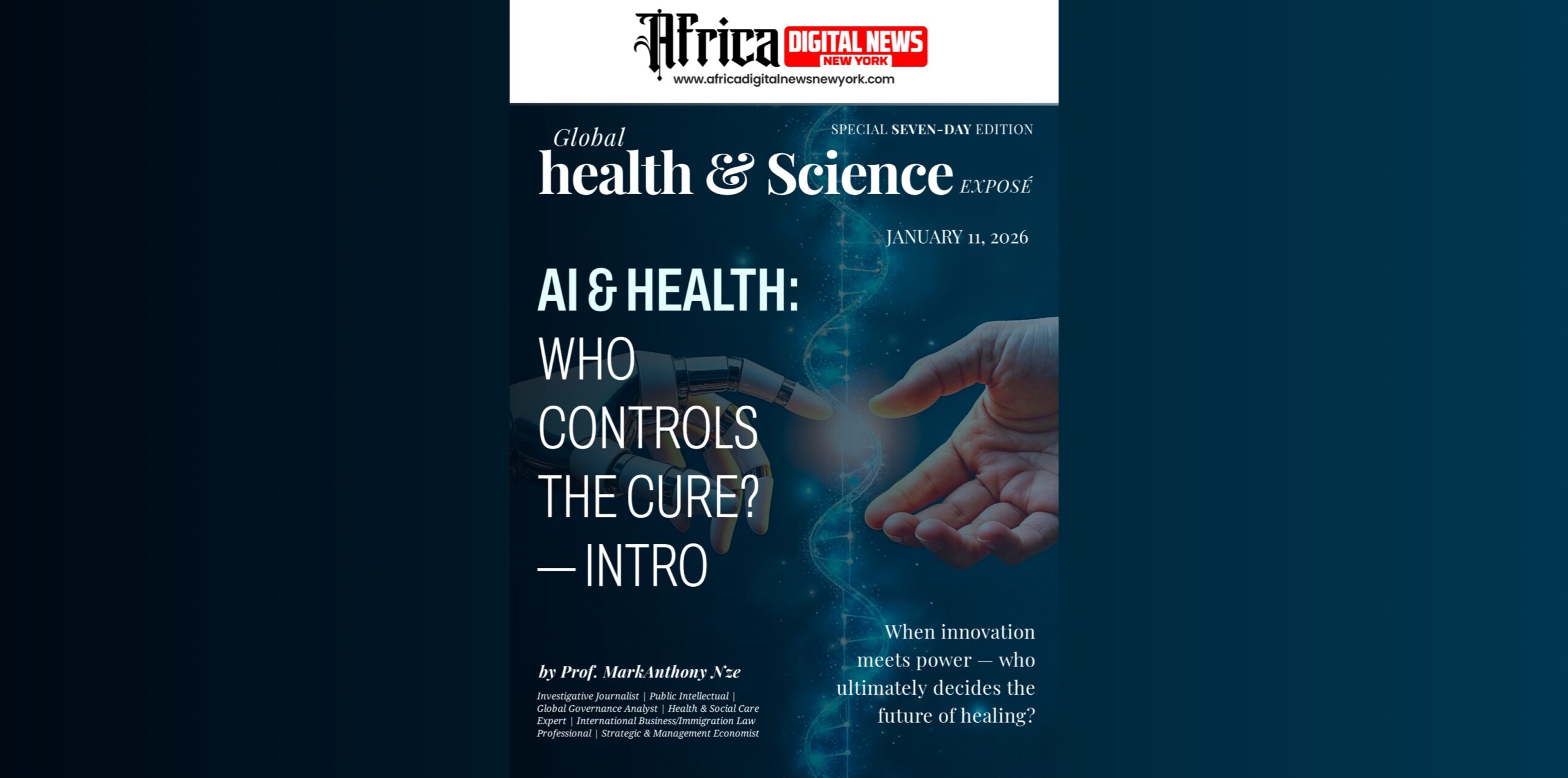
AI & Health: Who Controls The Cure?—Intro

When innovation meets power — who ultimately decides the future of healing?

By Prof. MarkAnthony Nze

In promises of precision and cures, artificial intelligence has captivated the imagination of technologists, clinicians, policymakers, and the public alike. Across the globe, from Silicon Valley boardrooms to academic medical centers, a compelling narrative has taken hold: that AI will transform medicine, obliterate inefficiencies, and usher in a new era of personalized, data-driven care. Yet beneath the glossy rhetoric of innovation lies a more complex truth — one that demands rigorous, evidence-based scrutiny. For AI in healthcare is not merely a story of computing

Diseases That Pay: The Global Health Economy—EPILOGUE

Diseases That Pay: The Global Health Economy—EPILOGUE

When survival is priced, dignity becomes negotiable

By Prof. MarkAnthony Nze

The Final Bill

The final bill does not arrive in an envelope.
 It arrives quietly—after the diagnosis, after the delay, after the denial, after the bargain is struck between what is needed and what is affordable. It arrives when survival becomes a calculation and health is no longer assumed, but negotiated.

This is the moment modern medicine rarely names.

Across systems and continents, disease has become the most honest mirror of political economy. According to global health expenditure data, societies now spend more on health than at any point …

Diseases That Pay: The Global Health Economy—Part 7

Diseases That Pay: The Global Health Economy—Part 7

When medicine can heal—but the market decides who is allowed to recover

By Prof. MarkAnthony Nze

The Cure Economy

The cure is always announced with ceremony.
A press release. A stock surge. A promise framed as a breakthrough. The language is triumphant, almost moral: historic, life-saving, transformational. Yet beneath the celebration lies a quieter, unresolved question—one that modern medicine rarely confronts honestly: what happens when curing disease threatens the business of treating it?

In today’s health system, a cure is no longer just a scientific achievement. It is an economic event. It must justify its price, defend …

Diseases That Pay: The Global Health Economy—Part 6

When care becomes code, and the body becomes a permanent data source

By Prof. MarkAnthony Nze

The Quiet Displacement of Care

The stethoscope did not disappear.
It was quietly displaced—without resistance, without debate—by something smaller, more intimate, and infinitely more persistent. A phone in the pocket. A sensor on the wrist. A platform that never sleeps. Health no longer waits for symptoms or appointments. It now unfolds continuously, translated into data points that stream into infrastructures most patients will never see and agreements they will never fully understand.

This transformation is marketed as empowerment.
It feels like convenience.
It operates …

Diseases That Pay: The Global Health Economy—Part 5

Diseases That Pay: The Global Health Economy—Part 5

When vulnerability is repackaged as opportunity in global health

By Prof. MarkAnthony Nze

The experiment did not begin with a molecule or a hypothesis.
 It began with absence.

Absence of clinics with diagnostic equipment. Absence of hospitals stocked with essential medicines. Absence of systems capable of offering care without conditions. In these places, illness is not merely biological; it is logistical and financial. Care does not arrive as one option among many. It arrives as the only door left open.

That door is often labeled research.

According to the World Health Organization’s Global Health Expenditure Database (2023), global health …

Diseases That Pay:The Global Health Economy—Part 3

Diseases That Pay: The Global Health Economy—Part 3

The Price of Being Human

When health becomes currency, survival becomes conditional.

By Prof. MarkAnthony Nze

When Care Stopped Being a Moral Guarantee

There was a time when illness, though feared, did not immediately translate into financial dread. Health systems were imperfect, uneven, and often unjust—but the act of seeking care was not, in itself, an economic negotiation. That moral baseline has eroded.

Today, the experience of illness is inseparable from cost calculations. Before diagnosis comes coverage verification. Before treatment comes authorization. Before healing comes an invoice. The modern health system no longer asks first what does this patient need?

Diseases That Pay: The Global Health Economy—Intro

Diseases That Pay: The Global Health Economy—Part 2

The Pharmaceutical Empire

Beneath the white coats lies the most sophisticated market ever built — one where human frailty is the raw material and the cure is the product line.

By Prof. MarkAnthony Nze

The modern pharmaceutical industry presents itself as medicine’s cathedral, laboratories gleaming like sanctuaries, scientists in spotless coats, and advertisements that equate capsules with compassion. But the illusion is costly. Behind the glass facades and charity campaigns lies one of the most profitable and secretive industries in history, a trillion-dollar enterprise that has converted human suffering into its most renewable resource.

By 2025, the world’s pharmaceutical spending …

Diseases That Pay: The Global Health Economy—Part 1

Diseases That Pay: The Global Health Economy—Part 1

How medicine became the world’s most profitable promise — and the patient its most expendable asset.

By Prof. MarkAnthony Nze

The Price of Survival

The modern hospital looks nothing like a factory, but it functions like one. From the gleam of the surgical theater to the hum of the billing department, every breath, every test, every tablet has a price. What once stood as a sanctuary for the sick has become the engine room of a trillion-dollar enterprise, a marketplace where recovery is purchased in installments, and health is the currency most people can no longer afford.

In 2025, the …

Diseases That Pay: The Global Health Economy—Intro

Diseases That Pay: The Global Health Economy—Intro

In a world where every illness is an industry, healing has become humanity’s most expensive pursuit.

By Prof. MarkAnthony Nze

Introductory Overview

How the World Learned to Monetize Sickness

There was a time when medicine was a calling, and when the physician’s oath was a covenant between compassion and science. But somewhere along the fluorescent corridors of the twenty-first century, the language of healing changed. The patient became a consumer, the hospital a revenue center, the prescription pad a financial instrument. In this new moral arithmetic, illness is no longer an interruption of life — it is an industry.

Across …