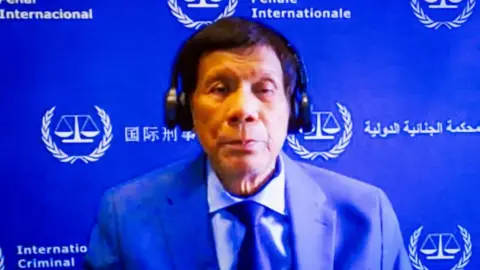
Judges at the International Criminal Court launched a multi-day hearing to determine if they should put Philippine ex-President Rodrigo Duterte on trial for crimes against humanity over the thousands of deaths that resulted from his anti-drug crackdown, which dominated his presidency and elicited strong criticism from the international community.
The hearing, which will take place over several days, makes Duterte, the first-ever Asian head of state, the first from the region to appear before the ICC as a defendant, not a plaintiff or witness, on charges of crimes against humanity over a campaign of violence that prosecutors said caused widespread and systematic attacks on civilians from November 2011 to March 2019, covering Duterte’s tenure as Davao City mayor and the early years of his presidency.
The confirmation of charges hearing, which is set to last four days, is meant to determine if prosecutors have presented enough evidence to support a trial, although the judges’ decision on the matter is set to be released on a later date.
Duterte, aged 80, did not attend the opening session of the court as he waived his right to appear at the trial.
His legal counsel claimed that he does not recognize the jurisdiction of the ICC and that he is innocent of the charges leveled against him. In his statement released prior to the trial, Duterte called the accusations “an outrageous lie” and claimed that he was “too old, too tired, too frail” to attend the trial.
Read Also: Sara Duterte Impeachment Push Intensifies In Philippines
Speaking to the judges at the ICC trial, prosecutor Mame Niang claimed that the case involved “crimes committed in the exercise of State authority.”
“Duterte’s so-called war on drugs resulted in the killing of thousands of civilians, and many of these victims were children,” Niang said, adding that the trial was “a reminder that those in power are not above the law.”
ICC prosecutors have accused Duterte of three crimes against humanity, including the involvement of at least 76 murders, and accused him of being an “indirect co-perpetrator” by facilitating the killings carried out by his subordinates.
The prosecutors have accused the authorities and hired gunmen of targeting individuals identified as drug suspects as part of the anti-drug crackdown code-named Operation Double Barrel.
Duterte was propelled to the presidency by his promise to solve the issues of crime and illegal drugs, which he used to win the 2016 presidential election by a wide margin.
Before becoming the president, he had served as the mayor of Davao City for many decades, earning the reputation of being a strict adherent to the rule of law.
Upon assuming the presidency, he openly urged police officers to kill drug peddlers and users.
The killings carried out by the police and unknown assailants have become the hallmark of the anti-drug campaign, which has drawn condemnation from other nations, the United Nations, and human rights groups.
Human rights groups have estimated that as many as 30,000 people may have died, although the exact numbers remain disputed.
The Philippine police have always claimed that they were simply acting in self-defense as part of legitimate policing. They also deny the existence of systematic executions.
These accusations have been repeatedly denied by Duterte and his predecessors.
Read Also: Sara Duterte Faces New Impeachment Complaints In Philippines
Many of the victims were from poor urban areas, human rights groups claim, and the enforcement was biased against low-level traffickers, leaving the large networks largely untouched. However, the Philippine authorities have disputed these claims.
The ICC has jurisdiction over alleged crimes that took place when the Philippines was still a party to the Rome Statute, which established the court.
The Philippines withdrew from the court in 2019, but the prosecutors claim that the court still has jurisdiction over crimes that took place before the withdrawal.
Duterte has consistently disputed the validity of the investigation, claiming that the Philippine judiciary was sufficient to handle any issues of abuse within the country.
The case is politically motivated, according to supporters of the former president, a claim that has been denied by ICC officials.
Soon after the trial began, Duterte’s son Sebastian Duterte, the acting mayor of Davao, expressed his discontent on social media, stating: “This is not justice, not accountability, but selective prosecution masquerading as moral superiority.”
Nevertheless, Duterte still enjoys political support from some parts of the country, as demonstrated by his recent victory in the Davao City mayoral election in 2025, where he was a candidate and was incarcerated at the time.
His daughter, Sara Duterte, currently serves as vice president of the Philippines, signifying the family’s enduring political influence in the country.
The role of the judges at this point is only to determine whether the prosecution has enough evidence to support the belief that the crimes were committed and that Duterte can be held responsible for them. If so, the case will go to trial, which could take years