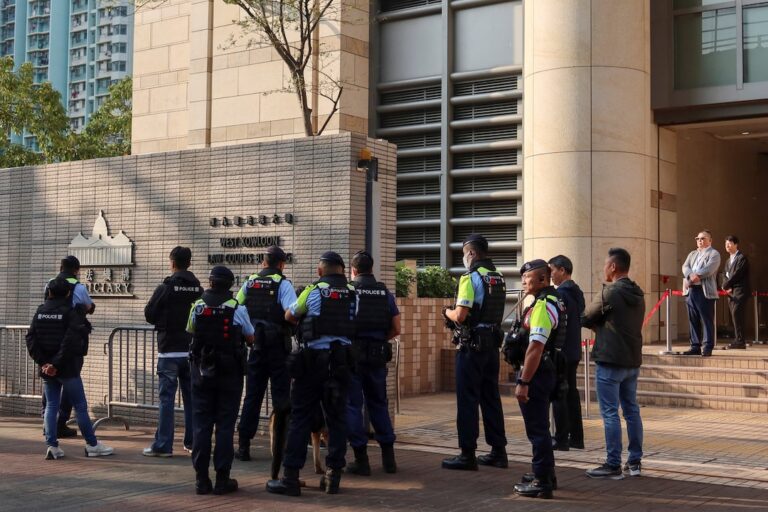
The Court of Appeal in Hong Kong on Monday affirmed jail terms imposed on a batch of pro-democracy individuals convicted of violating the national security law in the city, dismissing appeals filed by 12 activists in one of the most high-profile legal cases since the implementation of the security law in Hong Kong in 2020.
The decision affirmed convictions related to the “Hong Kong 47” case, in which dozens of opposition politicians and activists were charged with conspiring to subvert state power.
The case has attracted criticism from Western governments and human rights groups, but the Hong Kong and Chinese governments have defended the case as being conducted in accordance with the law and as having improved stability following months of unrest.
In a judicial judgment, three appeal judges stated that the defendants had been taking part in a coordinated action aimed at undermining the constitutional structure of Hong Kong through the use of electoral means to hinder the governance process.
Read Also: Hong Kong Tycoon Jimmy Lai Sentenced To 20 Years In Jail
The court stated that the plan, conceptualized and advocated by legal scholar Benny Tai, was a scheme to employ what it termed a “constitutional mass destruction weapon” with the aim of compelling political change through unconventional means.
The appeals were based on convictions related to an unofficial primary election organized by pro-democracy groups in mid-2020.
The exercise was aimed at identifying candidates who were best suited to run in a Legislative Council election scheduled later in the year, which had been postponed by the authorities.
The prosecution case was that the organizers and participants of the event had the intention of gaining a legislative majority and then preventing the passage of the government’s annual budget, regardless of its content, which would compel the resignation of Hong Kong’s chief executive on constitutional grounds.
In response, the defence lawyers argued that legislators are entitled to vote against bills, including budgets, and that the action of opposition was within the political rights guaranteed by the Basic Law of Hong Kong, the mini-constitution of the territory.
The supporters of the defendants have all along argued that the case is about criminalizing normal political activity.
The Court of Appeal has dismissed the argument, stating that the indiscriminate voting strategy would amount to abuse of legislative power and not oversight.
The court stated that the motive of the strategy was different from normal opposition in parliament and that the actions of the defendants had crossed the line to illegality in terms of national security.
Among those whose appeals were rejected were former lawmakers Helena Wong, Lam Cheuk-ting, Raymond Chan, and veteran activist Leung Kwok-hung, also known as “Long Hair,” as well as former district councillors Clarisse Yeung, Kalvin Ho, and Tat Cheng.
Activists Gwyneth Ho, Owen Chow, Winnie Yu, and Australian citizen Gordon Ng also appealed against their convictions or sentences.
Most of them had been given prison sentences between four and 10 years after sentencing hearings concluded in late 2024 after prolonged pre-trial detention and hearings.
One of the defendants, Gwyneth Ho, appealed against her conviction but not the sentence. Another activist, Prince Wong, challenged the sentences imposed by the lower court along with other activists but was unsuccessful.
In court, onlookers reported that the accused appeared calm when the verdict was read out, nodding to acknowledge family and supporters in the public gallery.
Chan Po-ying, wife of defendant Leung Kwok-hung, expressed skepticism about the verdict, asking reporters, “What crimes have they committed?” This comment was in line with the defense’s assertion that legislative vetoes are a recognized means of checks and balances in the political system of Hong Kong.
The appellate court also rejected the Department of Justice’s bid to reverse the acquittal of barrister Lawrence Lau, one of the two accused who was acquitted at trial.
The judges ruled that the prosecution had not proved that Lau publicly advocated the proposed budget veto strategy, like the other defendants. Lau was “happy” that the acquittal had been affirmed, he told reporters.
The case has become a rallying point for international concern about civil liberties in Hong Kong after the imposition of the national security law by Beijing in June 2020.
Read Also: Hong Kong Election Turnout Tested, Fire Fuels Public Anger
The government has argued that the law was needed to restore stability following large-scale anti-government protests in 2019 that turned violent at times and disrupted transport and economic activity.
Australia’s foreign minister, Penny Wong, said that her government was “deeply concerned” that Gordon Ng’s appeal had failed, adding in a statement that Australia had repeatedly expressed its objections to the Chinese and Hong Kong governments about what it saw as the wide application of national security laws.
The Hong Kong government denies claims that the judiciary is not independent, with courts still functioning in line with common law.
The government has consistently stated that defendants in national security cases have a fair trial and that the rule of law is in place.