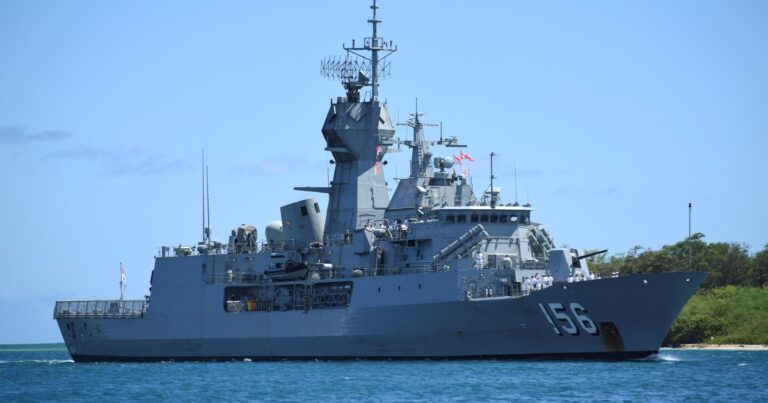
An Australian naval frigate completed a two-day passage through the Taiwan Strait on Saturday, drawing surveillance operations from the Chinese People’s Liberation Army and a formal warning from Taiwan’s armed forces directed at the ship’s helicopter, in a transit that illustrated the competing and mutually incompatible territorial claims layered over one of the world’s most strategically sensitive waterways.
HMAS Toowoomba, an Anzac-class guided-missile frigate of the Royal Australian Navy, entered the strait on Friday morning local time and completed its passage on Saturday as part of what an Australian government source described as a Regional Presence Deployment in the Indo-Pacific.
“All interactions with foreign ships and aircraft were safe and professional,” the source said. The frigate measures 118 metres in length and is equipped with an embarked MH-60R Seahawk maritime helicopter, a detail that became directly relevant when Taiwanese authorities intervened during the transit.
As HMAS Toowoomba began its passage on Friday afternoon local time, her Seahawk helicopter launched and flew toward the strait’s median line, the informal central boundary that Taiwan, the United States, and most Western nations regard as separating each side’s operating zone. The aircraft approached the median line west of Penghu, the Taiwanese-controlled archipelago of 90 islands and islets situated roughly midway through the strait. Taiwan’s Air Force issued a broadcast command ordering the helicopter to leave the area, effectively driving it back toward the frigate. The episode was the most operationally significant element of the transit, and one that complicates the routine framing offered by Canberra.
China’s state-backed Global Times newspaper, citing an unnamed PLA military source, reported that “the Chinese People’s Liberation Army carried out full-process tracking, monitoring, and alert operations throughout the transit.” That language, full-process tracking, is a standard formulation used by Chinese military sources to assert continuous surveillance of a foreign vessel from strait entry to exit, and it has been used in connection with every significant foreign naval transit in recent years. The PLA did not describe any physical interception.
Read Also: Australia Commits A$3.9bn To AUKUS Submarine Yard
The transit occurred on the fourth day of the Lunar New Year holiday and came immediately after HMAS Toowoomba completed a trilateral maritime patrol exercise involving the United States and the Philippines off the coast of Luzon. That sequencing, allied military exercise, then strait transit, is consistent with a pattern of operational coordination among AUKUS partners and their regional allies that Beijing has repeatedly characterised as deliberate provocation and encirclement.
Chief of Joint Operations Vice Admiral Justin Jones had addressed HMAS Toowoomba’s South China Sea mission in a statement issued on February 12, before the strait transit began.
“The Australian Defence Force has a long history of operating in the South China Sea region, at sea, in the air, and on land. It remains a vital waterway for the entire international community,” he said. “This routine deployment demonstrates our commitment to regional security, upholding a peaceful, stable, and prosperous Indo-Pacific.” The Defence Department did not issue a separate public statement at the time of the strait transit itself, with confirmation coming only through an unnamed government source on Sunday.
The legal and geopolitical dispute that makes every such transit consequential is well established, though not widely understood in its full complexity. The United States, Australia, and most Western governments regard the Taiwan Strait as an international waterway through which all nations have a right of passage under the United Nations Convention on the Law of the Sea. Beijing’s position is that the strait falls within Chinese territorial waters and that foreign military transits without prior authorisation constitute an infringement of sovereignty. Neither argument has been adjudicated by an international tribunal, and no legal resolution is in prospect. The practical result is that every transit becomes both a navigational event and a political statement.
HMAS Toowoomba previously transited the Taiwan Strait in November 2023, prompting formal objections from Beijing on that occasion as well. Before that, Australian vessels had made periodic strait transits going back several years, each generating Chinese protests and Australian assertions of lawful navigation rights. France, Britain, and Canada have also conducted strait transits, collectively establishing that opposition to Beijing’s territorial claims in the waterway is not exclusively an American position but a view shared across a meaningful cross-section of democratic naval powers.
Read Also: Australia Bars Syrian Camp Detainee Under Terror Powers
China has significantly escalated its military presence around Taiwan in the past year. The PLA conducted its most recent large-scale exercises around the island in late December, drills that included simulated naval blockade formations and joint air-sea assault scenarios, and that Taiwan’s Defence Ministry described as rehearsals for an actual attempt to take the island by force.
Beijing has not confirmed that characterisation. Taiwan’s government has reiterated that it rejects Beijing’s sovereignty claims and that the island’s political future is a matter for its own people to determine.
The Taiwan strait is 180 kilometres wide at its broadest point and approximately 130 kilometres at its narrowest. Roughly 50,000 vessels transit the waterway each year, making it one of the world’s most heavily trafficked shipping lanes. The presence of military vessels from non-regional powers adds a further layer of tension to a corridor that carries significant volumes of global trade.
No response had been received from Beijing through official diplomatic channels by Sunday evening. Canberra did not indicate whether the Seahawk helicopter incident would be the subject of further discussions with Taiwan.