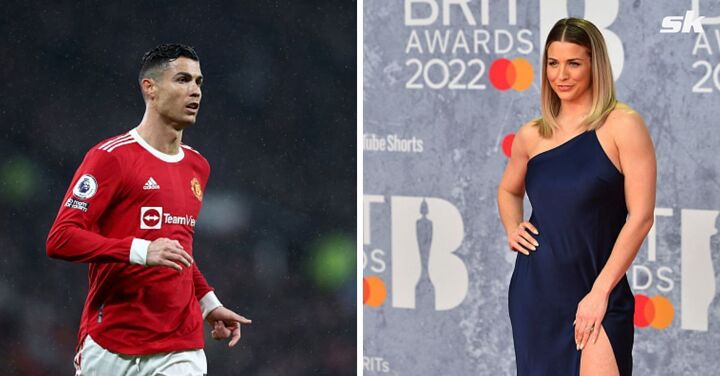
In an era where celebrity breakups routinely evolve into commercial spectacle, Gemma Atkinson’s account of her separation from Cristiano Ronaldo offers a counterpoint to a familiar script. The British television personality has disclosed that she was offered substantial sums of money to criticise the Portuguese footballer after their relationship ended—an offer she says she declined because she had no adverse experiences to recount.
Atkinson’s remarks illuminate a broader ecosystem in which personal relationships involving global sports figures are quickly monetised. The intersection of fame, media demand and financial incentive often places former partners at the centre of narratives shaped less by fact than by market appetite. In this case, Atkinson’s refusal underscores the pressures surrounding one of the most recognisable athletes of the modern era.
Cristiano Ronaldo has spent nearly two decades at the apex of global football. From his early rise at Sporting Lisbon and breakthrough years at Manchester United to record-setting spells at Real Madrid and Juventus, Ronaldo has built not only a decorated sporting career but also an expansive commercial brand. His name carries global weight across Europe, Africa, Asia and the Americas. Any personal development tied to him generates automatic international interest.
Atkinson, known in the United Kingdom for her work in television and radio, dated Ronaldo during his first tenure at Manchester United. Their relationship unfolded at a time when both were in the early stages of heightened public visibility. British tabloids followed their appearances, social engagements and eventual split with predictable intensity.
Reflecting on that period, Atkinson has said that after their breakup she received offers of money in exchange for negative commentary about Ronaldo. The implication was clear: media outlets were prepared to pay for damaging or sensational claims. She declined, explaining that she had “nothing negative to say” and therefore saw no reason to speak ill of him.
Her decision not to capitalise on the opportunity stands in contrast to a media culture that frequently rewards controversy. In high-profile separations, former partners often become sources of exclusive interviews, memoir excerpts or broadcast appearances designed to reveal private details. The market logic is straightforward. A globally recognised name guarantees audience attention. Conflict drives clicks and circulation. Payment follows.
Atkinson’s account suggests that financial inducements can be substantial. While she did not disclose specific figures, her description of the offer as “a LOT of money” points to the commercial value attached to Ronaldo’s personal narrative. For media organisations competing in a crowded digital marketplace, securing a first-person critique of an international sports icon carries immediate commercial upside.
Read Also: Canada’s Immigration Structure (2026 System Design)—Part 1
The episode also raises questions about reputational vulnerability. Elite athletes operate within complex brand architectures involving sponsors, endorsements and multinational partnerships. A negative allegation—particularly from a former partner—can reverberate beyond tabloid headlines into corporate boardrooms. For that reason, post-relationship narratives are rarely trivial.
Ronaldo’s public persona has long combined sporting excellence with disciplined image management. His social media presence ranks among the largest in the world. Sponsorship portfolios have included global apparel and lifestyle brands. Against that backdrop, the prospect of adverse personal disclosures carries tangible financial implications.
Atkinson’s refusal to participate in that cycle highlights a distinction between private experience and public storytelling. Her position, as she describes it, was rooted in personal integrity rather than commercial calculation. If she had no grievances, she reasoned, there was no justification for inventing or exaggerating them.
The broader context extends beyond a single relationship. Modern celebrity culture often blurs the boundary between lived reality and narrative construction. Individuals adjacent to fame—former partners, friends, associates—may find themselves approached as potential contributors to a marketable storyline. The incentives can be powerful, particularly when tied to figures whose global footprint ensures widespread coverage.
For audiences across Africa and the diaspora, Ronaldo’s career has been closely followed. His performances in European competitions and international tournaments have resonated far beyond Portugal. In many African cities, his club jerseys are commonplace, and his career trajectory is cited as an example of upward mobility through sport. That global resonance amplifies the commercial value of any personal detail attached to his name.
Atkinson’s remarks therefore speak to the mechanics of celebrity media rather than to any allegation of misconduct. She has not accused Ronaldo of wrongdoing. On the contrary, her statement emphasises the absence of negative experiences. The story lies in the offer itself and the decision to reject it.
Such moments reveal the transactional undercurrents that shape entertainment journalism. Financial inducements for exclusive commentary are not uncommon. What varies is whether individuals choose to engage. In declining, Atkinson preserved both her account and, arguably, her autonomy over her own narrative.
For Ronaldo, the episode reinforces the durability of a carefully maintained public image. While elite athletes cannot control every external narrative, the absence of hostile testimony from former partners contributes to brand stability. In industries where reputation is currency, silence can carry weight.
The incident also prompts reflection on the ethics of media consumption. Audiences frequently demand personal revelations from public figures, creating a market for intimate disclosures. Yet the willingness of individuals to monetise private relationships remains a personal decision shaped by values as much as opportunity.
Read Also: Authorities Open Probe Into Alleged Burials At Epstein Ranch
Atkinson’s stance suggests a boundary—one that separates commercial possibility from personal truth. Her explanation was succinct: she had nothing negative to say, and therefore no reason to accept payment for saying otherwise.
In a media landscape saturated with commodified conflict, such restraint is notable. It underscores the reality that not every high-profile breakup must translate into public acrimony. Sometimes, the most consequential choice is the refusal to participate in a profitable narrative.
For global observers, the episode offers a window into how celebrity economies function behind the scenes. Fame generates not only admiration but also ancillary markets for stories, commentary and critique. Whether those markets are supplied depends on individual judgment.
In this instance, Gemma Atkinson chose discretion over remuneration. In doing so, she illuminated the unseen transactions that often accompany the end of a relationship involving one of the world’s most recognisable athletes—without adding to the noise that typically follows.