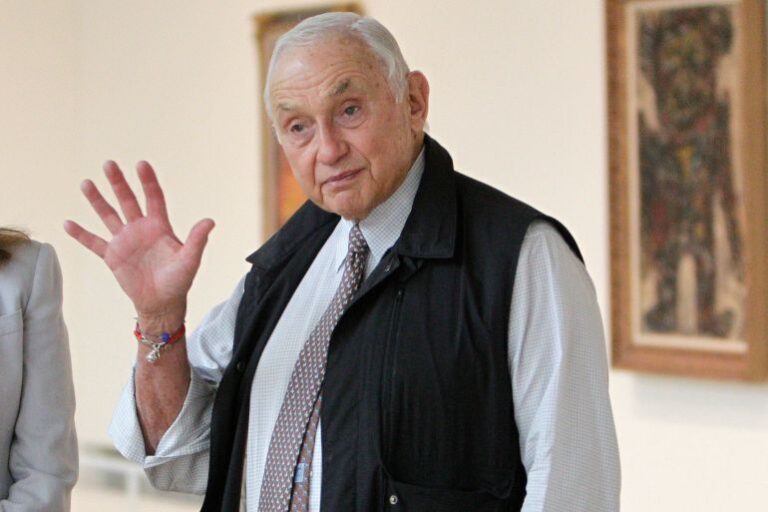
Ohio retail billionaire Les Wexner appeared before a House congressional committee on Wednesday and flatly denied any knowledge of Jeffrey Epstein‘s crimes during a six-hour closed-door deposition at his New Albany estate, an assertion that prompted swift and pointed scepticism from Democratic lawmakers who said it simply was not credible given the documented depth of the two men’s financial relationship.
Wexner, 88, the former founder and chief executive of L Brands, the retail conglomerate that once controlled Victoria’s Secret, Bath and Body Works, and Abercrombie and Fitch, appeared under subpoena before the House Committee on Oversight and Government Reform as part of its sprawling investigation into Epstein and his associates. The deposition took place weeks after the Justice Department released more than three million pages of Epstein-related files under the Epstein Files Transparency Act, a document disclosure that has renewed scrutiny of Wexner’s decades-long financial ties to the convicted sex trafficker.
“I never witnessed nor had any knowledge of Epstein’s criminal activity. I was never a participant nor co-conspirator in any of Epstein’s illegal activities,” Wexner told the committee.
“To my enormous embarrassment and regret I, like many others, was duped by a world-class con man. I cannot undo that part of my personal history even as I regret ever having met him.” He described Epstein as having lived a “double life,” presenting a carefully controlled face to business associates while concealing his abuse of girls and young women.
Epstein first entered Wexner’s orbit around 1986, introduced through a mutual business associate. Within a few years, Wexner had appointed Epstein to manage his vast personal fortune, granting him power of attorney in 1991, authority that allowed Epstein to make investments, execute property deals, and take a series of financial decisions on the billionaire’s behalf. Among those transactions was the purchase and subsequent transfer of a Manhattan townhouse that would become one of the most notorious addresses in Epstein’s operation. Wexner disputed certain claims about the property in his statement, including persistent accounts about how ownership was transferred, though he did not elaborate in detail.
Democrats were not persuaded by the broader posture of ignorance as Representative Stephen Lynch of Massachusetts said afterward: “In a very real way, Les Wexner gave Epstein credibility to commit some of the crimes that he did. There is no question in my mind, given the evidence so far, that Les Wexner knew about this and failed to stop it.” Representative Dave Min of California was equally blunt, saying: “He has basically alleged that he saw no evil, heard no evil despite being in the room with Jeffrey Epstein over and over and over. And it’s really just not credible.”
Table of Contents
ToggleRead Also: French Prosecutors Setup Special Team To Review Epstein Files
The committee’s top Democrat, Representative Robert Garcia of California, said Wexner’s account throughout the deposition sought to “downplay” the closeness of the relationship.
“There would be no Epstein island, there’d be no Epstein plane, there would be no money to traffic women and girls, Mr Epstein would not be the wealthy man he was, without the support of Les Wexner,” he told reporters. Garcia also said Wexner had told the committee he had never been formally questioned by either the FBI or the Justice Department about his ties to Epstein, a disclosure Garcia called “outrageous” given that Wexner’s name appears in Epstein-related documents more than 4,000 times, according to Attorney General Pam Bondi.
Five Democratic lawmakers, Garcia, Lynch, and Representatives Jasmine Crockett, Dave Min, and Yassamin Ansari, travelled to Wexner’s home state to conduct the questioning in person. No Republican members of Congress were present, though committee GOP staff attended. House Oversight Committee Chair James Comer was absent due to scheduled oral surgery.
As the deposition progressed, Democratic members said Wexner appeared to recall less and less.
“The more this deposition goes on, the less Les Wexner knows about Jeffrey Epstein,” Lynch said at a midday press briefing held outside Wexner’s property.
Republicans, for their part, said Wexner answered every question put to him. A committee spokeswoman confirmed the session concluded at approximately 5 p.m. local time and said the video and transcript would be released publicly.
Among the more sensitive areas of questioning was the allegation made by the late Virginia Giuffre, one of Epstein’s most prominent accusers, who said in a prior deposition that she had been trafficked to Wexner. Wexner has consistently denied any such encounter and reiterated Wednesday that he had never met Giuffre. He also addressed fidelity directly and unsolicited in his opening remarks. “Never once in 36 years have I been unfaithful to Abigail in any way, shape, or form,” he said of his wife. “Any suggestion to the contrary is absolutely and entirely false.”
Read Also: French Diplomat Denies Sharing UN Files With Epstein
The deposition unfolded against a broader legal backdrop that is only widening. Subpoenas have also been issued to Epstein’s longtime lawyer Darren Indyke and his accountant Richard Kahn, and former President Bill Clinton and former Secretary of State Hillary Clinton are scheduled to appear before the panel next week, having agreed to deposition terms rather than face contempt proceedings. Ghislaine Maxwell, Epstein’s former partner and convicted sex trafficker, testified before the committee last week.
Wexner faces legal exposure in a separate matter as well. Former athletes at Ohio State University who allege they were sexually abused by former team physician Richard Strauss, who died before the extent of his crimes was publicly established, have pursued Wexner in connection with his tenure as chair of OSU’s Board of Trustees, a period during which Strauss received a tenured appointment and ultimately retired. A judge ruled last week that Wexner can be compelled to testify in their civil lawsuit against the university.
Wexner has never been charged with any offence. A legal representative said a federal prosecutor informed his counsel in 2019 that Wexner was being treated as a source of information rather than a target. The committee has not indicated when it expects to release the deposition transcript.