
Sweden’s government said on Friday that a small unmanned aerial vehicle jammed by its military forces was likely to have been of Russian origin, in an incident that points to NATO allies’ concern over drone activity in the region.
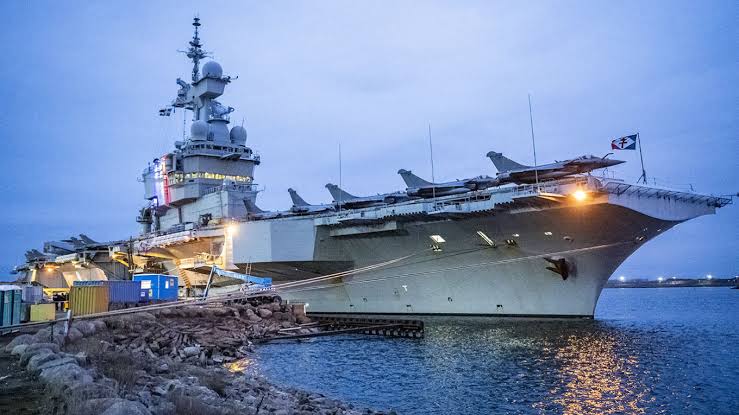
The incident took place in Swedish waters off the port of Malmö, where the French nuclear aircraft carrier Charles de Gaulle is docked in its first port visit to Sweden.
The French warship is to take part in NATO military exercises in the Baltic and North Sea regions.
The Swedish government said that while the incident was serious in nature, it was consistent with Russian behavior in other parts of Europe. The incident did not result in any confrontation.
The Swedish Prime Minister, Mr. Ulf Kristersson, who made the comments on the French aircraft carrier Charles de Gaulle, said that Stockholm had judged there to be a high probability that the drone was connected to Russia.
“It is very difficult to see this as a coincidence,” Mr. Kristersson said. “It is a Russian way of acting that we recognise from other places.”
The Swedish Prime Minister did not give any evidence to support the Swedish claims of Russian involvement in the drone incursion.
The Kremlin Spokesman Dmitry Peskov referred to the Swedish claims as “absurd.”
Read Also: Teenager Bags Life Sentence For Killing 2 Teachers In Sweden
The French warship, which was named as the Charles de Gaulle, was reportedly detected by the French military as having located the unmanned aircraft at a distance of seven nautical miles (13 kilometres) from the war vessel.
The Swedish defence officials reportedly employed their electronic warfare technology to interfere with the unmanned aircraft’s systems, thereby forcing it to leave the area.
It was not immediately clear what had happened to the unmanned aircraft after the jamming was initiated, with Swedish Defence Minister Pal Jonson indicating that the incident was currently under investigation.
Sweden’s defence minister indicated that there was a “strong link” between the unmanned aircraft and a Russian vessel that had entered Swedish territory through the Øresund Strait, a small body of water that separates southern Sweden from Denmark.
The minister indicated that the Russian vessel had moved towards the Baltic Sea after the encounter, without indicating its name or affiliation.
The French foreign minister, who was on board the aircraft carrier along with Mr Kristersson, also echoed Swedish concerns but presented the situation in a more controlled manner.
“If indeed there is a potential Russian origin for this incident, the only conclusion I would draw is that it would be a ridiculous provocation,” Mr Barrot told reporters. “We have confidence in the actions of Swedish authorities.”
The French General Staff Spokesman, Colonel Guillaume Vernet, said that the situation did not affect the French aircraft carrier’s mission. “This has demonstrated the robustness of the Swedish response,” he said. “The situation did not affect the French mission.”
The French aircraft carrier strike group, along with its escort ships, includes a contingent of Rafale fighter jets and reconnaissance aircraft.
When in Swedish waters, the aircraft carrier depends on host nation support for some aspects of its security, officials said.
Analysts and former military officials have indicated that this event represents a larger pattern of low-level aerial and maritime probing activity conducted by Russian forces in the region of NATO nations.
General Dominique Trinquand, a former French military leader who has also worked under United Nations commands, indicated that if the drone can be confirmed to have originated from Russia, then the actions of Russia would represent a continuation of prior intelligence-gathering activities in the region.
“That they would do so while the French aircraft carrier is deployed there is certainly a strategic signal,” he said to French media.
Read Also: Sweden Resolves To Move Demining Anti-Tank Weapons To Ukraine
The deployment of the Charles de Gaulle in northern Europe is part of the larger French naval mission, dubbed “La Fayette 26.” The mission had been planned in advance of the reported incident, with the French warship participating in a series of NATO war exercises in the Baltic Sea, the North Atlantic, and Norwegian waters off the Norwegian coast.
French defense authorities have indicated that the mission is meant to strengthen the alliance between member states, particularly in the face of rising security concerns following Russia’s invasion of Ukraine in 2022 and subsequent military posturing in the European waters.
NATO member states have reported the sighting of unmanned aerial vehicles in the vicinity of military bases, ports, and civil aviation infrastructure in the past months, particularly in Denmark, the Baltic states, and possibly in Norway.
While the source and intended use of the drones have not been confirmed, NATO member states have indicated that the unmanned aerial vehicles have been behaving in an unusual, erratic, and possibly suspicious manner, particularly in the vicinity of sensitive locations.
Defence officials announced that further information will be made available when evidence is evaluated and when the results of the analyses are made available.