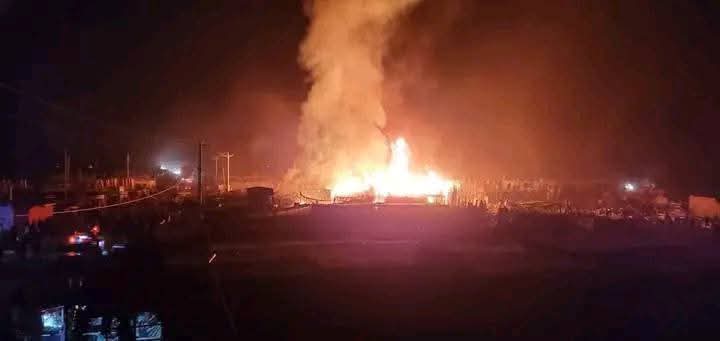
Pakistani warplanes struck military targets inside Kabul, Kandahar, and Paktia in the early hours of Friday morning, hitting Taliban brigade headquarters, command centres, and ammunition depots in what Islamabad formally designated as Operation Ghazab Lil Haq, Righteous Fury, the largest Pakistani military assault on Afghan territory in decades and one that has shattered a four-month ceasefire brokered by Qatar and Turkey following the deadliest cross-border clashes of the post-2021 era.
At least three explosions were heard across Kabul before dawn, with local sources in the capital reporting military jets overhead and a large explosion near Pul-e-Charkhi prison east of the city. Taliban government spokesperson Zabihullah Mujahid confirmed the strikes, describing them as attacks on “certain areas of Kabul, Kandahar, and Paktia.”
He said retaliatory operations had immediately resumed. Pakistan’s government spokesperson Mosharraf Ali Zaidi, writing on the social media platform X, said Pakistani forces were delivering “punishment” to Taliban positions across five border sectors, Chitral, Khyber, Mohmand, Kurram, and Bajaur, and described the strikes as a response to “unprovoked Afghan attacks.”
Pakistani military sources confirmed the operation struck the 313 Brigade headquarters, the 201 KBW Brigade headquarters, and the 205 Brigade headquarters in Kabul and Kandahar, along with the Taliban’s Command and Control Centre, the Intelligence Chief’s headquarters, Ghazi headquarters, the headquarters of Defence Minister Mullah Yaqub, the offices of Mullah Anas and Mullah Nasrullah, ammunition depots in Nangarhar province, and the largest military compound at Pul-e-Charkhi. Two senior Pakistani security officials, speaking on condition of anonymity because they were not authorised to address the media, said at least two brigade bases had been destroyed.
The casualty figures reported by each side diverged sharply and could not be independently verified. Zaidi said Pakistani forces had killed at least 133 Afghan fighters and wounded more than 200, with 27 Taliban posts destroyed and nine captured, adding that further casualties were anticipated from the Kabul, Paktia, and Kandahar strikes. Taliban Deputy Spokesperson Hamdullah Fitrat countered that 55 Pakistani soldiers had been killed, 19 Pakistani military outposts seized, and Afghan fighters had captured some troops alive. The Taliban said eight of its own fighters were killed, 11 wounded, and 13 civilians injured in Nangarhar, including from a missile strike on a refugee camp near the Torkham border crossing that was being evacuated by Afghan authorities. Pakistan’s Zaidi denied that any Pakistani soldiers had been captured.
Read Also: Pakistan Strikes Afghan Soil After Ramadan Bombings Kill Dozens
The current assault represents the culmination of an escalatory sequence that began five days earlier.
On February 22, the Pakistan Air Force struck seven militant camps and hideouts across Nangarhar, Paktika, and Khost provinces, describing the operation as a retributive response to a Shia mosque bombing in Islamabad on February 6 that killed 31 worshippers and was claimed by Islamic State-Khorasan Province, as well as to attacks in Bajaur and Bannu during the opening days of Ramadan.
Taliban officials said those strikes killed 18 civilians in Nangarhar, including 11 children from a single family buried under rubble. The United Nations Assistance Mission in Afghanistan recorded 13 civilian deaths in Nangarhar from the February 22 strikes. Pakistan denied targeting civilians.
The Taliban’s Defence Ministry said its military launched cross-border attacks on Thursday evening along six provinces of the Durand Line, calling the operation a retaliation for the February 22 strikes and declaring it concluded at midnight. Pakistan characterised Thursday’s Afghan offensive as unprovoked. Following the Taliban’s overnight assault, Pakistan launched the Kabul strikes in the pre-dawn hours of Friday, and Mujahid announced that “extensive retaliatory operations have once again begun against Pakistani military centres from Kandahar and Helmand.”
The conflict has been building since the Taliban returned to power in August 2021. Pakistan’s Institute of Peace Studies recorded 699 terrorist attacks inside Pakistan in 2025, a 34 percent increase from the previous year, killing 1,034 people, making it the country’s deadliest year in a decade.
Most of that violence was attributed to the Tehreek-e-Taliban Pakistan and affiliated groups, which Islamabad accuses of operating with sanctuary on Afghan soil. The Taliban government categorically denies providing cover to the TTP, which it describes as a separate organisation, and has accused Pakistan of fabricating the pretext for military action.
Read Also: Pakistan Buries 31 Victims Of Deadly Islamabad Bombing
The most recent ceasefire, announced by Qatar on October 19, 2025, after ten days of fighting that was the largest cross-border conflict since the Taliban takeover, committed both governments to refrain from targeting each other’s security forces, civilians, or critical infrastructure, and required Kabul to cease support for groups conducting attacks against Pakistan. Two subsequent rounds of peace talks in Istanbul failed to produce a lasting framework, with Pakistan demanding written Taliban guarantees to curb the TTP backed by regional powers, and Afghan negotiators accusing Islamabad of making unreasonable demands. Pakistan’s Defence Minister Khawaja Asif had warned publicly on February 11 that Islamabad might act against militants in Afghanistan before Ramadan if the Taliban failed to address Pakistani concerns, a warning the Taliban’s leadership dismissed. Shortly before the February 22 airstrikes, three Pakistani soldiers who had been captured during the October 2025 clashes were released through Saudi-mediated negotiations, an event that appeared to signal a potential de-escalation before the cycle of strikes resumed.
Pakistan’s strategic calculus has been further complicated by growing diplomatic ties between India and the Taliban government, a development that Pakistani analysts say has added urgency to Islamabad’s desire to neutralise what it views as Afghan-based threats before its regional position is further eroded.
For its part, the Taliban government referred Pakistan’s airstrikes on Kabul and Kandahar to Afghanistan’s Permanent Mission to the United Nations, with Acting Permanent Representative Naseer Ahmad Faiq describing the attacks as a serious breach of international law and Afghan territorial sovereignty.
Neither Pakistani Prime Minister Shehbaz Sharif nor Taliban Supreme Leader Hibatullah Akhundzada had issued a formal statement calling for a halt to hostilities as of Friday morning. Qatar, Turkey, and Saudi Arabia, the three primary mediators of the October ceasefire, had not publicly announced any new diplomatic initiative. The Torkham border crossing, one of the main trade arteries between the two countries, remained disrupted, with Afghan civilians being moved away from the area. No ceasefire timeline had been communicated by any party as of the time of publication.