Sri Lanka‘s criminal investigators arrested the country’s former intelligence chief on Wednesday in connection with the 2019 Easter Sunday bombings that killed 279 people, including 45 foreigners, in what police described as the most high-profile arrest in the long-running investigation.
Retired Major General Suresh Sallay was taken into custody at dawn in Peliyagoda, a suburb of the capital Colombo, by the Criminal Investigation Department.
“He was arrested for conspiracy and aiding and abetting the Easter Sunday attacks,” an investigating officer told AFP. “He has been in touch with people involved in the attacks, even recently.” Sallay has consistently denied any involvement in the bombings and had not publicly commented on the arrest as of Wednesday.
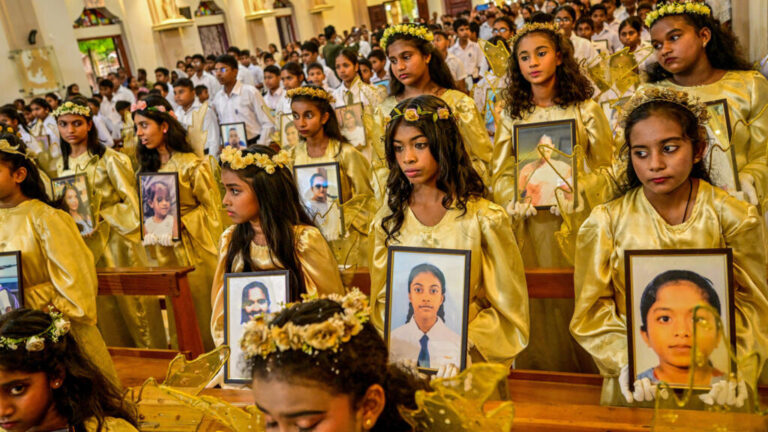
Two Islamist groups carried out six nearly simultaneous suicide bomb attacks on April 21, 2019, targeting churches and leading tourist hotels on Easter Sunday. The coordinated bombings struck three upmarket hotels in the capital, two Roman Catholic churches, and an evangelical Protestant church outside Colombo. More than 500 people were wounded. The attacks killed five United States nationals, and US authorities in 2021 charged three Sri Lankans for supporting the perpetrators, three of the 25 suspects subsequently indicted in Sri Lanka’s High Court.
The investigation into Sallay has its origins in a complaint filed by Father Rohan Silva, Executive Director of the Centre for Society and Religion, requesting an independent inquiry into allegations aired in a documentary by British broadcaster Channel 4 in 2023. Channel 4 reported that Sallay was linked to the Islamist bombers and had met them before the attack. A whistleblower told the network that Sallay had permitted the attack to proceed with the intention of influencing that year’s presidential election in favour of Gotabaya Rajapaksa. Two days after the bombings, Rajapaksa announced his presidential candidacy, and he went on to win the November 2019 election in a landslide after campaigning on a platform of national security and the suppression of Islamist extremism.
A former member of the jihadist group told reporters in 2019 that they had originally been funded by a military intelligence unit to propagate a fundamentalist ideology in Sri Lanka’s multi-ethnic eastern province, and that Sallay was employed in that same intelligence unit.
The government at the time admitted that the military had been behind the radical group. Investigators said they found no direct evidence establishing a foreign link to the Islamic State, which claimed responsibility for the bombings two days after they occurred, though the local cell was described by officials as inspired by the group’s ideology.
Sallay was promoted to head the State Intelligence Service following Rajapaksa’s electoral victory in November 2019, making him the country’s most senior intelligence official, a position he held until President Anura Kumara Dissanayake won the 2024 presidential election, having campaigned in part on a promise to prosecute those behind the Easter attacks. Dissanayake dismissed Sallay shortly after taking office.
The arrest arrives nearly seven years after the bombings, and it follows a period in which accountability efforts have proceeded through multiple, overlapping legal and political channels.
The Sri Lanka Supreme Court ruled in 2023 that then-President Maithripala Sirisena and four other senior officials bore responsibility for failing to act on intelligence warnings and thereby failing to prevent the attacks. Sirisena was ordered to personally pay 100 million rupees, equivalent to approximately $273,000, in compensation to victims’ families who brought the civil case. The then police chief, two senior intelligence officers, and the Ministry of Defence secretary were jointly ordered to pay a further 210 million rupees.
A critical dimension of the intelligence failure centred on advance warnings provided by India’s intelligence apparatus. Multiple investigations established that India’s Research and Analysis Wing had provided specific and actionable intelligence to Sri Lankan authorities before the bombings indicating that an attack was being planned. Those warnings were not acted upon through the chain of command. Whether Sallay, as a senior figure in military intelligence at the time of the bombings, he had not yet been appointed SIS chief, serving instead in a military intelligence role when the attacks occurred, received, transmitted, or suppressed those warnings is expected to be a focus of the CID’s investigation.
The United Nations has separately called on Sri Lanka to release portions of earlier official inquiries into the bombings that were withheld from the public, arguing that full disclosure is necessary for accountability and for the families of victims.
Those withheld sections have not been published, and their content has not been officially confirmed, though domestic media reports have suggested they contain findings about state actors and security service conduct that successive governments have been reluctant to make public.
The arrest of Sallay does not resolve the broader question of how a localised jihadist network, which had been under surveillance by security services and whose overseas contacts included individuals on international watchlists, managed to acquire the operational capacity and freedom of movement to conduct six coordinated suicide bombings simultaneously at high-security targets. The Easter Sunday attacks remain the deadliest act of mass violence against civilians in Sri Lanka since the end of the civil war in May 2009, which itself had killed an estimated 100,000 people over nearly four decades. The bombings killed worshippers at morning Easter mass at St Sebastian’s Church in Negombo, St Anthony’s Shrine in Colombo, and Zion Church in Batticaloa, as well as guests at breakfast sittings at the Shangri-La, Cinnamon Grand, and Kingsbury hotels.
Sri Lanka’s tourism sector, which had been recovering steadily from the war’s devastation and had recorded nearly 2.3 million arrivals in 2018, collapsed in the aftermath of the bombings. Arrivals fell to 1.9 million in 2019 and were further devastated by the Covid-19 pandemic in 2020 and 2021, before the sector faced yet another blow from the 2022 economic crisis that produced fuel and food shortages, the collapse of the rupee, and mass public protests that forced President Rajapaksa to flee the country. The sector has only partially recovered since.
Sallay was presented before a magistrate after his arrest. He was not immediately charged. The CID said the investigation was ongoing.