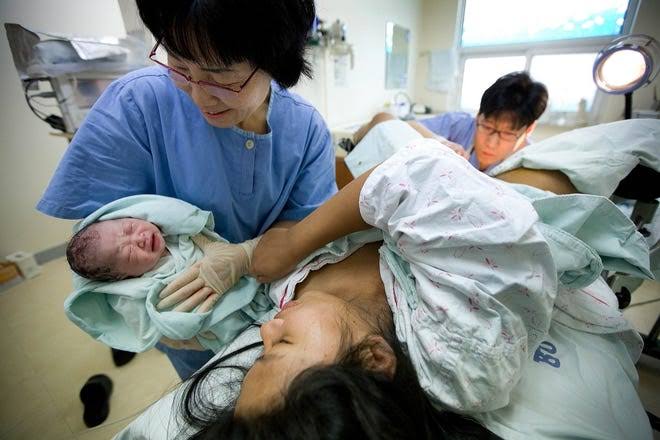
South Korea‘s total fertility rate rose to 0.80 in 2025, preliminary government data showed on Wednesday, outpacing the government’s own optimistic-case projection that had forecast a rate of 0.75 for 2025 and only 0.80 by 2026, a second consecutive year of improvement after a decade-long decline that reached its lowest recorded point in 2023 and prompted successive governments to declare a demographic national emergency.
The total fertility rate, which measures the average number of children a woman is expected to have during her reproductive years, stood at 0.80 in 2025, up from 0.75 in 2024, according to preliminary data from the data and statistics ministry. New births began rebounding in 2024 on a post-pandemic boost and government policy support, after eight consecutive years of declines that saw South Korea register the world’s lowest birthrate at 0.72 in 2023. The decline over those eight years was driven by a convergence of structural pressures: rising house prices concentrated in Seoul and its satellite cities, a notoriously competitive private education market that imposes significant costs on parents, a gender pay gap that remains the widest of any OECD country, and a workplace culture characterised by long hours that has historically made it difficult for women to re-enter the labour force after childbirth without severe career penalties.
There were 5.0 new births per 1,000 people in 2025, up from 4.7 in 2024, compared with 5.6 in China, 4.6 in Taiwan, and 5.7 in Japan in 2024, where the trend remains downward.
South Korea remains the country with the lowest total fertility rate among all 38 OECD member states, whose average stands at 1.43, nearly twice the South Korean figure. The replacement rate required to sustain a population at its current level without immigration is 2.1. Wednesday’s figure of 0.80 represents less than 40 per cent of that threshold.
Marriages, regarded as a leading indicator of births with a lag of one to two years, rose 8.1 per cent in 2025 after recording the largest annual jump in the country’s statistical history, 14.8 per cent, in 2024.
“The biggest part is that marriages are increasing a lot accumulatively,” Ministry official Park Hyun-jung told reporters, citing a growing cohort of people in their thirties, the age group with the highest propensity to marry and have children in South Korea, alongside measurable shifts in social attitudes toward family formation.
Read Also: South Korea Birth Rate Remark Sparks Party Expulsion
The sharpest rise in births was recorded in the capital. Seoul’s fertility rate reached 0.63 in 2025, up 8.9 per cent from 0.58 in 2024, though it remains the lowest of any administrative region across the country. Rural areas have historically recorded higher fertility than the capital but have suffered more severe population loss overall as young people migrate to cities for education and employment. The only area where the population is expected to record natural increase is Sejong, the planned administrative capital built from scratch in Chungcheong province.
Despite the improvement in the fertility rate, South Korea’s overall population continued to shrink. New births rose 6.8 per cent to 254,457 in 2025, the largest percentage increase since 2007, while deaths rose 1.3 per cent to 363,389, producing a natural population decrease of more than 108,000 people, the sixth consecutive year in which deaths exceeded births. The demographic mathematics of that gap will take decades to close even if fertility continues to recover, because the most demographically active cohorts, women in their twenties and early thirties, are among the smallest in the population due to the low birth rates of the late 1990s and 2000s.
Sociology professor Shin Kyung-ah of Hallym University said the data required further scrutiny before conclusions could be drawn.
“Still, it is meaningful as an indicator suggesting positive changes, which will, at least indirectly, also help make people become more positive about having a baby,” she said. Other analysts were more cautious. Nicholas Eberstadt, a political economist at the American Enterprise Institute, had warned after the 2024 uptick that the country should not be “popping the champagne corks,” given that the rate remains far below the 2.1 replacement level. He noted that the average number of children South Koreans say they ideally want to have stands at 1.89, below replacement but well above what the fertility rate currently reflects, suggesting a gap between stated preferences and actual behaviour that policy has so far failed to close.
Read Also: South Korea Japan Defense Cooperation Deepens With New Pact
South Korea’s government has been working on the fertility issue for the past 20 years, investing more than $320 billion in possible solutions.
Earlier efforts focused on short-term, one-time actions such as providing funds for low-income families, which failed to address the root causes of the problem: income instability in combination with high costs for childcare and education.
The ongoing fourth iteration of the five-year national plan on low birth rates and ageing, covering 2021 to 2025, has itself cost more than $270 billion. Critics have argued these fertility policies fell short due to fragmented policy administration, poor planning, and failure to address structural barriers including labour market inequality and a family-unfriendly work culture.
President Lee Jae Myung’s administration is preparing a new five-year demographic policy roadmap this year, with plans to expand childbirth support and introduce immigration measures to attract skilled foreign workers to offset the shrinking workforce. The policy challenge is multi-dimensional. South Korea’s potential economic growth rate, currently estimated at around 2 per cent annually, fell by six percentage points in the last three decades, more sharply than in most major economies, and is expected to fall to 0.6 per cent by 2045 to 2049, according to the central bank. The country’s public pension fund, the world’s third-largest with $1 trillion in assets, is projected to run out by 2071. Credit ratings agencies have flagged growing strains on public finances from welfare expenditure linked to an ageing population.
At the end of 2024, South Korea became a “super-aged” society, defined by the United Nations as an economy with more than 20 per cent of the population aged 65 or over. Notably, South Korea reached this threshold in roughly seven years, compared with 11 years for Japan, the first nation to reach the designation, and 19 years for Europe. By 2045, South Korea is projected to become the most aged population in the world, surpassing Japan, with senior citizens constituting 46.5 per cent of the population by 2067.
Lee proposed at last year’s Asia-Pacific Economic Cooperation summit that the group hold its first population policy forum in South Korea this year, and reached agreements with Chinese President Xi Jinping and Japanese Prime Minister Sanae Takaichi during visits to Beijing and Tokyo in January to explore regional collaboration on demographic challenges. South Korea’s population of 51.8 million is projected to shrink by nearly a third to 36.2 million by 2072, according to government estimates published in 2022. The government’s optimistic scenario projects the total fertility rate breaking above 1.0 per woman by 2031. Whether the recovery recorded in the past two years can be sustained beyond the post-pandemic rebound in marriages, and whether it reflects a durable shift in attitudes toward family formation or a temporary statistical correction, is a question Wednesday’s data begins to raise but does not answer.