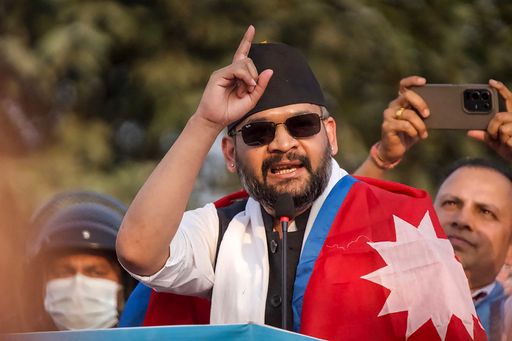
Balendra Shah a structural engineer, former rap star, and the politician whose terse social media dispatches have become one of Nepal’s most closely read political texts, is the leading candidate to become Nepal’s prime minister after the March 5 general elections, having leveraged a youth uprising that killed 77 people and toppled the previous government into the most consequential political launch in the Himalayan republic’s post-monarchy history.
Shah, 35, popularly known only as Balen, is dominating the race according to four political analysts and local media projections, pushing aside Nepal’s traditional political elite five months after the Gen Z-led protests of September 2025 forced then-Prime Minister K.P. Sharma Oli to resign. His ascent would mark not merely a generational transition but a structural rupture in a political system that has been governed, with brief exceptions, by the same rotating cast of leaders since the abolition of the monarchy in 2008, men in their sixties and seventies whose promises of stability have produced instead 13 governments in 17 years.
Shah sealed the formal mechanism of his national ambition on December 28, when he reached a seven-point agreement with the Rastriya Swatantra Party, a centrist newcomer founded in 2022, designating him as the alliance’s parliamentary leader and prime ministerial face.
RSP chief Rabi Lamichhane, a former television journalist who built the party into Nepal’s fourth-largest political force in its debut election, remains as party chairman under the deal. The agreement explicitly frames the partnership as a political continuation of the September youth movement. Shah resigned as Kathmandu’s mayor on January 18, leaving office three and a half years into a five-year term, and visited RSP headquarters the same day, where he and Lamichhane rang the bell, the party’s registered election symbol, before supporters.
His choice of constituency frames his ambition in the starkest possible terms: Shah is contesting the parliamentary seat from Jhapa constituency 5 in far-eastern Nepal, the political heartland of KP Sharma Oli, the same Oli who governed the country until the protests forced his resignation, and whose CPN-UML party remains one of Nepal’s two largest political organisations.
Defeating Oli in his home territory would be a symbolically catastrophic blow to the old guard and a mandate-defining result for whatever government Shah goes on to lead.
Shah was born on April 27, 1990, in Naradevi, Kathmandu, to a family of Maithili origin. His father, Ram Narayan Shah, was an Ayurvedic practitioner who relocated to Kathmandu from Mahottari district after being posted to Naradevi Ayurvedic Hospital. Shah studied civil engineering in Nepal before completing a master’s degree in structural engineering in southern India. His early inclination toward poetry evolved into a passion for rap music, influenced by American artists including Tupac Shakur and 50 Cent. He had already emerged as a rap star in Nepal before his political career began. He has been a figure in the Nepali hip-hop industry since 2012.
Read Also: Nepal Election Alliance Shakes Up For March Vote
His political career launched with a result that confounded every established assumption about how Nepali elections work.
In the 2022 local elections he was voted mayor of Kathmandu as an independent candidate, the first person to win the position without the backing of a major political party, defeating the Nepali Congress and CPN-UML candidates in a landslide on a platform of transparency, urban management, and waste disposal that resonated most sharply with the capital’s young voters. The work he did as mayor shaped his national reputation. Constitutional law expert Bipin Adhikari of Kathmandu University described his urban footprint succinctly: “Balen Shah is so popular that now buses coming to Kathmandu have stickers on them saying, ‘Headed to Balen’s city’.”
That record, however, is not without its complications. His tenure as mayor was also highly controversial for his high-handed approach to complex issues including squatter resettlement, demolition of illegally built private structures, and his administration’s treatment of street vendors.
Human Rights Watch documented allegations that police were used to seize the properties of economically vulnerable people as part of his urban clearance programme. In November 2022, his administration attempted to evict landless squatters residing on the banks of the Bagmati River. The Nepal Student Union, the student wing of the Nepali Congress, filed a police complaint against him after the September 2025 protests, accusing him of inciting violence and failing to deploy fire services to buildings set ablaze by demonstrators. He rejected the claims.
The geopolitical dimension of the election adds a layer of international consequence that transcends the domestic political contest. Nepal has long been caught between China and India, with Oli’s CPN-UML widely perceived as leaning toward Beijing and the Nepali Congress seen as closer to New Delhi. The RSP’s election manifesto commits to “balanced foreign relations” with both neighbours, a formulation that gives neither capital a guarantee and reflects a deliberate attempt to position the party outside the established pro-China and pro-India camps that have traditionally defined Nepal’s foreign policy debate.
Read Also: Nepal’s Gen Z Turns To Discord To Select Interim PM
How that balance is maintained in practice, if Shah becomes prime minister, will be one of the central challenges of any RSP-led government, particularly given Beijing’s active infrastructure lending programme in Nepal and New Delhi’s historical expectation of privileged access to Kathmandu’s foreign policy decision-making.
Analysts are realistic about the scale of the institutional challenge awaiting Shah if he takes power. “It needs a team, experts and support,” said independent political analyst Puranjan Acharya. “Under the existing state apparatus, he can’t perform and he will be finished like wood attacked by termites.” Nepal’s bureaucracy, which has absorbed and survived 13 governments in 17 years without fundamental reform, is widely regarded as one of the country’s most significant structural obstacles to effective governance. Whether Shah brings the administrative depth required to overcome it, rather than being consumed by it, as so many predecessors have been, is the question that most interests observers who are sympathetic to his political project but uncertain about its durability.
Shah’s campaign style reflects the discipline that defined his years as mayor: carefully curated social media posts, trademark dark sunglasses and a salt-and-pepper beard on the trail, and a preference for long silences punctuated by statements that travel further than conventional political speech.
“What makes Balen special is that he stays connected with the youth through his short messages on social media,” Acharya said, “but it would not be a cakewalk for him after becoming prime minister.”