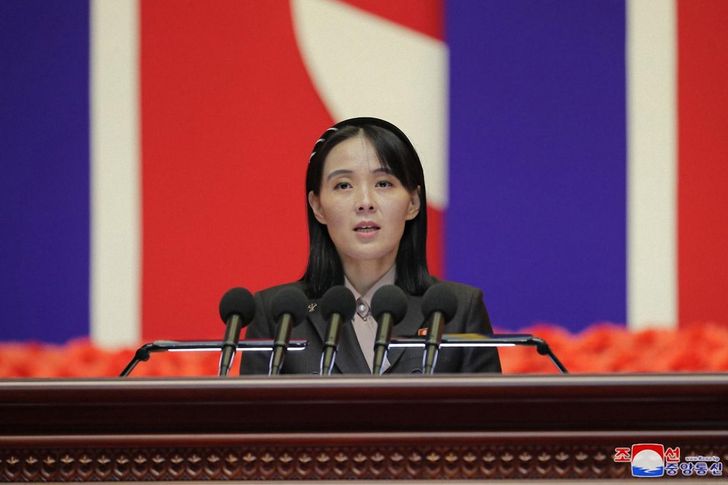
North Korea‘s Ninth Party Congress concluded its substantive proceedings on Monday with two developments analysts had closely anticipated: Kim Jong Un’s pledge to drive a five-year economic transformation under what he called a “full-scale progress phase,” and the formal elevation of his sister Kim Yo Jong to one of the ruling party’s most senior institutional positions.
KCNA published a press release from the first plenary meeting of the ninth Central Committee, naming Kim Yo Jong as one of 17 newly elected department directors, elevating her from her previous position as vice department director. She was simultaneously reinstated as an alternate member of the Political Bureau of the Central Committee, returning to the party’s core collective decision-making structure five years after her removal from that post at the 2021 congress. KCNA did not disclose which department she now heads, but South Korean officials said they were closely monitoring whether she would assume control of the propaganda department, where she has long been believed to work, or whether she would take on the inter-Korean affairs portfolio or a broader external relations role.
The Korea Herald quoted an expert as saying her elevation positions her as “the likely operational architect of Pyongyang’s hardline strategy toward Seoul and Washington.” Analysts at Seoul’s Unification Ministry described her reinstatement as consistent with a broader congress objective of consolidating party governance capacity through generational change across propaganda, military oversight, economic management, and external affairs.
Kim Yo Jong, born in the late 1980s, was educated alongside her brother at school in Switzerland before Kim Jong Un inherited the leadership following his father Kim Jong Il’s death in December 2011. Her rise within the party hierarchy accelerated quickly thereafter. She visited South Korea in February 2018 as part of the delegation that attended the Pyeongchang Winter Olympics, during a brief period of inter-Korean diplomatic warming that subsequently collapsed.
Read Also: Kim Wins Unanimous Re-Election As General Secretary Of His Party
Since then, she has functioned as Pyongyang’s most visible external voice on inter-Korean and US affairs, issuing a succession of inflammatory statements denouncing South Korean officials and American military exercises, communications whose rhetorical sharpness has often exceeded official party statements in their provocation. Her formal party title had never previously matched that operational visibility. The new designation narrows that gap.
Among the broader personnel changes disclosed at the plenary, the Presidium of the Politburo was listed as comprising Kim Jong Un, alongside Jo Yong Won and Premier Pak Thae-song, with party secretaries Kim Jae-ryong and Ri Il-hwan also named. Kim Song-gi was elevated to the Politburo and Central Military Commission, apparently taking over as director of the General Political Bureau of the Korean People’s Army from Jong Kyong-thaek. Choe Ryong-hae, who had chaired the Standing Committee of the Supreme People’s Assembly and was one of the most senior figures to have survived successive political cycles under Kim’s leadership, was removed from that post, a departure that South Korean analysts said was likely a prelude to the appointment of a successor from the newly elevated cohort.
Presiding over those personnel decisions and setting economic direction for the next half-decade are the congress’s two central functions, and Kim’s economic speech delivered Monday addressed the second directly. He characterised the 2026–2030 period as a “full-scale progress phase,” a formulation distinct from the 2021 congress’s “crisis management” framing, and called for revolutionising thought, technology, and culture to ensure new projects would be managed sustainably over time. He warned that “dereliction of duty, irresponsibility and other ingrained maladies of seeking only immediate gains” would be systematically eliminated.
Read Also: North Korea Warns Of Retaliation Over Drone Incursion
The shift in language from survival to ambition echoed the self-assessment Kim offered in his opening speech, in which he described the past five years as a “proud period” of national development after the extreme contraction of 2020.
The congress’s deliberate silence on foreign policy, specifically the absence of any messaging on the United States or South Korea, continued through Monday’s proceedings. Later in the congress, Kim Jong Un is expected to unveil the next phase of North Korea’s nuclear weapons programme. Whether that announcement, when it comes, will include specific capability targets, weapons system descriptions, or production quotas, the kind of detail that has occasionally emerged from congress announcements, remains unknown.
Satellite imagery reviewed before the congress opened showed formations of people in central Pyongyang practising what observers assessed as preparations for a military parade, which could provide a public display of hardware alongside any formal programmatic announcement.
Chinese President Xi Jinping sent Kim a congratulatory message this week on his re-election as party general secretary, and Kim’s September trip to Beijing, where he stood alongside Xi and Russian President Vladimir Putin at a major military parade, solidified what analysts describe as his most consequential external alignment since taking power. Both partnerships have reduced the practical leverage of United Nations sanctions while deepening North Korea’s military and economic integration with two permanent Security Council members.
Kim’s teenage daughter Ju Ae did not appear in any KCNA coverage of the congress through its sixth day. The South Korean National Intelligence Service has publicly assessed that Kim is grooming her as a fourth-generation Kim family successor, but the congress produced no formal title or institutional role for her. Her absence from the proceedings does not exclude her from a succession trajectory that, by the NIS’s own assessment, operates on a longer timeline than a single five-year congress cycle.
The congress was ongoing as of Tuesday. A closing ceremony and formal adoption of policy resolutions were expected, though no date was confirmed.