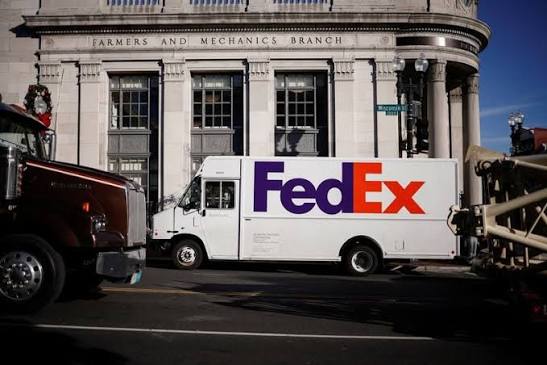
FedEx Corp. filed a lawsuit in the U.S. Court of International Trade Monday seeking reimbursement for tariffs imposed under former President Donald Trump’s emergency trade policies, one of the first major attempts to recoup payments following the U.S. Supreme Court’s ruling last week that the tariffs are unconstitutional.
The Memphis-based logistics firm alleged in the lawsuit that it is seeking “a full refund from Defendants of all IEEPA duties Plaintiffs have paid to the United States,” in reference to tariffs imposed under the International Emergency Economic Powers Act. FedEx, which along with its transportation business was the importer of record on the affected shipments, did not specify the amount of the refund it is seeking.
The lawsuit names U.S. Customs and Border Protection, CBP Commissioner Rodney Scott, and the United States as defendants.
The agency and the White House did not immediately respond to a request for comment.
The case is being handled by Washington-based law firm Crowell & Moring, which is representing FedEx. The firm did not respond to a request for comment.
The Supreme Court decision, handed down on Friday in a 6-3 ruling, held that Trump overstepped his statutory powers in using IEEPA, a sanctions act, to levy tariffs on foreign imports.
Read Also: Donald Trump Expands U.S. Entry Restrictions To 24 Countries
Economists from the Penn-Wharton Budget Model forecast that more than $175 billion in tariffs collected could be eligible for refund.
The ruling is likely to set off a series of lawsuits by importers and distributors seeking refunds.
But trade lawyers say that how refunds will actually be obtained is up to lower courts, and that there may be practical hurdles to overcome in recovering significant amounts of money.
FedEx is the first major company to take steps to recover money. Crowell & Moring, the law firm handling the FedEx case, is also representing other companies in seeking refunds under IEEPA for tariffs, including retailer Revlon Inc., eyewear firm EssilorLuxottica, and other importers.
Ron Ciotti, a partner at the Boston law firm of Hinckley Allen, who represents construction and development clients, said that companies with detailed customs paperwork or itemized invoices showing the specific amount paid as a tariff are in the best position to get a refund.
“If there was a tariff escalation in your contract or a price adjustment clause based on tariffs, and that’s why the price went up, if you had a contract that said that, then you might be able to get a refund,” Ciotti said.
However, Ciotti also noted that many companies and consumers may have a hard time proving their eligibility for a refund.
Unlike companies, consumers do not have written contracts showing how tariffs affected prices.
“Many people paid higher prices for goods without any written explanation about how tariffs contributed to higher prices and may lack the proof needed to win a refund,” he said.
The range of possible claims is wide-ranging. Firms that were importers of record, distributors, and suppliers are likely to have records showing how tariffs were related to specific shipments, which could help support their claims.
Analysts note that the litigation landscape is likely to expand rapidly over the next few months as more companies explore the possibility of seeking refunds.
Read Also: Donald Trump, Marjorie Taylor Greene Clash Ahead Of Midterms
The issue in the litigation is the interpretation of IEEPA, which grants the President authority to regulate economic transactions in the event of national emergencies but does not specifically address the authority to impose import tariffs for trade policy reasons.
The Supreme Court decision held that the Trump administration overstepped the authority granted by Congress.
The lower courts will need to determine how refunds will be processed, which could involve sophisticated accounting procedures for billions of dollars collected.
At the same time, political leaders have reacted to the ruling. California Governor Gavin Newsom, who is rumored to be a possible Democratic candidate in the 2028 presidential election, urged the government to distribute tariff refund checks to Americans affected by the decision of the Supreme Court.
“I’ve heard some people say this is such a win for the consumer, because they should get refunds back on certain products that would have been under tariffs,” Newsom said in a statement.
The federal government has not provided a timeline for processing claims, and it is not clear how individual consumers will be able to participate.
Trade attorneys forecast that companies that have already developed a legal team and detailed customs records will be able to process the fastest, but smaller importers and individual consumers may encounter administrative or evidentiary obstacles.
The FedEx lawsuit marks the beginning of the first major corporate challenge to the decision of the Supreme Court and may influence how lower courts rule on similar refund claims.
It is likely that the case will take several years to litigate due to the magnitude of the claims and the complexity of tracing tariff payments through global supply chains.