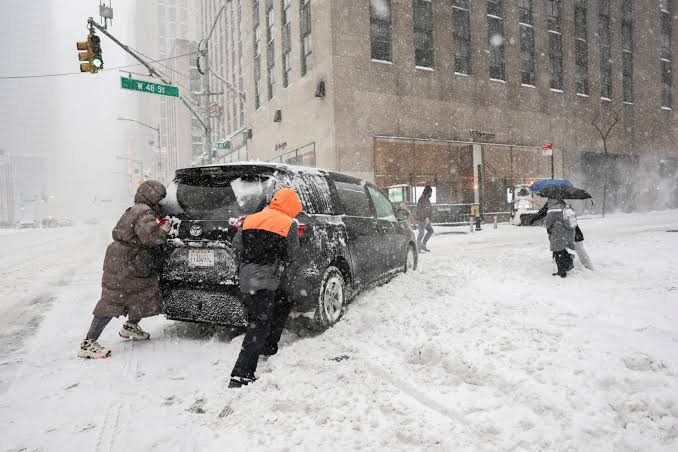
The intense winter storm that moved through the northeastern United States forced school closures, suspended public transportation, and disrupted air travel on Monday as authorities urged residents to stay indoors due to the expected heavy snowfall and high winds in the region.
The winter storm moved through a highly populated area that included the mid-Atlantic region and New England, forcing emergency declarations and shutdowns in the region.
The heavy snowfall and high winds expected in the region could pose a significant threat to travel and power in the area as the storm intensified overnight into Monday.
The city of New York, which has the largest public school system in the country, postponed in-person classes for the day, canceling all after-school activities and forgoing remote learning.
The city government also canceled in-person services at city offices, advising non-essential city employees to work from home whenever possible.
These decisions came after a state of emergency was declared by Mayor Zohran Mamdani, who restricted non-essential vehicle traffic starting Sunday night to enable snow removal and emergency services to function more effectively.
Read Also: US, Iran Gear Up For Fresh Diplomatic Talks In Geneva
“I’m asking every New Yorker to please stay home,” Mamdani said, citing the worsening road conditions and weather forecasts.
Meteorologists issued the city’s first blizzard warning in years, indicating the possibility of strong winds and poor visibility.
In the state of New York, Governor Kathy Hochul gave the order to mobilize about 100 members of the National Guard to help local authorities in regions where the highest snowfall was expected, including Long Island, New York City, and parts of the Lower Hudson Valley.
According to state officials, the preparations made were aimed at clearing transportation paths, supporting emergency services, and addressing the potential impacts of strong winds on the coastline.
The United Nations headquarters in Manhattan was also closed on Monday due to the storm, reflecting the wider disruptions to business and organizational activities in the region.
The forecasts made by the federal government indicated that some areas could expect up to two feet (about 60 cm) of snowfall, along with wind gusts of up to 70 miles per hour (113 km/h).
The U.S. Department of Homeland Security warned that such conditions could lead to the risk of fallen trees, blocked roads, and power outages, especially in coastal and suburban areas that are vulnerable to strong winds.
Despite the current funding gap that has been affecting some areas of the department, officials reported that the Federal Emergency Management Agency had continued its disaster response efforts across the country.
In a statement issued on Sunday, the agency explained that emergency deployments, travel, and assistance programs related to active disasters were still functioning, and that the “safety of life and protection of property” were still among its priorities.
Read Also: EU Rejects Any US Tariff Hike After Supreme Court Ruling
The agency’s announcement came after reports that the administration of President Donald Trump had ordered the Federal Emergency Management Agency to suspend some of its deployments of aid personnel to disaster areas due to the funding interruption.
The neighboring states also took their own emergency actions as the storm moved northward.
Massachusetts Governor Maura Healey declared a state of emergency and ordered state employees to stay home, while Connecticut imposed certain restrictions on commercial vehicles operating on limited access highways starting Sunday evening, allowing only essential deliveries and emergency vehicles to operate.
New Jersey Governor Mikie Sherrill declared a state of emergency across the state starting Sunday afternoon and asked residents to restrict their travel.
“People need to take this seriously,” she said in a CNN interview, citing the possibility of rapidly deteriorating snowfall intensity and wind conditions.
Transportation systems were some of the first to be affected. NJ TRANSIT announced the suspension of bus and light rail operations Sunday evening and halted rail service across the state later that night, with plans to resume only when weather conditions permitted the safe operation of trains.
In a neighboring state, Rhode Island, the Rhode Island Public Transit Authority announced the suspension of all transit services, including paratransit services, through Monday, with plans to resume when conditions improved.
Air travel in the United States was also severely impacted. Flight tracking service FlightAware reported over 5,000 cancellations for Monday, while aviation analytics firm Cirium reported that more than 25,000 flights had been scheduled for the day across the country.
Airlines began canceling additional flights Tuesday as the industry struggled to reposition planes and crews amidst the continued uncertainty of the weather.
The storm also had the potential to impact the delivery of mail. The U.S. Postal Service issued a notice stating that the severe winter weather may cause delays in the processing and delivery of mail and packages, depending on the accessibility of the roads.
The officials in the Northeast stated that the timing and severity of the snowfall may differ from one area to another, making it difficult to predict. The emergency management agencies advised the residents to be prepared for the potential power outage.