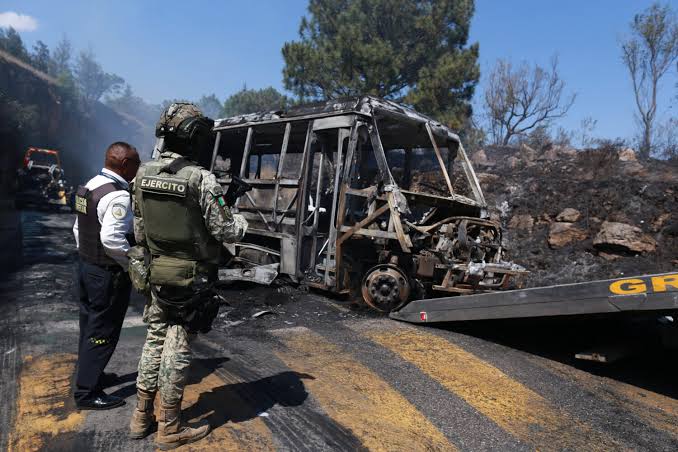
Mexico’s security forces have been hit by a wave of coordinated attacks in different parts of the country following the death of one of Mexico’s most powerful drug traffickers, according to officials on Monday, as warnings of potential violence related to internal conflicts within the criminal group emerged.
Security Minister Omar García Harfuch said that 25 members of Mexico’s National Guard and one private security guard had been killed in retaliatory attacks by suspected cartel gunmen following the capture and death of Nemesio Oseguera Cervantes, commonly known as “El Mencho,” just hours after Mexican forces arrested the cartel leader in a security operation in western Mexico.
Oseguera, a long-suspected target of Mexican authorities as the country’s most-wanted criminal, led the Jalisco New Generation Cartel (CJNG), a trafficking organization that grew in size and strength over the last decade and became one of the most heavily armed criminal groups in Mexico.
Mexican authorities said he died in custody after suffering injuries during a military raid carried out by special forces in Tapalpa, a mountainous city in the state of Jalisco.
The Defense Ministry said the raid was a result of intelligence developments that allowed authorities to finally track down the fugitive leader after years of unsuccessful efforts to capture him.
Read Also: Mexico’s Wanted Drug Lord “El Mencho” Dies In Military Raid
Defense Minister Ricardo Trevilla said that the information that led to the arrest of Oseguera was gathered through a romantic partner of the cartel leader.
The United States had offered a reward of up to $15 million for information leading to his arrest.
Hours after the news of his death broke, violence broke out in various regions of western and central Mexico.
García Harfuch stated that there were 27 attacks on government personnel in Jalisco alone, which he said were “coordinated actions aimed at undermining public order and proving the cartel’s capabilities.”
Thirty suspected cartel members were killed in shootouts with security forces, while one civilian bystander was also killed, according to official statistics announced at a daily morning press conference hosted by President Claudia Sheinbaum.
Federal authorities arrested at least 70 people in seven different states as part of security operations launched in response to the violence.
Security forces have since stepped up patrols and deployed more personnel in regions that are deemed at risk of retaliatory attacks.
García Harfuch stated that the government is keeping a close eye on possible changes in the cartel’s leadership structure, as internal struggles or divisions could lead to further violence.
“We are watching very closely for any type of reaction or reorganization in the cartel that could lead to violence,” he said.
The CJNG has been responsible for some of the most public attacks against Mexican security forces in recent years, including ambushes of military convoys and the deployment of improvised armored vehicles and explosive devices.
The group’s leadership structure, which has been seen as a central command under Oseguera, has long been attributed to its rapid territorial expansion and organized structure.
A successor to Oseguera was not immediately named by Mexican authorities, and officials were not asked to comment on speculation about who might take control.
It has been noted that leadership changes in organized crime groups often lead to periods of short-term violence as rival groups vie for control and access to revenue streams.
The United States government responded quickly to the events. U.S. President Donald Trump called on Mexico to heighten its fight against drug cartels, writing on social media:
“Mexico must step up their effort on Cartels and Drugs!” This is in line with long-standing U.S. concerns about the smuggling of fentanyl and other drugs associated with Mexican cartels.
Read Also: Mexico Response To U.S. Venezuela Attack Signals Tension
The two nations have increased their security collaboration in recent years, including intelligence sharing and joint probes, as part of efforts to target high-ranking cartel members. U.S. officials have in the past named the CJNG as one of the main sources of synthetic opioids smuggled into North America.
The Mexican government described the operation against Oseguera as part of a strategy to weaken the leadership of organized crime while trying to minimize civilian casualties.
But the extent of the retaliatory attacks shows the difficulties the government faces in trying to pursue its enforcement strategy while trying to stabilize areas affected by cartel activity.
Local governments in affected areas reported temporary school closures and disruptions to transportation routes as security forces worked to clear blockades and secure highways.
Officials said conditions had begun to stabilize by late Monday, though heightened alert levels remained in place.
No additional details were released regarding the medical circumstances surrounding Oseguera’s death, and authorities said forensic and legal procedures connected to the case were continuing.
Federal prosecutors are expected to coordinate with international counterparts regarding outstanding investigations tied to the cartel’s activities.