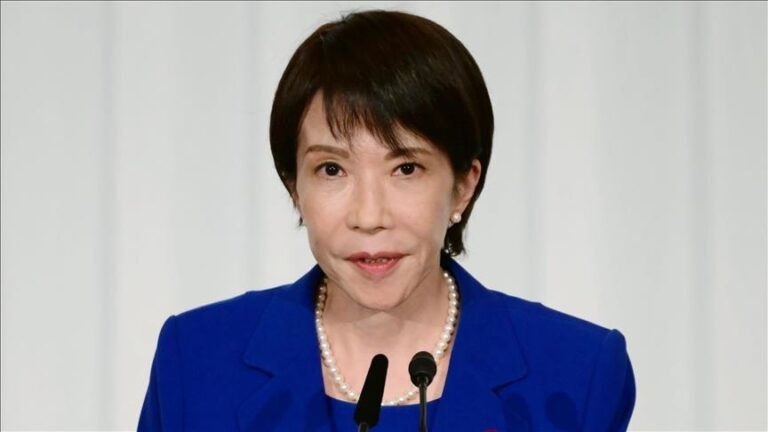
Japan’s Prime Minister Sanae Takaichi delivered her first parliamentary policy address since winning a commanding supermajority in this month’s lower house elections on Friday, using the platform to announce the most sweeping overhaul of her country’s security architecture in decades, a package that encompasses weapons exports, intelligence reform, foreign investment screening, supply chain independence, and nuclear energy, framed explicitly around the threat she believes China poses to the regional order.
The address, delivered to both chambers of the Diet in Tokyo, came twelve days after the Liberal Democratic Party captured 352 of the 465 lower house seats in a snap election on February 8, a gain of 118 seats that handed the ruling coalition more than two-thirds of the chamber and effectively removed any meaningful legislative obstacle to Takaichi’s agenda. Her governing partners now control sufficient seats to override the upper house on most legislation.
“Japan faces its most severe and complex security environment since World War Two,” she told lawmakers, citing China’s expanding military activities, its deepening strategic coordination with Russia, and North Korea’s advancing nuclear and ballistic missile programme.
The diplomatic context in which she spoke was already fraught. Her tenure as prime minister, which began in October 2025 when she became Japan’s first female leader, was immediately marked by controversy with Beijing after she suggested in early November that Japan could respond militarily if China attacked Taiwan and that attack threatened Japanese territory.
China characterised the remarks as crossing a red line, demanded a full retraction, and launched a broad pressure campaign that included diplomatic rebukes, increased Chinese Coast Guard incursions near the disputed Senkaku Islands, a PLA military exercise in the Yellow Sea, and economic sanctions including a travel advisory against Japan and restrictions on rare earth exports.
A PRC consul general threatened in the days after Takaichi’s initial remarks to decapitate her, drawing formal protests from Tokyo. Beijing’s response did not produce the political outcome it had apparently anticipated. Rather than weakening Takaichi’s position, China’s pressure campaign appears to have strengthened her electoral standing. The LDP’s February 8 supermajority victory left Beijing holding what analysts have described as “zombie sanctions,” measures that failed to achieve their stated objective but which Beijing now finds politically difficult to rescind. At the Munich Security Conference days before Friday’s address, China’s top diplomat Wang Yi described forces in Japan as seeking “to revive militarism.” The framing found little traction internationally.
On weapons exports, Friday’s speech marked the clearest official signal yet that Japan intends to abandon a self-imposed postwar constraint that has defined its defence industry for decades.
Takaichi said she would accelerate discussions on further loosening restrictions on the export of lethal defence equipment, arguing the change would “contribute to strengthening the deterrence and response capabilities of our allies and like-minded partners, while also helping to reinforce Japan’s defence production base.” Separately, an LDP policy panel proposed on Friday that the government scrap rules limiting military exports to non-lethal items such as body armour, a recommendation that, if adopted, could open Japanese manufacturers to full participation in the global market for fighter aircraft components, naval systems, and guided munitions. Japan’s defence industry has long possessed competitive technical capabilities but has been constrained from commercialising them internationally.
Japan committed in 2023 to double defence spending to two per cent of GDP by the end of the current fiscal year, a target it is now on track to meet, which would place it among the world’s five largest defence spenders by absolute expenditure despite the pacifist constitution enacted under American occupation after World War Two.
Takaichi has pledged to revise all three of Japan’s core security policy documents by the end of 2026, with the new national security strategy expected to guide planning for years beyond. Some within the LDP have discussed pushing defence spending to three per cent of GDP, according to party members who spoke to reporters before the election, though Takaichi has not made that figure a formal commitment.
Read Also: Japan PM Takaichi Wins Historic Majority In Snap Vote
Two institutional announcements from Friday were less immediately visible but potentially as significant in the long run. The first was the creation of a National Intelligence Council chaired by Takaichi herself, designed to integrate information flowing from the police, the Defence Intelligence Headquarters, the Cabinet Intelligence and Research Office, and other agencies that have historically operated with limited coordination. Japan has no external intelligence service comparable to the CIA or Britain’s Secret Intelligence Service, and no domestic equivalent of MI5, a gap that security officials have identified as a structural liability. The council would not create such agencies outright but is intended as a command-and-control mechanism to make better use of existing collection capabilities.
The second was the proposed establishment of a body modelled on the U.S. Committee on Foreign Investment, known as CFIUS, to scrutinise overseas acquisitions in sensitive sectors before they proceed. China had already imposed export controls in January on all dual-use items bound for Japan with military applications, citing Takaichi’s Taiwan remarks as justification. The proposed investment screening body would be Japan’s institutional response: a formal mechanism to assess and, where necessary, block inbound transactions that could affect semiconductor manufacturing, telecommunications infrastructure, or other technologies with defence relevance.
Read Also: Sanae Takaichi Becomes Japan’s First Female Prime Minister
Takaichi pledged to reduce dependence on “specific countries,” a formulation that avoided naming China directly while leaving little interpretive doubt, by partnering with allies to secure critical raw materials. She cited rare earth deposits around Minamitori, a remote Pacific island within Japan’s exclusive economic zone, as a strategic resource the government intends to develop. China’s restriction on rare earth exports to Japan in the months since November has illustrated Japan’s acute vulnerability, given that China controls approximately 60 per cent of global rare earth mining and an even larger share of processing capacity.
Takaichi is expected to visit Washington next month for her first bilateral summit with President Donald Trump, at which rare earth cooperation and economic security are expected to be central topics. She has also signalled willingness to restart civilian nuclear reactors idled since the 2011 Fukushima disaster, framing energy self-sufficiency as inseparable from defence preparedness. Friday’s address included that commitment explicitly.
On fiscal policy, Takaichi moved to reassure markets that anxiety over her spending plans was overstated. “We are not going to pursue a reckless fiscal policy that would undermine the market’s confidence,” she told parliament, pledging to reduce Japan’s debt-to-GDP ratio over time. The caveat carried weight: yields on long-dated Japanese government bonds have risen to multi-decade highs in recent weeks amid investor concern about the cost of the tax cuts, social security commitments, and defence expansion her government is pursuing simultaneously. The government also announced a cross-party national council to discuss how to fund ageing Japan’s ballooning social security obligations.
Japan’s parliament is now in regular session. Legislation to implement the weapons export liberalisation, the investment screening mechanism, and the intelligence council structure will require Diet passage, where Takaichi’s supermajority makes approval near-certain in the lower house. The upper house, where the coalition lacks comparable dominance, may present more friction on some measures. The revised core security documents are expected by December.