Mali is poised to break its dependence on costly overland trade routes after four member states of the Organisation for the Development of the Senegal River formally approved the launch of a long-delayed navigation project that would give the landlocked country its first direct waterway connection to the Atlantic, a development that has been on the drawing board since the 1970s but has consistently stalled on financing and institutional momentum until now.
The decision was taken at the 78th Ordinary Session of the OMVS Council of Ministers, held on January 30 and 31 in Nouakchott under the chairmanship of Mali’s Minister of Energy and Water, Boubacar Diane. Ministers from Guinea, Mali, Mauritania, and Senegal collectively authorised the launch of the first phase of construction works in April 2026.
The session was attended by OMVS High Commissioner Mohamed Abdel Vetah and represented the first formal, multi-state commitment to move the project from technical preparation into physical execution after more than five decades of planning, delay, and aborted financing attempts.
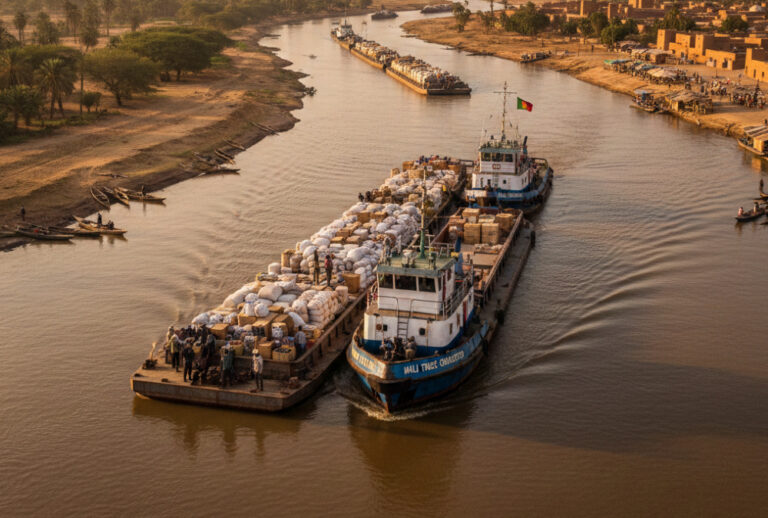
The corridor stretches 905 kilometres along the Senegal River, from the Atlantic port of Saint-Louis in northern Senegal to the future river terminal at Ambidédi, a settlement in Mali’s Kayes region approximately ten kilometres from the regional capital. Goods unloaded at Saint-Louis’s maritime port would travel upriver by barge directly into Malian territory, eliminating the need for onward overland transport through multiple transit countries.
For a country that currently routes nearly all its international trade through the ports of Dakar, Abidjan, Lomé, and Tema, routes subject to road deterioration, border delays, and periodic political disruption, the riverway would represent a structural shift in logistics.
The first phase is valued at 7.38 billion CFA francs, equivalent to approximately $12 million, and covers three categories of civil works: dredging of the navigation channel to ensure sufficient depth for loaded barges; installation of day and night buoyage and beaconing conforming to international safety standards; and rehabilitation of river staging posts along the corridor with quays, storage areas, and logistics infrastructure. Technical designs for the channel’s 24-hour navigation system include around 910 river buoys, 120 shore beacons, and a fluvial VHF communication network based on approximately 25 relay stations interconnected through a shared telecom backbone, a system designed to allow the future addition of AIS transponders and River Information Services once traffic volumes justify the investment.
The 7.38 billion first-phase budget represents just over 21 per cent of the project’s total estimated cost of 35 billion CFA francs, approximately $53 million. That figure was itself a scaled-down version of earlier estimates that had run into hundreds of billions of francs, a financial burden that had previously made the project technically viable but practically frozen.
SOGENAV, the management and operations company created by the four OMVS member states in 2011 specifically to restore commercial navigation on the Senegal River, proposed the phased approach as a deliberate strategic reframing: rather than waiting for a single large external financing package that never materialised, member states would self-finance an initial demonstrative phase, establish proof of operational feasibility, and use that credibility to attract private and multilateral partners for subsequent phases.
The political impetus for this shift came directly from Mali’s transitional leader, General Assimi Goïta, who set the condition at the OMVS session of July 2023 that states must finance the inaugural phase themselves, without dependence on external donors, in order to signal seriousness and accelerate implementation. That instruction reflected a broader orientation of the Alliance of Sahel States, the political and security bloc comprising Mali, Burkina Faso, and Niger, toward reducing strategic dependence on external actors in infrastructure as well as defence and diplomacy.
The economic case is well-established and predates the current political configuration by decades. UN-commissioned studies conducted in the 1970s confirmed that the cost of transporting goods by river between Kayes and the Senegalese coastline was lower per tonne than equivalent rail costs, particularly for agricultural produce, fuel, and construction materials.
Estimates from various sources suggest the corridor could reduce logistics costs for Malian exporters by between 40 and 60 per cent compared with existing road-based alternatives. Mali’s principal export commodities, gold, cotton, livestock, and cereals, would be among the most directly affected. Gold alone accounted for approximately 70 per cent of Mali’s export revenues in recent years.
Beyond the economic arithmetic, the project carries geopolitical weight that has become more acute rather than less as Mali has restructured its external relationships. The recent crises in supply chains have revealed the fragility of a near-total dependence on external road corridors. Each disruption, each period of regional tension, exposes the national economy. Ambidédi introduces a strategic alternative: a complementary axis capable of absorbing geopolitical shocks.
The project, however, faces operational obstacles that officials have acknowledged without fully resolving. The security situation in the Kayes region, where jihadist activity has intensified in recent months, represents the most significant variable.
One procurement process has already been launched and a contractor selected, but construction start in April 2026 was described as conditional on security conditions permitting. River banks along the corridor are also partially occupied by informal economic activity, fishing communities, agricultural users, and small traders, whose displacement or integration into the project’s operational model will require community consultation before construction can proceed at full pace. Seasonal water levels on the Senegal River impose a narrow window for effective dredging operations each year, adding time pressure to an already compressed schedule.
Ministers also called on member states to accelerate the finalisation of their financial commitments, acknowledging that even the first-phase budget had not been fully secured at the time of the January resolution. Complementary financing mechanisms under discussion include public-private partnerships and, at a longer horizon, instruments linked to green transport and energy transition financing.
The OMVS, established in 1972 following the Sahelian droughts as a framework for shared management of the Senegal River basin, built its reputation on hydropower, the Manantali dam, completed in 1988, and the Félou and Gouina installations commissioned in 2013 and 2022. Navigation has been described as the third pillar of its founding mandate and the one that has remained unrealised throughout its 50-year history. The April groundbreaking, if it proceeds on schedule, will be the first physical commitment to delivering on that original promise.
Africa Digital News, New York