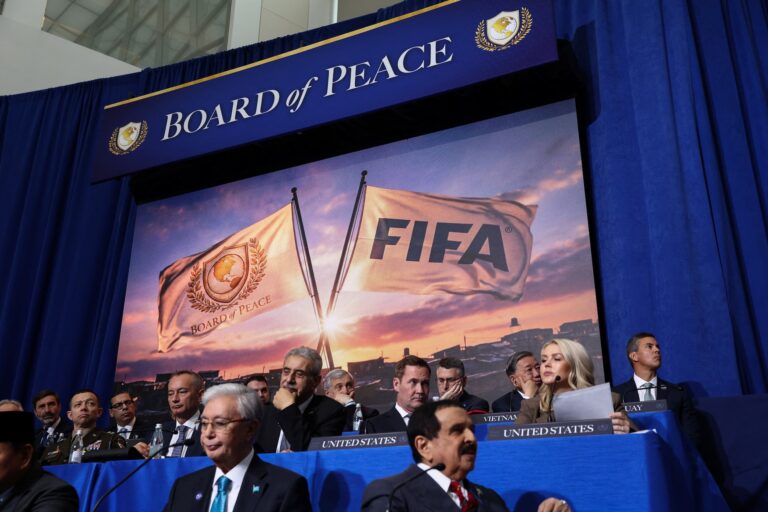
World football’s governing body FIFA formalised a $75 million partnership with the United States-backed Board of Peace on Thursday, committing to construct a national stadium, an elite academy, and dozens of pitches across the Gaza Strip, infrastructure that does not yet exist and cannot be built until security conditions that remain unresolved permit construction to begin.
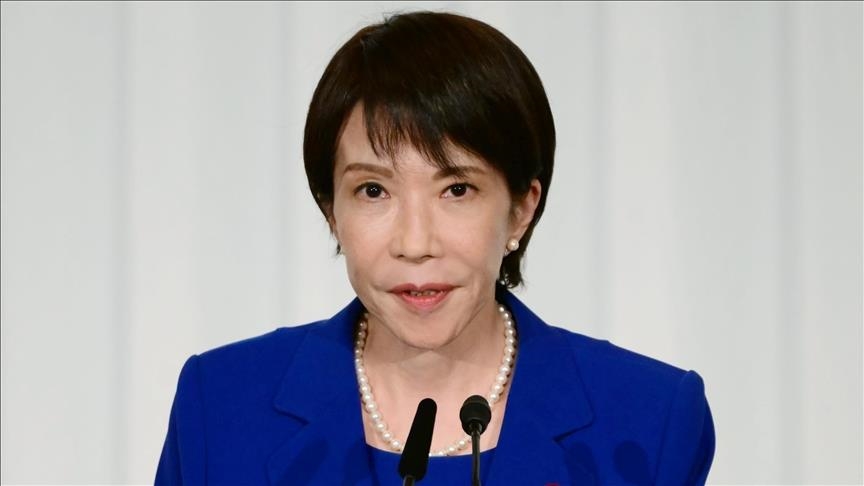
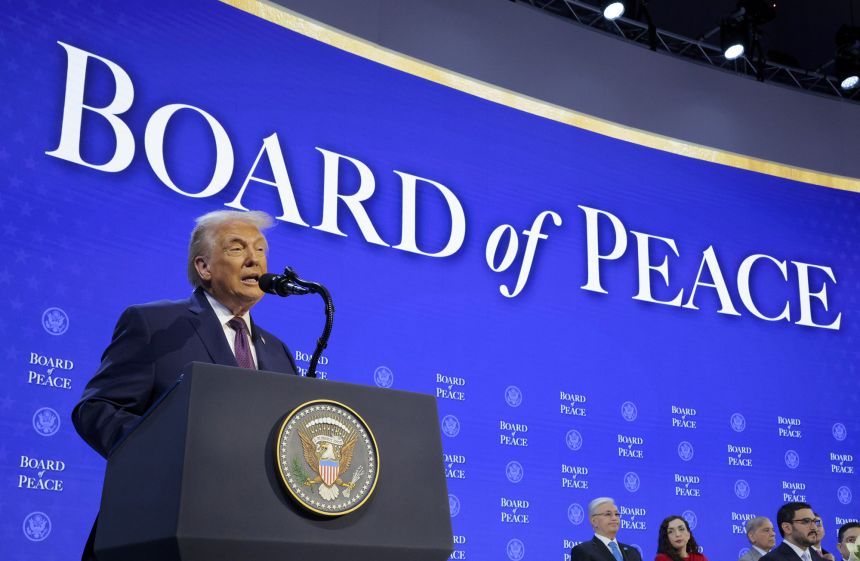
The agreement was signed at the inaugural Board of Peace meeting in Washington by FIFA President Gianni Infantino alongside Gaza Executive Board of Peace member Yakir Gabay, High Representative for Gaza Nickolay Mladenov, and Dr Ali Shaath, the Chief Commissioner of the National Committee for the Administration of Gaza, a technocratic governing body that has not yet entered Gaza and continues to operate from Egypt while the terms of Hamas’s cession of administrative control remain unsettled.
Fifty FIFA Arena mini-pitches, to be installed near schools and residential areas, are budgeted at $50,000 per unit, representing a total outlay of $2.5 million. Five full-size regulation fields across five districts are costed at $1 million each. A FIFA Academy carries an estimated price tag of $15 million. The centrepiece is a $50 million national stadium designed to seat 20,000 spectators, intended to host sporting and cultural events and serve as a long-term commercial and community anchor.
The framework divides implementation into four phases, beginning with community activation over a three-to-six month window covering mini-pitch installation and the rollout of FIFA’s Football for Schools programme.
Read Also: FIFA President Tells Trump: ‘Football Is Bigger Than Any Leader’
The national stadium, Phase IV, carries a projected construction timeline of 18 to 36 months, and is explicitly contingent on monitoring of safety and security conditions before work can commence.
Gaza has no national football team. A unified Palestinian squad representing both Gaza and the West Bank has held FIFA membership since 1998 but has never qualified for a World Cup. The territory’s existing football infrastructure was largely destroyed or severely damaged during the conflict between Israel and Hamas that began in October 2023.
Infantino framed the announcement in terms that moved beyond sporting administration. “We don’t have to just rebuild houses or schools or hospitals or roads,” he said. “We also have to rebuild and build people, emotion, hope and trust. And this is what football, my sport, is about.” He presented an artificial intelligence-generated video depicting stadiums and pitches rising from the rubble of Gaza, with children playing on bright green surfaces and multiracial crowds in newly constructed stands.
The partnership drew scrutiny on procedural as well as substantive grounds. Article 15 of the FIFA Ethics Code requires political neutrality from FIFA officials in dealings with government institutions and international organisations.
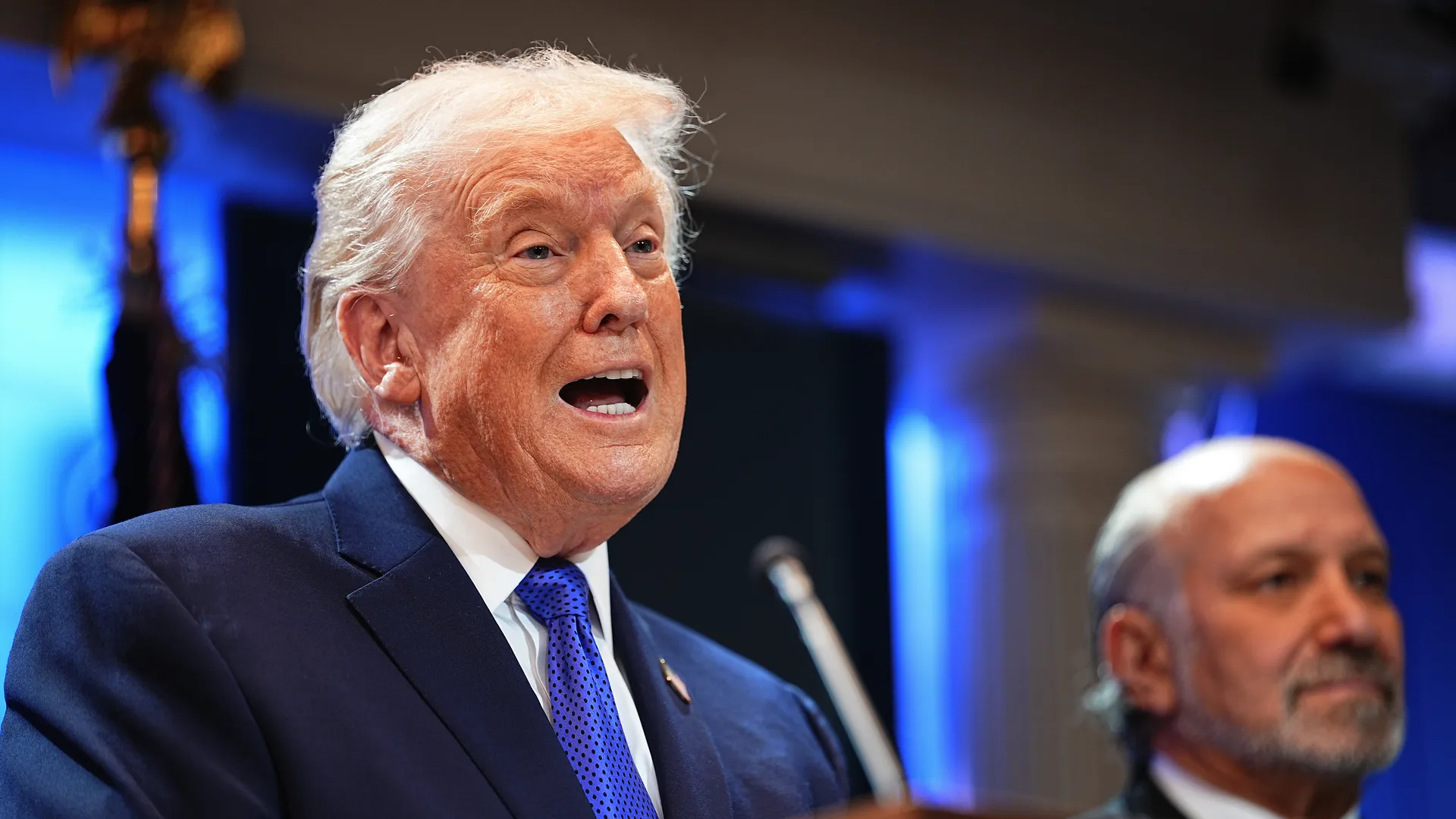
An ethics complaint was filed against Infantino by the NGO FairSquare in December 2025, citing his repeated appearances at Trump administration events and his presentation to the former president of a FIFA Peace Prize created specifically for the occasion at the World Cup 2026 Final Draw. FIFA has not commented publicly on that complaint. Infantino’s appearance at the Board of Peace meeting, where he was seen holding a Trump-branded hat before cameras, extended the pattern critics have documented.
The Board of Peace itself excludes Palestinian representatives and was criticised by several European governments, including France, Germany, and Italy, which declined invitations to join it as full members.
Read Also: US Vows To Block Any Ban On Israel From 2026 FIFA World Cup
The fundamental preconditions the board has set for Gaza’s reconstruction, Hamas’s disarmament and Israel’s military withdrawal, remain subjects of active and unresolved negotiation. No timeline for either has been agreed.
“Today, FIFA and the Board of Peace have signed a landmark partnership agreement that will foster investment into football for the purpose of helping the recovery process in post-conflict areas,” Infantino said in a formal statement. “Together with the support of the Board of Peace, FIFA will drive this partnership which is built to deliver impact at every stage.”
The programme, as described by FIFA, also encompasses job creation, workforce training, youth participation, organised leagues for boys and girls, community engagement, and the stimulation of local commercial activity alongside the physical infrastructure commitments. No independent mechanism for monitoring delivery against those commitments was announced.
Phase I implementation was described as beginning once circumstances allow. A date was not specified.