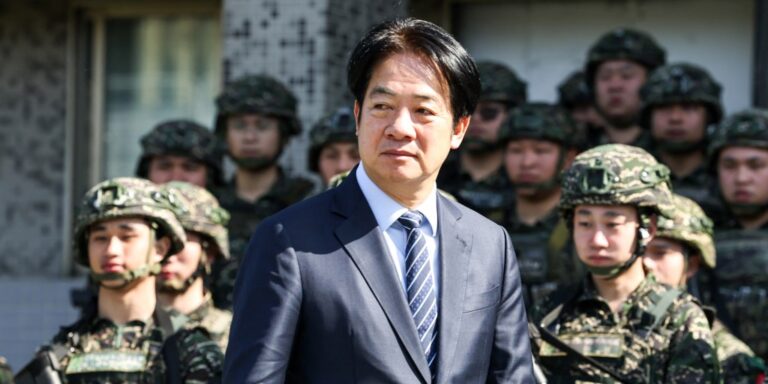
Taiwan’s opposition-controlled parliament committed on Monday to making President Lai Ching-te‘s stalled 40-billion-dollar special defense budget the first item for review when the legislature reconvenes after the Lunar New Year holiday, responding to mounting pressure from Washington as China intensifies military activities around the island and questions grow about the credibility of Taiwan’s deterrence posture.
Parliament Speaker Han Kuo-yu and Deputy Speaker Johnny Chiang, both senior figures in the main opposition Kuomintang party, issued a joint statement pledging to facilitate cross-party negotiations on the proposal, saying the special defense budget and related legislation would be treated as the legislature’s “very first” items in the new session beginning in late February. “We value the open, candid, and sincere exchanges between the Legislative Yuan and the U.S. Congress and take your views seriously,” the two speakers said, referring to parliament by its formal name and addressing their remarks explicitly to the 37 bipartisan American lawmakers who wrote to Taipei last week expressing concern about parliamentary delays. “Taiwan will continue to act with seriousness and resolve to make responsible contributions to its own security and to peace and stability in the Indo-Pacific.”
The statement represented a notable shift in tone from the KMT, which has repeatedly blocked review of the budget since Lai announced it in November.
The proposal, worth NT$1.25 trillion over 2026 to 2033, would fund new missile defense systems, long-range precision weapons, and unmanned combat systems designed to complicate any Chinese military campaign against the island. Han and Chiang described themselves as representatives of the entire legislature rather than a single party, signaling an intention to broker compromise rather than simply defend the KMT’s prior obstruction.
The KMT’s actual counter-position has been far more restrictive. In an alternative proposal advanced through parliament in recent weeks, the party, backed by the smaller Taiwan People’s Party, capped arms spending at NT$400 billion through 2033, a reduction of nearly 70 percent from Lai’s request, and required that funding be allocated on an annual basis rather than approved as a multi-year package.
The counter-proposal funds the purchase of some U.S. weapons Taiwan has already committed to buying but omits capabilities that both Taiwan’s Defense Ministry and American officials have described as critical to maintaining credible deterrence against a Chinese attack.
Read Also: Taiwan Hits Back At China’s Munich Conference Speech
The gap between the two sides had already alarmed Washington. Senate Armed Services Committee Chairman Roger Wicker, a Republican from Mississippi, wrote publicly on X in early February: “I’m disappointed to see Taiwan’s opposition parties in parliament slash President Lai’s defense budget so dramatically.” The bipartisan letter from 37 lawmakers, signed by Republican Senator Pete Ricketts, Democratic Senator Chris Coons, and Republican Representative Young Kim, among others, warned that “the threat posed by the People’s Republic of China against Taiwan has never been greater” and that Xi Jinping was “focusing every element of the PRC’s national power to control Taiwan.”
The letter also called on Washington to address what it described as a massive backlog in weapons deliveries to Taiwan, an issue that has strained the bilateral relationship independently of the budget debate. “Likewise, we need Taiwan to step up with us,” the letter said.
DPP legislative caucus leader Chung Chia-pin said the American letter sent an unambiguous signal about the terms of the bilateral relationship under the Trump administration. He said U.S. political circles now broadly expected countries dealing with Washington to take responsibility not only for reciprocal trade but also for maintaining regional security in their own territories.
The Taiwan People’s Party, which holds the balance of power in the legislature and whose support the KMT requires to sustain its parliamentary majority, has shown some movement. Party leader Huang Kuo-chang recently traveled to Washington before announcing that the TPP would propose modifications to the special defense budget, a development that think tank co-founder Yang Kuang-shun of US Taiwan Watch said he was watching closely as a potential indicator of where the final compromise might land.
International pressure has also mounted from beyond Washington. A European parliamentary delegation concluded a six-day visit to Taipei on Friday, with multiple European lawmakers urging Taiwan to remain vigilant and increase defense spending. Ukrainian legislator Serhii Soboliev, drawing on his country’s experience of Russian invasion, told his Taiwanese counterparts: “All those who claim they want to protect you actually want to conquer you,” in a pointed warning about the limits of relying on external guarantees over domestic military readiness.
Lai has committed to raising defense spending to three percent of GDP in 2026 and five percent by 2030, figures that align with NATO’s evolving benchmark and which the Trump administration has repeatedly endorsed as a model for its allies. For context, Taiwan currently spends approximately 2.5 percent of GDP on defense under its regular annual budget; the special budget is intended to supplement rather than replace that baseline.
Read Also: US Lawmakers Pressure Taiwan To Pass $40bn Defense Budget
The KMT has argued that Lai’s proposal amounts to a blanket authorization of expenditure without sufficient parliamentary oversight. Caucus leader Fu Kun-chi said the president was asking the legislature for approval “without any knowledge of the situation” and demanded that Lai appear before parliament in person to explain how the money would be spent. The KMT also launched separate impeachment proceedings against Lai in a move widely described by analysts as unlikely to succeed but indicative of how severely relations between the executive and the opposition-controlled legislature have deteriorated.
The new session of the Legislative Yuan begins in late February. Whether Monday’s commitment from the KMT speakers produces a genuine legislative breakthrough or another round of procedural blocking disguised as negotiation will be determined within weeks, with consequences that extend well beyond Taiwan’s own domestic politics.