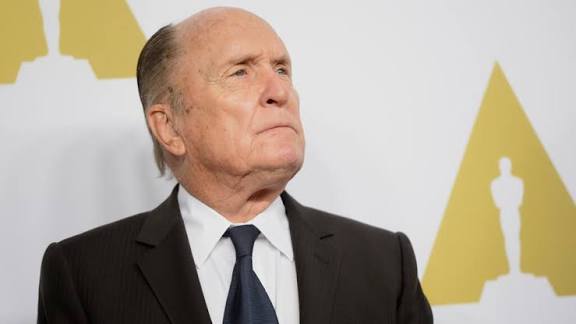
LOS ANGELES — Robert Duvall, the Oscar-winning American actor known for iconic performances in The Godfather and Apocalypse Now, died on Sunday at the age of 95, his wife, Luciana Duvall, confirmed on Monday.
“Yesterday we said goodbye to my beloved husband, cherished friend, and one of the greatest actors of our time. Bob passed away peacefully at home,” she said in a statement. “To the world, he was an Academy Award-winning actor, a director, a storyteller.
To me, he was simply everything. His passion for his craft was matched only by his deep love for characters, a great meal, and holding court.”
Duvall’s career spanned more than six decades, during which he became renowned for his understated, rigorous approach to acting. He won the Academy Award for Best Actor in 1983 for his portrayal of a washed-up country singer in Tender Mercies, and he received six additional Oscar nominations for performances across film and television.
He gained early recognition in 1962 with his performance as Boo Radley in the film adaptation of Harper Lee’s To Kill a Mockingbird. Despite starting his career relatively late — Duvall was 31 at the time — he steadily built a reputation for versatility, moving seamlessly between supporting and leading roles.
Read Also: British Oscar-Winning Playwright Tom Stoppard Dies At Age 88
Among his most memorable characters was Tom Hagen, the soft-spoken and loyal consigliere in the first two installments of The Godfather (1972, 1974). He also achieved widespread acclaim for his role as Lieutenant Colonel William Kilgore in Francis Ford Coppola’s 1979 Vietnam War epic Apocalypse Now. Kilgore, the surf-loving and brash officer, became one of cinema’s most recognizable figures, immortalized by the line: “I love the smell of napalm in the morning.”
Duvall’s portrayal of Kilgore reflected his careful preparation and commitment to character development. Originally conceived as the over-the-top “Colonel Carnage,” the role was moderated under Duvall’s influence to create a more grounded yet commanding presence. “I did my homework,” he told talk show host Larry King in 2015. “I did my research.”
Throughout his career, Duvall was known for his avoidance of Hollywood glitz, focusing instead on the substance of his roles. He appeared in a broad range of films, including the corporate satire Network (1976), the family drama The Great Santini (1979), and the country music-themed Tender Mercies, which earned him the Academy Award.
Television also featured some of his most personal work. In the 1989 mini-series Lonesome Dove, adapted from Larry McMurtry’s novel, Duvall played Texas Ranger-turned-cowboy Augustus McCrae. He described this role as one of his favorites, combining elements of humor, toughness, and human vulnerability.
Critics often highlighted Duvall’s technical skill and breadth. Film critic Elaine Mancini called him “the most technically proficient, the most versatile, and the most convincing actor on the screen in the United States.”
His performances were widely praised for their subtlety, precision, and authenticity, whether in small supporting roles or commanding lead appearances.
Read Also: A Costly Slap: Will Smith Barred From Oscars For 10 years
Beyond acting, Duvall also directed films and maintained a reputation as a storyteller deeply engaged with character-driven narratives.
His choices often reflected a careful balance of artistic integrity and audience appeal, demonstrating a commitment to craft over celebrity.
Born in San Diego, California, in 1931, Duvall studied at the Neighborhood Playhouse School of the Theatre in New York and began his career on stage before transitioning to film.
His approach emphasized immersion into character, often eschewing traditional Hollywood promotion in favor of sustained preparation and research.
Duvall’s influence extended across multiple generations of filmmakers and actors. Colleagues frequently noted his meticulous attention to detail, collaborative spirit, and ability to elevate ensemble casts.
He was a recurrent presence in American cinema during periods of intense social and political change, from the Vietnam War era to the late 20th century’s evolving film landscape.
His passing marks the end of a career that bridged classical and contemporary American cinema, leaving behind a legacy of performances that continue to resonate.
Awards, nominations, and critical acclaim reflect only part of his impact; he is remembered for his consistent devotion to craft and the memorable humanity he brought to his roles.
Duvall is survived by his wife, Luciana, and extended family. No further details about funeral arrangements or public memorials have been released.