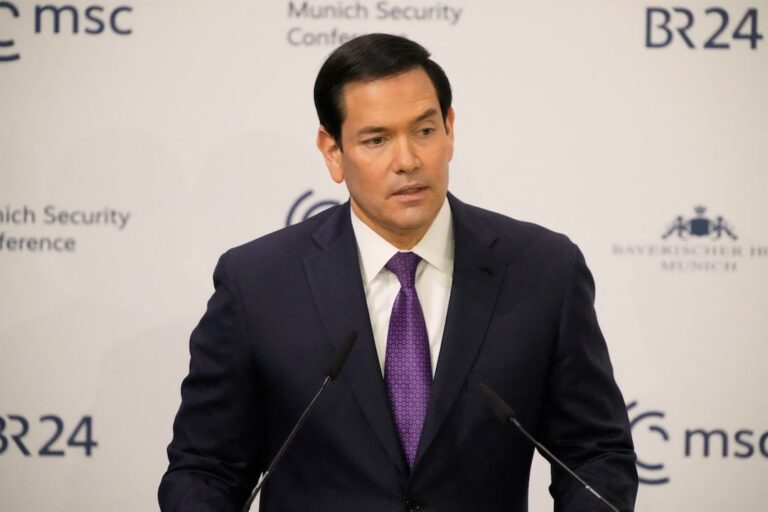
U.S. Secretary of State Marco Rubio received a standing ovation at the Munich Security Conference Saturday after delivering a deliberately measured address that sought to repair transatlantic trust while still pressing European allies to embrace the Trump administration’s vision of a refashioned global order built on sovereignty, reindustrialization, and renewed military strength.
Reminding his audience of America’s centuries-long roots in Europe, Rubio said the United States would remain forever tied to the continent even as it pushes for changes in the relationship and the international institutions that have underpinned the post-war world.
“We do not seek to separate, but to revitalise an old friendship and renew the greatest civilisation in human history,” Rubio said. “For the United States and Europe, we belong together.” He added that the U.S. was prepared to pursue its vision alone if necessary, but that doing so together with European allies remained Washington’s clear preference.
The speech drew a direct line from the Cold War origins of the conference in 1963, when the Berlin Wall was newly erected and the Cuban Missile Crisis had just passed, to the present moment of renewed great power competition. Rubio argued that the euphoria following the Cold War’s end had produced what he called a dangerous delusion that history itself had ended, allowing structural weaknesses in trade, migration, and energy policy to accumulate unchecked.
“We made these mistakes together, and now together, we owe it to our people to face those facts and to move forward,” he said, framing the Trump administration’s disruptions not as aggression toward allies but as a necessary reckoning with shared failures.
Read Also: Munich Security Summit Opens Amid Deepest Transatlantic Crisis
He placed civilization itself at the center of the alliance’s rationale, arguing that armies do not fight for abstractions but for a people, a nation, and a way of life. “That is what we are defending: a great civilization that has every reason to be proud of its history, confident of its future, and aims to always be the master of its own economic and political destiny,” Rubio said.
Despite the conciliatory framing, Rubio did not retreat from core administration positions. He attacked international institutions directly, saying the United Nations had played “virtually no role” in resolving active conflicts including Gaza and Ukraine. “The United Nations still has tremendous potential to be a tool for good in the world. But we cannot ignore that, today, on the most pressing matters before us, it has no answers and has played virtually no role,” he said.
On Ukraine, Rubio acknowledged that the administration remained uncertain about Russian intentions. “We don’t know if the Russians are serious about ending the war,” he told the conference during a Q&A session, adding that Washington would continue to test Moscow’s stated willingness for dialogue while maintaining other pressure instruments. He disclosed that in conversations with India, Washington had secured a commitment to stop buying additional Russian oil, a notable diplomatic achievement aimed at tightening the economic constraints on Moscow.
Ukrainian President Volodymyr Zelensky, also present in Munich, said Europe’s absence from the negotiating table between Washington and Moscow was “a big mistake.” He told the conference that “the Americans often return to the topic of concessions, too often discussed in the context of Ukraine, not Russia.” Zelensky said he would agree to elections after two months of ceasefire if Washington pressed for them.
Chinese Foreign Minister Wang Yi spoke directly after Rubio, offering a contrasting vision of the global order that implicitly challenged American framing of the current moment. His presence at a conference from which Russia is excluded underscored the competing frameworks being advanced in Munich for the post-American order.
European responses to Rubio’s address divided along predictable lines. European Commission President Ursula von der Leyen called the speech “reassuring,” though officials around her noted quiet discontent over dismissive references to the United Nations and climate change and Rubio’s justification of the Greenland position. Von der Leyen used her own remarks to invoke the EU’s mutual defence clause, saying collective defence was “not an optional task” but “an obligation within our own treaty.”
Austrian Foreign Minister Beate Meinl-Reisinger offered a blunter assessment: “In substance nothing changes, Europe now has to become more independent and assume more responsibility, also in the security and defense area.”
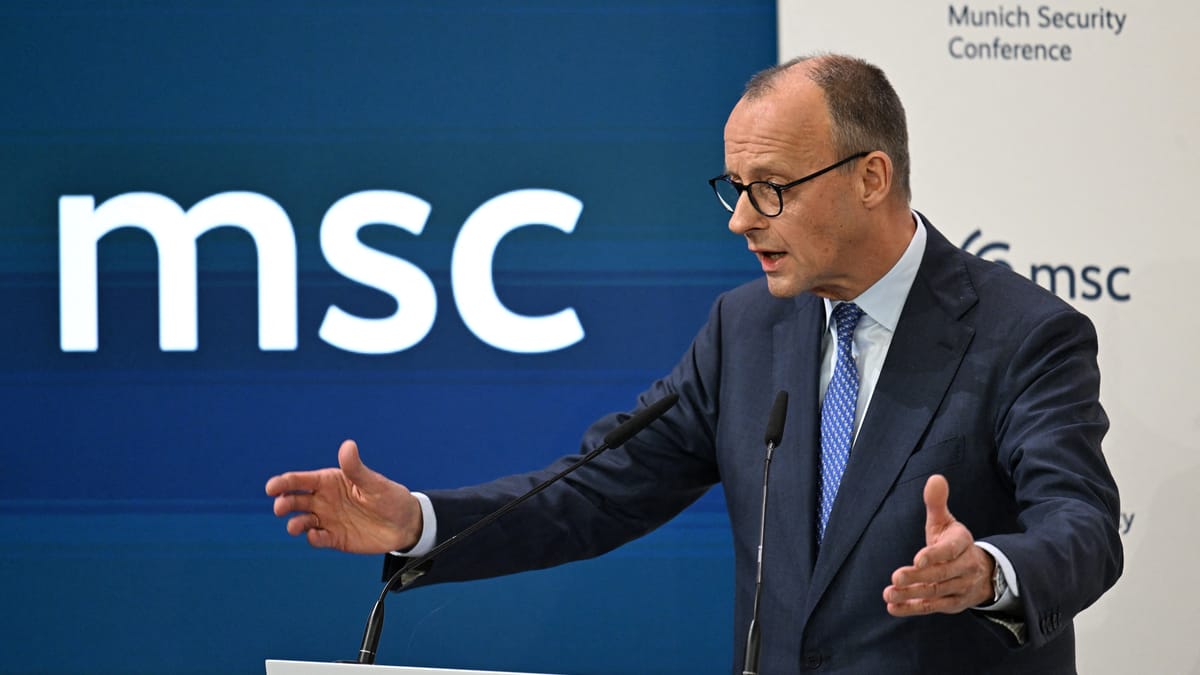
Read Also: Merz: Rules-Based World Order “No Longer Exists”
American Democratic members of Congress present in Munich acknowledged the shift in tone but questioned its depth. Senator Richard Blumenthal said Rubio “was clearly trying to escape the vituperative ghost of JD Vance,” but described the speech as “so lacking in substance and specificity that in the end, its impact will be very limited.” Republican Senator Thom Tillis, the top Republican on the Senate NATO Observer Group, disagreed, saying the speech carried the White House’s implicit endorsement. “We all know that that speech would not have been delivered if the White House hadn’t agreed with it,” Tillis said.
CNN’s assessment captured the ambivalence in the room: Rubio had met a low bar, the applause reflecting nervous relief rather than warm embrace of the policy espoused and the wide-ranging cultural changes demanded.
The conference continues Sunday with further sessions on Ukraine, European defense financing, and the future of NATO burden-sharing.