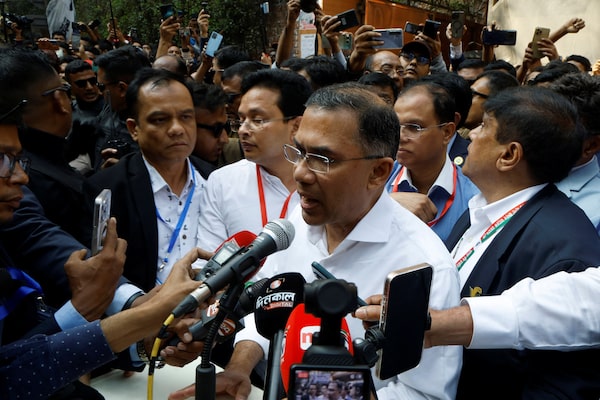
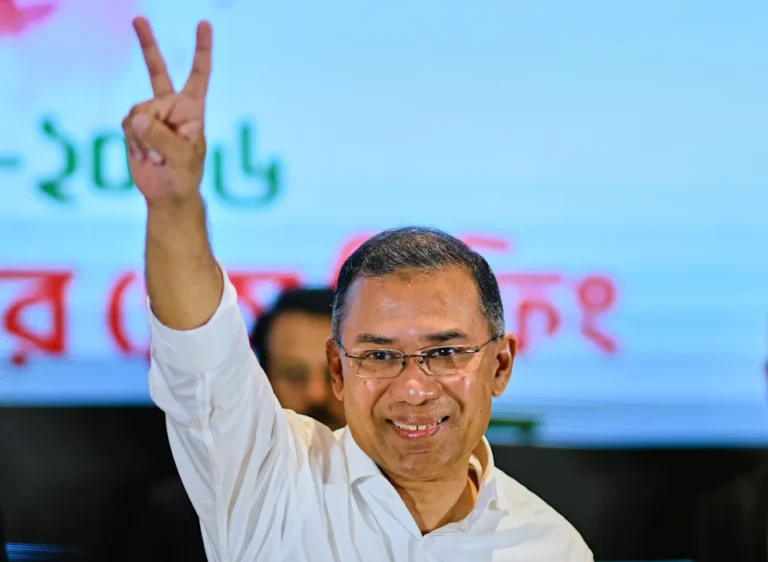
Tarique Rahman emerged Saturday as Bangladesh’s prime minister-in-waiting following his Bangladesh Nationalist Party’s commanding two-thirds parliamentary majority, with the country’s interim administration, regional neighbors, and international observers all moving to formally acknowledge a political transition that ends two decades of BNP exclusion from national power.
In his first public statement since the results were confirmed, Rahman appealed for national unity across political and ideological lines. “Our paths and opinions may differ, but in the interest of the country, we must remain united,” he told reporters at a Dhaka news conference, evoking the reconciliatory tone he had struck throughout a campaign designed to present him as a changed figure from the politically divisive operator associated with BNP’s previous tenure in government between 2001 and 2006.
Invoking the spirit of Martin Luther King Jr. in his address, Rahman declared: “I have a plan for my people and my country,” outlining economic recovery and institutional reform as the twin pillars of his incoming administration.
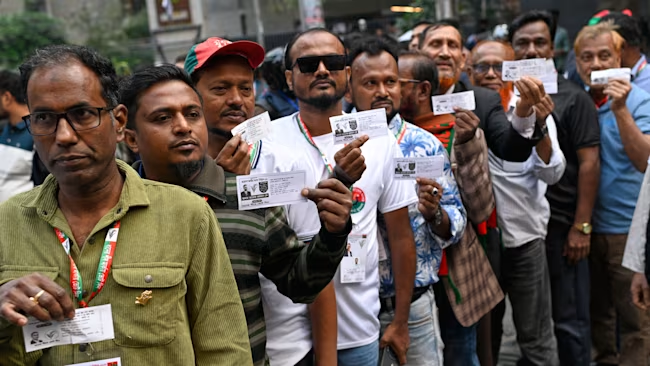
The BNP secured 209 seats in the 300-member Jatiya Sangsad with a 59.44 percent voter turnout, giving Rahman a supermajority that will allow him to legislate without dependence on coalition partners, a significant advantage for a leader inheriting an economy destabilized by more than a year of political upheaval and garment industry disruption following the 2024 uprising.
Read Also: Just In: Tarique Rahman Set To Lead Bangladesh After BNP Win
Interim leader Muhammad Yunus, whose caretaker administration organized the election following Hasina’s ouster, congratulated Rahman on “the landslide victory of his party,” saying the incoming leader “would help guide the country toward stability, inclusiveness, and development.” Yunus prepared to step down and hand over power to the elected government.
Indian Prime Minister Narendra Modi contacted Rahman directly by telephone to offer congratulations, with the BNP formally thanking Modi and pledging constructive bilateral engagement. “We look forward to constructive engagement with India to further strengthen bilateral relations,” the party said in a statement.
On economic priorities, Rahman said he would prioritize job creation, private sector expansion, and foreign investment attraction. BNP’s campaign manifesto had promised financial aid for poor families, a 10-year limit on prime ministerial tenure, measures to boost foreign investment, and anti-corruption policies. He also positioned China as a “development friend,” signaling that the incoming government intends to maintain and potentially deepen the economic partnership that expanded during the interim period as ties with India cooled over the Hasina extradition dispute.
Jamaat-e-Islami chief Shafiqur Rahman, who had initially alleged “inconsistencies and fabrications” in the vote count, ultimately conceded on Saturday and said the party would serve as “a vigilant, principled, and peaceful opposition.” Jamaat and its allies won 68 seats.
The U.S.-based International Republican Institute assessed the election as peacefully and competently administered but cautioned that the broader political environment remained fragile, urging the incoming government to implement reforms quickly to consolidate democratic gains.
Alongside the parliamentary vote, a concurrent national referendum on the 84-point July National Charter passed decisively with a 60.26 percent approval rate. The charter mandates reforms including caretaker government arrangements, a bicameral parliament, enhanced women’s quotas in public life, and strengthened judicial independence. The new assembly has been tasked with implementing the charter’s provisions within 180 days of convening.
Seven women won parliamentary seats in Thursday’s election, six of them representing the BNP. The results came in a poll notably lacking the dominant female political icons who have defined Bangladesh’s recent democratic history, with both Hasina and the late Khaleda Zia absent from the political landscape.
Read Also: Bangladesh Votes In First Post-Hasina Election
Rahman returned to Bangladesh in December 2025 after 17 years of self-imposed exile in London following the death of his mother Khaleda Zia, who founded the BNP alongside his father, former president and independence war hero Ziaur Rahman. Multiple corruption convictions secured against him under Hasina’s government were overturned by courts after Hasina’s ouster.
He has acknowledged past missteps, telling supporters in the campaign’s final days: “If any unintentional mistakes were made while governing the country in the past, I sincerely apologize to the people.”
The size of his mandate removes the immediate legislative obstacles that have hampered previous governments but does not resolve structural challenges including inflation, disrupted garment exports, strained relations with India, and the economic integration of five million first-time voters who drove the 2024 uprising and whose expectations for change remain high.
Whether Rahman’s conciliatory public posture translates into governing practice, and whether the institutional reforms promised during the campaign materialize within the new parliament’s first legislative sessions, will determine the durability of the optimism that accompanied Bangladesh’s first genuinely competitive election in more than a decade.