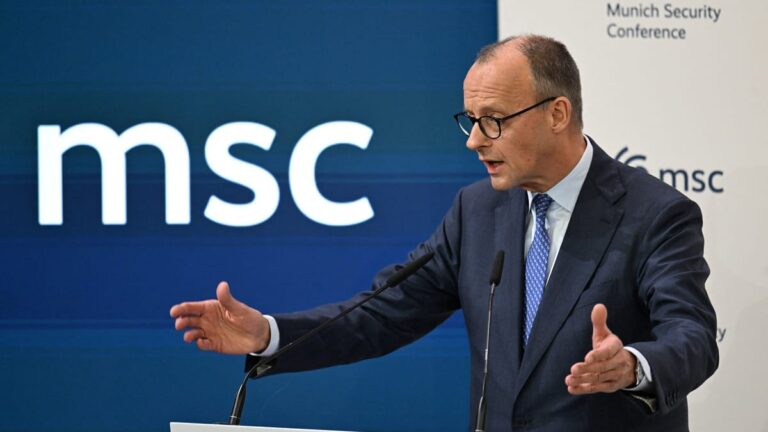
German Chancellor Friedrich Merz opened the Munich Security Conference Friday with one of the starkest assessments of global order delivered from a Western leadership stage in a generation, declaring that the rules-based world order had effectively ceased to exist and that Europe must now accept the reality of a world governed by raw power rather than law.
Speaking to more than 60 heads of state and government gathered at the Hotel Bayerischer Hof in southern Germany, Merz said the conference had long served as a “seismograph” for global politics, but argued that today’s landscape was far more severe than anything encountered in previous decades. Referring to this year’s conference motto, “Under Destruction,” he said the description was grim but still insufficient.
“The international order based on rights and rules no longer exists,” Merz declared, before adding in English that even the United States could not navigate the era of great power rivalry alone. “In the era of great power rivalry, even the United States will not be powerful enough to go it alone,” he said, to loud applause from the audience.
Merz said Europe had returned from what he called “a vacation from history” and now faced a world shaped by Russia’s violent revisionism in Ukraine and China’s ambition to redraw the global order in its own favor through the accumulation of strategic economic dependencies. He acknowledged that Germany’s foreign policy in previous decades had carried what he termed a “normative surplus of best intentions” while lacking the means to enforce any solutions.
The German leader was unflinching about the transatlantic fracture. “A divide has opened up between Europe and the United States,” he told the conference. “The United States’ claim to leadership has been challenged, and possibly lost.”
Read Also: Munich Security Summit Opens Amid Deepest Transatlantic Crisis
Yet Merz did not position the speech as a rupture. Switching between German and English, he appealed directly to Washington. “Let’s repair and revive transatlantic trust,” he said, arguing that Europe needed a new and healthy relationship with America even as it built autonomous capacity.
He drew a line, however, between shared values and shared politics, telling the audience: “The culture war of the MAGA movement is not ours. Freedom of speech ends here with us when that speech goes against human dignity and the constitution. We do not believe in tariffs and protectionism, but in free trade.” The line prompted sustained applause in the auditorium.
Merz challenged Europe’s self-perception on defense, pointing out that Russia’s GDP stands at approximately two trillion euros compared with the European Union’s economy nearly ten times larger, yet Europe is “not ten times as strong as Russia today.” Its military, political, and technological potential, he said, remained critically underutilized. “The most important thing is to turn the switch in our minds now,” he declared.
In the most significant policy disclosure of his speech, Merz confirmed that he had opened confidential talks with French President Emmanuel Macron on creating a joint European nuclear deterrent, a subject that has been debated for years but never formally advanced at the highest governmental level. He provided no further details on the scope or structure of the arrangement under discussion.
Conference chairman Wolfgang Ischinger used his opening remarks to confront the assembled leaders directly, asking: “Does the Trump administration truly believe that it needs allies and partners, and if so” what was it prepared to offer in return. Trump’s name appears in the Munich Security Report 214 times, a metric that captured the degree to which one leader’s decisions have consumed global security planning.
Read Also: Germany Broaden Deportations Of Afghanistan, Syria Nationals
EU foreign policy chief Kaja Kallas warned that the erosion of the post-war order demanded readiness for “a world of wars,” and challenged U.S. Ambassador to the United Nations Mike Waltz during a session on defense spending. “When America goes to wars, then a lot of us go with you, and we lose our people on the way. You also need us,” she told him. Waltz arrived at the conference wearing a cap reading “Make the UN Great Again.”
Macron spoke later Friday, reiterating his call for Europe to become a genuine geopolitical power and warning allies not to cave to Russian demands. “We have to accelerate,” the French president said, describing Ukraine as Europe’s “existential challenge.”
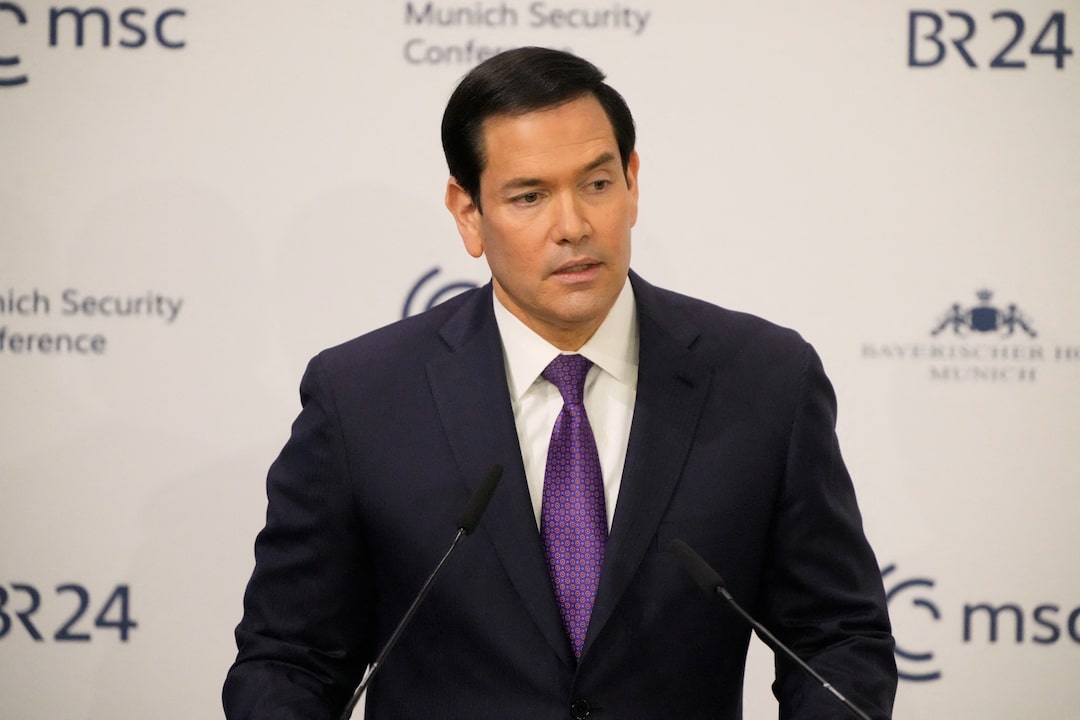
U.S. Secretary of State Marco Rubio, who attended Merz’s speech and is scheduled to address the conference on Saturday, told reporters on his flight to Munich that “the old world is gone” and that the new era in geopolitics would require all nations to reassess their roles. Danish Prime Minister Mette Frederiksen confirmed she had requested a bilateral meeting with Rubio to discuss Washington’s stated ambitions over Greenland. Representative Alexandria Ocasio-Cortez also attended the conference as part of a Democratic congressional delegation, offering what observers described as a competing American political vision to that of the administration.
Eight European leaders were absent from a pre-summit breakfast convened before the formal opening, a small but symbolic indication of the fractured cohesion within a continent being asked to unite faster than its political dynamics permit.
Rubio’s address on Saturday and Zelensky’s formal sessions with both American and European officials will determine whether the conference produces any concrete commitments on Ukraine security guarantees or remains an exercise in diagnosis without prescription.