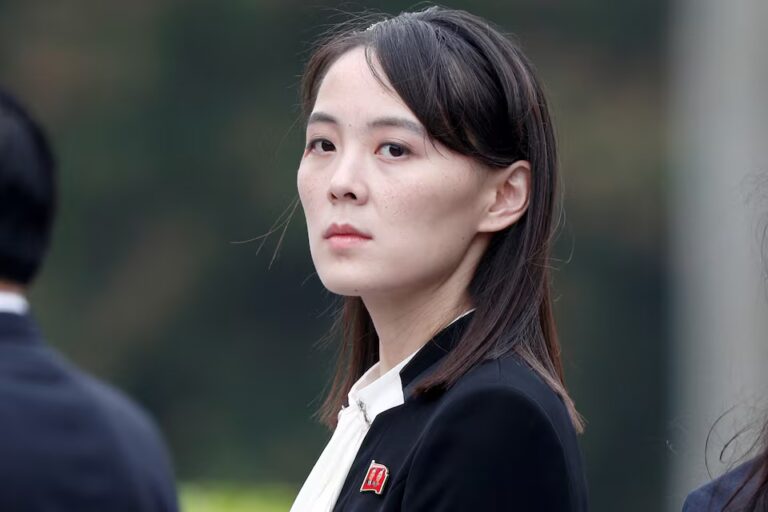
The sister of North Korea‘s leader has acknowledged South Korea’s expression of regret over an alleged drone incursion into its airspace while warning that any repetition would trigger a military response exceeding the scale of the original provocation.
Kim Yo Jong, the influential sister of North Korean leader Kim Jong Un and vice director of the ruling Workers’ Party Central Committee, issued a statement Friday through state media outlet KCNA that offered a partial acceptance of Seoul’s apology while demanding stronger preventive measures and reserving the right to retaliate.
The statement came after South Korean Unification Minister Chung Dong-young expressed “deep regret” over the alleged flights on Tuesday, stressing that Seoul’s liberal government seeks mutual recognition and peaceful coexistence between the two war-divided nations.
Kim described Chung’s remarks as displaying “sensible behavior” but said they fell short of what Pyongyang considers an adequate government response.
“I give advance warning that reoccurrence of such provocation as violating the inalienable sovereignty of the DPRK will surely provoke a terrible response,” Kim said, using the initials of North Korea’s formal name, the Democratic People’s Republic of Korea. “Various counterattack plans are on the table and one of them will be chosen without doubt and it will go beyond proportionality,” she added, without specifying which options were under consideration.
Read Also: North Korea Missile Launch Sparks Regional Condemnation
Kim said Pyongyang did not care whether the drone was operated by an individual or a civilian organization, holding Seoul responsible regardless of the identity of those involved. It was “fortunate,” she said, that a senior South Korean official had chosen to address the matter publicly.
South Korea’s government has denied that its military operated any drones during the periods specified by North Korea. Law enforcement authorities are investigating three civilians suspected of flying drones from border areas into North Korean territory.
South Korean President Lee Jae Myung ordered a swift and thorough joint military and police investigation in January, describing any confirmed civilian drone crossing as a serious crime threatening national security and peace on the Korean Peninsula. His administration has sought to signal to Pyongyang that the incident was not a deliberate government provocation.
Seoul’s Ministry of Unification issued its own statement Friday, saying the drone incident contradicted the government’s principle of peaceful coexistence and pledging to work to prevent any recurrence.
North Korea first raised the drone issue in early January, claiming South Korean drones had entered its airspace twice, once on September 27, 2025, and again on January 4, 2026, alleging both flights were conducted for reconnaissance with the backing of South Korean authorities. Seoul’s defense ministry rejected the claim that either flight involved military assets.
The episode has complicated President Lee’s efforts to revive inter-Korean dialogue, which had stalled under the previous administration. Lee, who leads the liberal Democratic Party of Korea, came to office pledging a conciliatory approach toward Pyongyang and has signaled willingness to engage without preconditions.
Analysts noted that Kim Yo Jong’s statement appeared designed to undermine rather than facilitate Seoul’s overtures. “This is a preemptive move to block South Korea’s conciliatory approach before it gains traction,” said Hong Min, a senior research fellow at the Korea Institute for National Unification. “By framing the issue as a clear-cut airspace violation, North Korea is trying to seize the narrative even before the investigation is concluded.”
Lim Eul-chul, a professor at Kyungnam University’s Institute for Far Eastern Studies, said the drone issue could serve multiple purposes for Pyongyang. “Beyond criticizing South Korea, this messaging helps the North build a justification for future actions and signals dissatisfaction with broader diplomatic trends in the region,” Lim said.
Read Also: China And North Korea Vow To Resist ‘Hegemony,’ Beijing Says
Analysts further noted that North Korea’s drone accusations were likely amplified by its efforts to build anti-South Korea sentiment ahead of a ruling Workers’ Party congress scheduled for late February. North Korea could use the congress to enshrine leader Kim Jong Un’s declaration of a hostile two-state system on the Korean Peninsula in the party constitution, the first such gathering in five years.
The drone dispute is the latest in a series of cross-border provocations and counter-accusations that have kept the peninsula on edge. North Korea has in recent years launched balloons carrying trash and leaflets southward, conducted ballistic missile tests, and deployed troops to support Russia’s military campaign in Ukraine, drawing international condemnation.
Defense Minister Ahn Gyu-back said Seoul was considering proposing a joint inter-Korean investigation through the United Nations Command to establish the facts surrounding the drone crossings. Pyongyang has not responded to that suggestion.
South Korea has no formal diplomatic channel with North Korea at present. All official inter-Korean communication lines were severed by Pyongyang in 2020 and have remained closed despite periodic appeals from Seoul for their restoration.
The investigation into the three civilian suspects was ongoing as of Friday. No charges had been announced, and it remained unclear whether the drones used were commercially available consumer models or more sophisticated aircraft capable of extended cross-border flights.