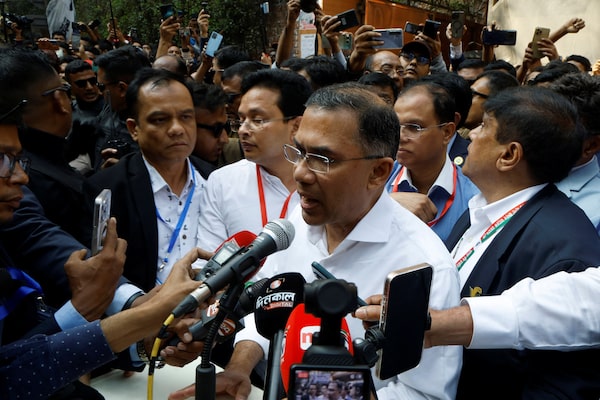
Tarique Rahman emerged as Bangladesh’s prime minister-elect Friday after his Bangladesh Nationalist Party secured an overwhelming parliamentary majority in the country’s first election since student-led protests toppled longtime ruler Sheikh Hasina in 2024, delivering a historic mandate for political renewal in South Asia’s third-largest nation.
The BNP-led coalition won 209 seats in the 300-member Jatiya Sangsad, or House of the Nation, securing a two-thirds supermajority that gives Rahman’s incoming government broad constitutional authority to implement the sweeping reforms his party campaigned on. The result far exceeded the simple majority required to form a government and confirmed pre-election polling that had consistently placed the BNP ahead of all rivals.
Soon after crossing the majority threshold in the overnight count, the BNP thanked the people and called for special prayers on Friday morning. “Despite winning the national parliamentary election by a large margin of votes, no celebratory procession or rally shall be organised by BNP,” the party said in a statement, urging supporters to pray at mosques, temples, churches and pagodas across the country.
Rahman, 60, is the son of former Prime Minister Khaleda Zia and former President Ziaur Rahman, who founded the BNP in 1978. His path to power followed one of the most turbulent political trajectories in modern South Asian history. He spent nearly 17 years in self-imposed exile in London, returning to Bangladesh in December 2024 following the death of his mother and the collapse of the Hasina government that had pursued corruption charges against him.
Read Also: Bangladesh Votes In First Post-Hasina Election
Rahman won from both his contested constituencies, Bogura-6 and Dhaka-17, reinforcing his personal mandate alongside the party’s national sweep. Senior BNP Secretary General Mirza Fakhrul Islam Alamgir also registered a commanding victory, securing a lead of nearly 250,000 votes in the Thakurgaon-1 constituency.
Jamaat-e-Islami chief Shafiqur Rahman all but conceded defeat following the result, stating his party would pursue “positive politics” in opposition. The Islamist alliance had mounted a competitive challenge and finished as the second-largest force in parliament, though its final seat total fell well short of BNP’s commanding margin.
The Awami League, barred from contesting the election, rejected the process outright. In a statement, Hasina’s party described the vote as a “stage-managed farce” and said it would not accept the results. From her exile in India, Hasina separately denounced the election as a “carefully planned farce” conducted without genuine voter participation.
The National Citizen Party, founded by student leaders of the 2024 uprising, secured at least six seats in its first-ever national election, signaling that the generation that drove Hasina from power intends to pursue its political ambitions through electoral channels rather than street protest alone.
Thursday’s vote also included a national referendum on an 84-point governance reform agenda collectively known as the July National Charter. The charter passed with approximately 72.9% approval, providing a constitutional foundation for the institutional overhaul Rahman has pledged to pursue.
The result hands the BNP its strongest democratic mandate in a generation. The party’s previous best performance in a genuinely competitive election was 193 seats in 2001, when it last held power. The Awami League’s 230-seat victories in subsequent cycles were widely regarded as products of boycotts, intimidation, or manipulation rather than free competition. Voter turnout stood at 47.91% based on data from more than 36,000 centers by 2 p.m. on polling day, a figure that reflected both genuine enthusiasm among first-time voters and the absence of the Awami League’s organizational machinery, which had historically driven turnout in areas under its control.
Read Also: Bangladesh On Edge As Tribunal Convicts Ex-PM Hasina
The election was conducted under the interim administration of Nobel laureate Muhammad Yunus, who assumed leadership after Hasina’s departure. His government oversaw the process with support from approximately 900,000 security personnel. Around 500 international observers attended, including delegations from the European Union and the Commonwealth. India’s Ministry of External Affairs said it would await the final certified mandate before offering formal comment, reiterating its support for free, fair, and credible elections.
The interim government is expected to transfer power once a new administration is formally constituted. No specific timeline for that transition has been announced.
The scale of the BNP’s victory carries significant implications beyond domestic politics. Bangladesh’s relationship with India, which maintained close ties with Hasina, has been strained since her departure. Hasina remains in self-imposed exile in India, a situation that has frayed ties between Dhaka and New Delhi and opened opportunities for China to expand its influence in Bangladesh.
Rahman has pledged to restore democratic institutions, revive the rule of law, and stabilize an economy battered by the disruption of the 2024 uprising. Bangladesh is the world’s second-largest garment exporter and a major recipient of remittances from overseas workers, making economic stabilization a primary test for the incoming government.