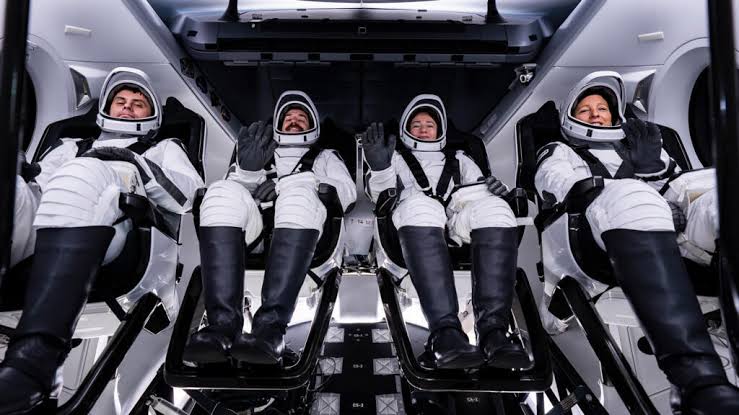
NASA and SpaceX are scheduled to launch four astronauts to the International Space Station (ISS) on Friday, restoring the orbiting laboratory to full staffing following a rare early crew departure.
The mission will include French astronaut Sophie Adenot, who will become only the second Frenchwoman to travel into space.
The launch from Cape Canaveral, Florida, was postponed by two days due to forecasts of high winds and adverse weather along the U.S. East Coast. The crew of four has already boarded the SpaceX Dragon spacecraft atop the Falcon 9 rocket, awaiting final countdown procedures.
The incoming team, designated Crew-12, comprises Americans Jessica Meir and Jack Hathaway, Russian cosmonaut Andrey Fedyaev, and Adenot, who previously served as a helicopter test pilot in the French Air Force and worked at Airbus. Adenot was selected in 2019 as one of five candidates from 22,500 applicants in the European Space Agency’s astronaut recruitment program.
Read Also: Russia Details Plans To Quit International Space Station After 2024
Meir, who has a background in marine biology and research on animals in extreme environments, will serve as mission commander. During the eight-month deployment, the astronauts will conduct a variety of experiments focusing on human physiology in microgravity.
Planned research includes a simulated lunar landing to examine how abrupt changes in gravity affect bodily systems and cognitive performance, ultrasound scans to track blood vessel and circulatory changes, and studies of bacteria linked to pneumonia to support pharmaceutical development.
The flight replaces Crew-11, which returned to Earth in January, a month earlier than scheduled, marking the first medical evacuation in ISS history.
Since that departure, the station has operated with a skeleton crew of three: Russians Sergey Kud-Sverchkov and Sergei Mikayev, and NASA astronaut Chris Williams.
The ISS, continuously inhabited for over 25 years, orbits roughly 250 miles (400 kilometers) above Earth. Measuring about the size of a football field, the laboratory has been central to scientific research in fields ranging from biology to physics. The aging station is planned to be deorbited into a remote area of the Pacific Ocean by 2030.
Adenot’s flight follows a notable path in France’s space program. She will join Claudie Haigneré as the only Frenchwomen to have traveled beyond Earth’s atmosphere. Adenot, who began her career at Airbus and joined the Air Force at 23, became France’s first female helicopter test pilot in 2019.
Read Also: NASA Astronauts Dock At International Space Station
During a recent briefing, she recalled being inspired by Haigneré’s mission, saying, “It was a revelation. At that moment, I told myself: one day, that will be me.”
Crew-12’s mission will also support ongoing international research efforts aboard the ISS. Experiments in microgravity contribute to a deeper understanding of how the human body adapts to space conditions, informing preparations for future long-duration missions to the Moon and Mars. In addition, the team will maintain the station’s operational systems and conduct routine maintenance to ensure continuity of scientific operations.
Weather-related delays have been a recurring challenge for launches from Cape Canaveral, particularly when high winds or storm systems threaten the safety of both crew and spacecraft.
NASA officials emphasized that postponing the launch allows for safe execution of potential emergency procedures during ascent.
Once in orbit, Crew-12 will join the current skeleton team to restore the ISS to full staffing levels. The astronauts’ arrival is expected to provide operational relief, as critical research and station maintenance tasks have been redistributed among the remaining personnel. The station continues to function as a hub for collaborative international research, involving partners from NASA, Roscosmos, ESA, JAXA, and other agencies.
The SpaceX Dragon capsule has a proven track record of ferrying astronauts to and from the station. This mission marks another milestone in the public-private partnership that has transformed access to low Earth orbit over the past decade.
The Falcon 9 rocket, which will carry the crew into space, has completed numerous launches with both cargo and crew, supporting both commercial and government missions.
Following liftoff, the crew is expected to dock with the ISS approximately 24 hours later. Once aboard, the astronauts will settle into a routine combining scientific experimentation, maintenance work, and daily life in microgravity. Their stay is scheduled to last eight months, after which a new crew rotation will be planned.
NASA and SpaceX are providing live coverage of the launch, with updates accessible through official agency channels.
The mission represents a return to full staffing for the ISS after a month of operating at reduced capacity and highlights ongoing international cooperation in human spaceflight.