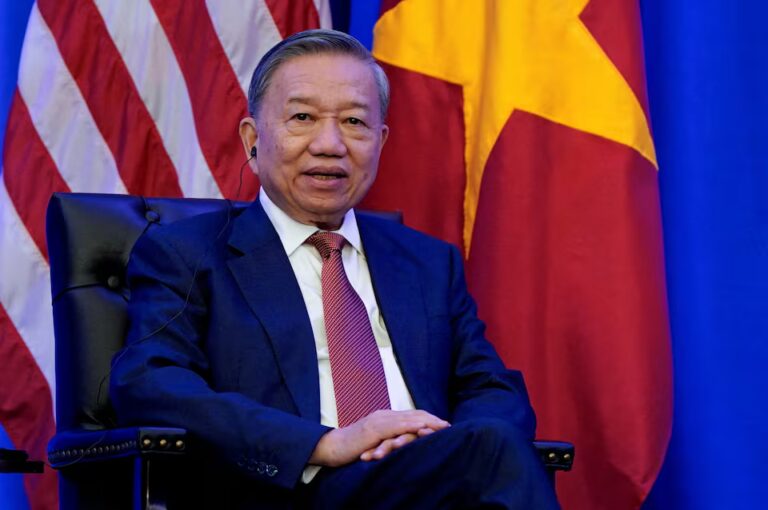
Vietnam’s top leader plans to travel to the United States next week to attend the inaugural gathering of President Donald Trump’s Board of Peace initiative, sources said, in what would be To Lam‘s first American visit since his re-election as general secretary of the ruling Communist Party and comes as Hanoi seeks to resolve a trade dispute that has strained relations between the countries.
Lam will attend the February 19 meeting in Washington convening founding members of the Board of Peace, a Trump-created organization initially pitched as overseeing Gaza Strip reconstruction but whose mandate has since expanded to addressing global conflicts, according to two people briefed on Lam’s travel plans and a document reviewed by Reuters.
Vietnam and the United States are negotiating a trade deal after Washington imposed 20 percent tariffs on Vietnamese goods in August amid accusations that Hanoi facilitates transshipment of Chinese products relabeled as Vietnamese to evade higher U.S. duties on Chinese exportsallegations Vietnam denies while acknowledging it has strengthened customs enforcement to prevent such practices. The two sides held their sixth round of trade negotiations last week but announced no commercial agreement afterward, leaving unresolved the question of whether tariffs will be reduced or lifted in exchange for Vietnamese commitments on monitoring supply chains and preventing Chinese goods from exploiting Vietnam as a backdoor into American markets.
Whether Lam will meet directly with Trump during the Washington visit remains uncertain. Bloomberg reported Wednesday that the Vietnamese leader is seeking trade talks with the president, citing people familiar with the matter, though the White House has not confirmed any bilateral meeting on Trump’s schedule for the week of February 17. Vietnam’s foreign ministry did not respond to requests for comment on the planned visit or potential meetings with U.S. officials beyond the Board of Peace gathering.
The Board of Peace initiative, announced by Trump at the World Economic Forum in Davos last month, has attracted approximately two dozen member countries including the United Arab Emirates, Saudi Arabia, Egypt, Qatar, Turkey, Pakistan, Indonesia, and several European and Latin American nations. Trump chairs the organization, which will hold its first leaders’ meeting at the U.S. Institute of Peace—a federally funded think tank the president has renamed after himself, changing signage and branding to reflect his personal association with the institution originally established by Congress in 1984 as a nonpartisan center for conflict resolution research and training.
Read Also: Trump Board Of Peace Gains Seven Nations Amid Gaza Talks
Vietnam announced January 18 that it had accepted Trump’s invitation to join the Board of Peace as a founding member, saying in its acceptance letter that “Vietnam believes that the establishment of the Board of Peace is a necessary step in implementing the Gaza Strip Peace Plan” adopted under United Nations Security Council Resolution 2803 on November 17, 2025. The resolution welcomed member state participation in reconstruction and peacekeeping efforts following the Israel-Hamas ceasefire that took effect in January after more than 15 months of fighting that devastated Gaza and killed tens of thousands.
In his reply to Trump, Lam proposed that Vietnam and the United States continue cooperating to promote their Comprehensive Strategic Partnership “in a more substantive and effective manner, enhancing cooperation across various fields in line with the needs and priorities of both sides, on the basis of mutual respect, safeguarding each country’s legitimate interests, and contributing positively to regional and global peace, cooperation and development.” The language reflects Vietnam’s careful diplomatic balancing as it seeks to maintain close economic ties with both Washington and Beijing while avoiding alignment with either power in their strategic competition.
The Board of Peace’s mission has evolved since Trump initially described it as focused specifically on Gaza reconstruction, with a draft charter sent to prospective members omitting any mention of Gaza and instead positioning the organization as a vehicle for addressing conflicts worldwide.
Read Also: White House Sets First Board Of Peace Meeting
Jared Kushner, Trump’s son-in-law who serves as an informal Middle East adviser, unveiled an 11-page presentation at Davos outlining plans for rebuilding Gaza with more than 150 skyscrapers lining the Mediterranean coast—a vision critics characterized as ignoring Palestinian displacement, ignoring political realities that would prevent such development, and prioritizing real estate speculation over humanitarian needs.
It is unclear which countries will attend the February 19 meeting and at what level they will be represented, with some member states reportedly planning to send foreign ministers or ambassadors rather than heads of state or government.
A U.S. official told reporters the gathering is intended partly as a fundraiser to support Board of Peace activities, though details about governance structure, budget, and operational plans remain undeveloped and no formal commitments from member countries have been announced beyond signing the charter at Davos.
Vietnam’s participation reflects Hanoi’s pragmatic foreign policy of engaging with multiple partners and international initiatives to maximize diplomatic options while protecting sovereignty and avoiding dependence on any single relationship. Joining the Board of Peace costs Vietnam little politically given the organization’s vague mandate and uncertain future, while demonstrating willingness to cooperate with Trump on an issue he has elevated as a personal priority, potentially creating goodwill that could help resolve the tariff dispute or advance other Vietnamese interests including access to American technology, investment, and security cooperation.