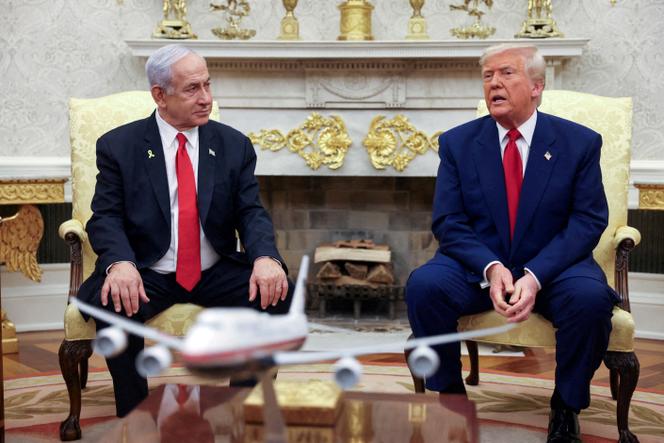
President Donald Trump met Israeli Prime Minister Benjamin Netanyahu at the White House for nearly three hours of closed-door talks focused largely on renewed U.S. negotiations with Iran over its nuclear programme.
In a statement posted after the meeting, Trump said he had made clear to Netanyahu that Washington would pursue further discussions with Tehran “to see whether or not a Deal can be consummated.” If an accord proves possible, he added, “that will be a preference.”
Failing that, Trump wrote, “we will just have to see what the outcome will be,” recalling that after Iran rejected a previous arrangement the United States struck Iranian nuclear facilities in June 2025. The meeting, the seventh between the two leaders since Trump returned to office in 2025, took place without media access.
Netanyahu entered the White House away from reporters, and the press pool was not permitted into the Oval Office, a departure from past visits that typically included public remarks. A photograph released by the Israeli Embassy showed the two men shaking hands. It was not immediately clear why the visit was handled with minimal public visibility.
Read Also: Donald Trump Denies Knowing Binance Founder He Pardoned
Netanyahu’s office said the prime minister underscored “the security needs of the State of Israel in the context of the negotiations.”
Israeli officials have expressed concern that Washington might pursue a narrowly defined nuclear accord that does not address Iran’s ballistic missile programme or Tehran’s support for armed groups including Hamas and Hezbollah.
The U.S. and Iran resumed indirect nuclear talks in Oman on Feb. 6, describing the discussions as constructive and indicating that further meetings would follow. Netanyahu’s Washington visit had originally been scheduled for Feb. 18 but was brought forward as diplomatic contacts intensified.
Speaking to Fox Business in an interview broadcast, Trump said a satisfactory agreement would ensure “no nuclear weapons, no missiles,” though he did not detail how such provisions would be structured.
In a separate interview with Axios, he said he was weighing whether to deploy a second aircraft carrier strike group to the region as part of what he described as a broader U.S. military buildup near Iran. Trump has repeatedly warned that military action remains an option if negotiations collapse.
On Feb. 10 he said that although he believed Iran wanted an agreement, he would do “something very tough” if it refused to reach terms. Tehran has said it would retaliate against any attack, heightening concerns among regional governments about the risk of escalation.
Iranian officials have signalled a willingness to discuss constraints on their nuclear activities in exchange for sanctions relief, but have ruled out linking those talks to missile capabilities. “The Islamic Republic’s missile capabilities are non-negotiable,” Ali Shamkhani, an adviser to Iran’s supreme leader, said on Feb. 10.
Israeli officials have urged caution, arguing that Iran’s commitments should not be accepted without robust verification and broader restrictions.
One person familiar with the discussions said Netanyahu was expected to address the possibility of military coordination should diplomacy fail, though neither government publicly detailed such contingency planning.
Read Also: Donald Trump Expands U.S. Entry Restrictions To 24 Countries
In its statement, Netanyahu’s office said the two leaders agreed to maintain “close coordination and tight contact.” Trump described the meeting as “very good” but indicated that no major decisions were taken.
Beyond Iran, Gaza featured prominently in the talks. Trump has sought to advance a ceasefire arrangement he helped broker and has outlined a 20-point framework aimed at ending the war and reconstructing the Palestinian enclave.
Progress has slowed in recent weeks amid disputes over key elements, including whether Hamas would disarm and how Israeli troop withdrawals would be sequenced. “We discussed the tremendous progress being made in Gaza, and the Region in general,” Trump said after the meeting, without elaborating on specific developments.
Israel and Iran have long viewed each other as principal adversaries, and Israeli leaders have consistently opposed any agreement they believe would leave Tehran with residual nuclear capabilities or enhanced regional influence.
The United States, Israel’s closest ally, has provided military and diplomatic backing to Israel while also pursuing periodic negotiations with Iran aimed at limiting its nuclear programme.
The Oman talks marked the first formal engagement between U.S. and Iranian negotiators since Trump’s return to office. Both sides said last week that discussions had been positive and that additional rounds were expected, though no date has been publicly announced.
Iran maintains that its nuclear activities are for civilian purposes and denies seeking nuclear weapons.
Western governments and Israel have long expressed concern that Tehran’s uranium enrichment and missile development could provide it with the capacity to build a weapon if it chose to do so. For the time being, no timetable has been set for the next round of negotiations, and neither side has released details of the proposals under discussion.