Washington — The U.S. House of Representatives on Wednesday approved the SAVE America Act, a Republican-backed measure that would impose stricter documentation and identification requirements for federal elections, sending the legislation to a politically divided Senate where its prospects remain uncertain.
The bill passed 218 to 213, with Texas Democrat Henry Cuellar joining all House Republicans in support. House Speaker Mike Johnson, a Louisiana Republican, framed the measure as a safeguard against noncitizen voting, citing public polling that indicates broad support for requiring proof of citizenship and photo identification at the polls. “Common-sense legislation to just ensure that American citizens decide American elections — it really is that simple,” Johnson said on Tuesday.
An October 2024 Gallup poll showed 83% of Americans favoring proof of citizenship for first-time voters, alongside a Pew Research Center survey from August 2025 in which 83% supported presenting a government-issued photo ID to vote.
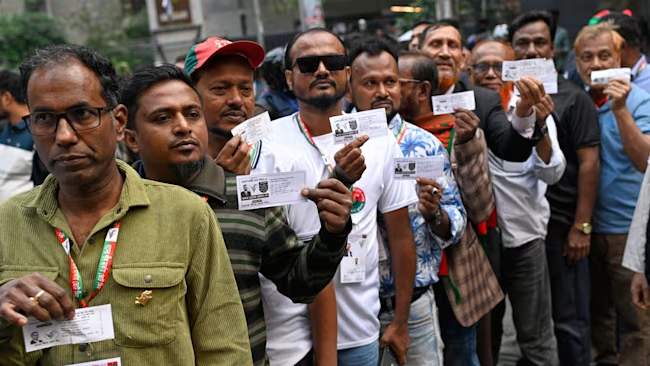
The SAVE America Act would mandate that prospective voters provide documents such as a passport or birth certificate to register for federal elections. It would also introduce photo ID requirements for casting ballots — a long-standing goal of House Republicans.
The legislation represents the latest iteration of an effort first introduced in previous congressional sessions, which has repeatedly passed the House with limited Democratic support.
Read Also: Marcos Impeachment Complaints Dismissed By House Panel
Republicans argue that the bill addresses a legitimate concern over election integrity, though instances of noncitizen voting are exceedingly rare. Johnson and other GOP lawmakers emphasized that the legislation is designed to prevent ineligible voting without affecting eligible citizens.
Democrats and voting rights experts counter that the bill could disenfranchise millions of Americans who lack immediate access to the required documents.
Senate Minority Leader Chuck Schumer, a New York Democrat, warned on the Senate floor Monday that the legislation could impact voters without passports or readily available birth certificates, calling it “extreme.”
House Minority Leader Hakeem Jeffries of New York described the bill as “voter suppression as an electoral strategy” and criticized it as more restrictive than prior versions. “If it squeaks by the House, it’s dead on arrival in the Senate,” Jeffries said.
Former President Donald Trump has publicly endorsed the measure, arguing that voter identification and proof of citizenship are critical for preserving the nation’s electoral system.
Read Also: US House Passes Bill Blocking Presidential Fracking Moratorium
He has also called for restrictions on mail-in voting, with limited exceptions, escalating partisan tensions over voting access.
Republican leaders in the House celebrated the bill’s passage at a Wednesday news conference, accusing Democrats of obstructing what they called a straightforward electoral reform. “This has become a bitter partisan fight and it’s madness to us,” Johnson said. “We’re hoping that some Democrats in the Senate will come to their senses and do the right thing for the people.”
Most legislation requires 60 votes to advance, a threshold Republicans cannot reach without Democratic support.
Senate Majority Leader John Thune, a South Dakota Republican, confirmed ongoing discussions about procedural options, including the possibility of a “talking filibuster” to bypass the 60-vote requirement, though the tactic is considered cumbersome and could allow Democrats to offer unlimited amendments.
Senate Republicans debated the strategy at a conference lunch on Tuesday. Sen. Mike Lee of Utah, a proponent of the talking filibuster, said the presentation was “well-received,” while Sen. Mike Rounds of South Dakota acknowledged its practical challenges but expressed interest in advancing the bill. “Reality is, I’d love to be able to see this particular SAVE Act brought in and voted on, and make our Democrat colleagues vote on the issue,” Rounds said.
Sen. Lisa Murkowski, a Republican from Alaska, has opposed the measure, citing concerns about federal changes to election procedures occurring too close to midterm elections.
“Election Day is fast approaching. Imposing new federal requirements now, when states are deep into their preparations, would negatively impact election integrity by forcing election officials to scramble to adhere to new policies likely without the necessary resources,” she said on X
With one Republican already opposed and at least seven Democratic votes required to meet the 60-vote threshold, the Senate faces significant hurdles.
Thune acknowledged on Tuesday that the chamber was engaged in a “very robust conversation” about the legislative path forward. “How we get to that vote remains to be seen,” he added. Johnson said he met with Thune on Tuesday to discuss the legislation and described the Senate leader as “committed” to considering it. “I don’t tell him how to run the Senate, but I trust that he is committed to it, and they’re trying to figure that out, figure out the right path,” Johnson said Wednesday night.
Earlier versions of the bill passed the House in previous sessions with limited Democratic support, but the 60-vote Senate threshold has repeatedly blocked its advancement. Proponents of the current version are pressing for a vote before the midterm election preparations intensify, while opponents warn that the legislation risks disenfranchising eligible voters without resolving documented instances of noncitizen voting.
As the legislation moves to the Senate, lawmakers and election officials face a compressed timeline to assess potential impacts and procedural options, leaving the bill’s ultimate fate unresolved