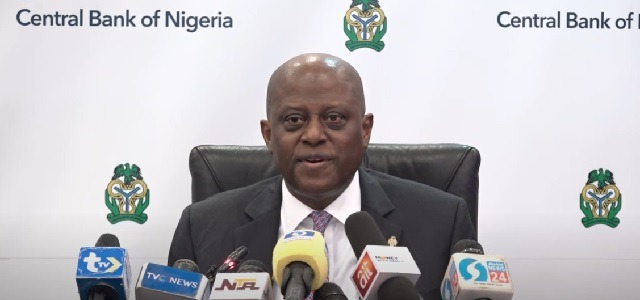
Nigeria’s foreign exchange reserves climbed to $49 billion as of February 5, a sixteenfold increase from the $3 billion inherited by the current Central Bank administration when President Bola Tinubu took office in May 2023, CBN Governor Olayemi Cardoso disclosed Monday at a national economic policy conference in Abuja.
Cardoso told participants at the second edition of the National Economic Council conference that the growth represents a 4.93 percent increase from the last reported figure of $46.7 billion, marking what he described as a fundamental turnaround in Nigeria’s external position after years of chronic foreign exchange shortages and market dysfunction.
“This is obviously a very important statistic,” Cardoso said. “When we took over, the net reserve figure was about $3 billion. As at the end of last year, the net reserve figure had gone up strongly into the 30s. And as I said, as of February 5, 2026, it is $49 billion. We are now net buyers.”
The reserve milestone came alongside other macroeconomic indicators presented by Cardoso, including GDP growth of 3.98 percent, a current account surplus of $3.42 billion recorded in the third quarter of 2025, and a significant moderation in inflation to 15.15 percent. When the current CBN leadership assumed office, inflation had peaked at 34.6 percent while the parallel market premium over the official exchange rate exceeded 16 percent.
Cardoso said the CBN now allows the foreign exchange market to largely determine its own level while intervening periodically to purchase foreign currency. The premium between the official and parallel market rates has collapsed to under two percent, a development he attributed to sustained reform implementation and restored market confidence.
Read Also: Nigeria’s Foreign Reserves Rise To $46.7 Billion — CBN Report
Diaspora remittances emerged as a significant driver of the reserve buildup. Cardoso said the apex bank engaged Nigerians living abroad and simplified the process for sending funds home, producing a measurable increase in inflows that contributed directly to reserve accumulation. “Remittances have made a big difference to how we have grown our reserves. The diaspora comes from every single state represented here. We have engaged with them and made it easier for them to remit money back to Nigeria,” he said.
The governor noted a tangible improvement in the naira’s regional standing, contrasting current conditions with the currency’s previous rejection across parts of West Africa.
“In those days, if you went around West Africa and gave them naira, nobody wanted to touch it. That has all gone now. There is predictability, and you can plan,” Cardoso said.
He also addressed Nigerians accumulating foreign currency beyond genuine transactional needs, warning that continued appreciation of the naira was eroding the value of such holdings. “Those holding unnecessary foreign exchange reserves are losing money every day,” he said.
Past CBN interventions totaling 10.93 trillion naira had provided temporary economic relief but created structural distortions, including excess liquidity and higher costs for managing that liquidity within the financial system. Cardoso acknowledged these legacies while arguing that reform-driven discipline had begun addressing the underlying imbalances.
Despite the positive indicators, the governor cautioned that Nigeria was not yet in a position to ease vigilance. He said large volumes of money circulating within the financial system must be carefully managed to prevent renewed inflationary pressures, warning that election-cycle spending had the potential to inject significant additional liquidity ahead of the 2027 general elections.
“We are not yet out of the woods. The election cycle is another risk, as election periods typically involve increased liquidity injections. This must be carefully monitored to ensure it does not undermine the bold reforms that have restored stability,” Cardoso said.
He also referenced global trade tensions as an external risk requiring attention, acknowledging that participants at the NEC conference were already aware of recent international developments.
Read Also: CBN Penalizes Banks ₦3m For ‘Mandatory Verification’ Failure
The CBN’s 2026–2030 roadmap, which Cardoso outlined at the conference, prioritizes price stability, foreign exchange market normalization, stronger external reserves, banking sector recapitalization, and financial system resilience, all positioned as supporting conditions for Nigeria’s ambition to build a one-trillion-dollar economy. By 2030, the bank aims to achieve single-digit inflation and a more inclusive, globally competitive financial system.
On the banking sector, Cardoso said ongoing recapitalization requirements were strengthening institutions and positioning them to support long-term economic transformation. He said investors were earning positive real returns and equity markets were recovering on the back of improved earnings and macroeconomic stability.
Minister of Budget and Economic Planning Senator Abubakar Bagudu cited external validation of Nigeria’s reform trajectory, saying a World Bank delegation that visited the previous week described Nigeria’s reforms as a global reference. An IMF report covering the same period also listed Nigeria among the ten countries contributing most to global economic growth, he said.
Separately, the CBN and the Nigerian Communications Commission jointly released an exposure draft framework Monday proposing new consumer protections for failed airtime and data transactions. The proposals include automatic reversals of failed transactions, real-time tracking mechanisms, and mandatory suspension of airtime and data sales during network downtimes. The framework would apply to banks, mobile network operators, merchants, and NCC-licensed entities, requiring prompt refunds to customers whose accounts are debited without service delivery.