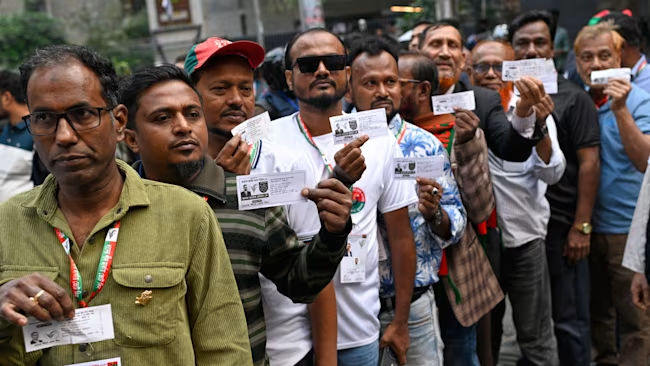
Bangladesh went to the polls Thursday in its first parliamentary election since student-led protests swept longtime Prime Minister Sheikh Hasina from power in 2024, with more than 127 million registered voters choosing between a nationalist party poised to end years of authoritarian rule and an Islamist-led coalition challenging for a historic breakthrough.
Polling opened at 7:30 a.m. local time and closed at 4:30 p.m., with votes cast across 42,761 polling centers in 64 districts for 300 parliamentary constituencies. Voter turnout stood at 47.91 percent as of 2 p.m., based on data collected from over 36,000 centers, according to the Election Commission.
The contest is effectively a two-way race between the Bangladesh Nationalist Party, led by Tarique Rahman, and an 11-party alliance anchored by the Islamist Jamaat-e-Islami. Hasina’s Awami League, which won the previous four elections, has been barred from participating.
Clashes erupted between BNP and Jamaat supporters in Dhaka’s Mirpur-10 constituency, leaving several people injured. Three people, including a child, were injured in a crude bomb explosion at a polling center in Gopalganj around 9 a.m., police said. A BNP leader, Mohibuzzaman Kachi, died at a polling station in Khulna after an alleged confrontation with Jamaat supporters outside the center. Jamaat denied responsibility, with one party official saying a BNP member had fallen ill. Police were investigating the incident.
Despite isolated disturbances, Chief Election Commissioner AMM Nasir Uddin described the overall voting process as peaceful and festive, comparing the atmosphere to the national celebration of Eid. Interim government leader Muhammad Yunus urged citizens to participate and exercise their votes consciously.
“All of you should exercise your respective voting rights consciously,” Yunus said. “The countrymen, through this national election, will elect people’s representatives, who are competent, responsible and respectful of the people’s aspirations.”
Read Also: Khaleda Zia Death Marks End Of An Era In Bangladesh
The election represents a defining moment for a country whose democratic institutions were severely eroded under Hasina’s 15-year grip on power. The 77-year-old former leader fled to India in August 2024 as mass protests, driven largely by students and young people, overwhelmed her government’s security crackdown. The UN human rights office estimates approximately 1,400 people were killed during the unrest.
A Dhaka court sentenced Hasina to death in November for her role in the violence. She has denied all charges. Bangladesh has formally demanded her extradition from India, which has indicated cooperation while urging protection of minority communities in Bangladesh.
Tarique Rahman, 58, returned to Bangladesh in December after 17 years in self-imposed exile in London, following the death of his mother, former Prime Minister Khaleda Zia, in December 2025. He cast his ballot Thursday morning at a polling center in Dhaka’s Gulshan district and told journalists his party would accept the results if the election was conducted fairly. “We have evidence that some attempts to mislead voters have been observed,” he said, referencing alleged irregularities at some polling stations, while maintaining overall confidence in the process.
Jamaat chief Shafiqur Rahman also voted Thursday and expressed cautious optimism. “It is a turning point. People demand change. They desire change. We also desire the change,” he said after casting his ballot.
Pre-election surveys put BNP support at 33 percent and Jamaat closely behind at 29 percent, according to polling by the U.S.-based International Republican Institute published in December 2025. Constituency-level dynamics, however, could produce results that diverge significantly from national vote share figures. The rise of Jamaat has generated considerable unease among women’s rights advocates and religious minority communities. The conservative Islamist party was banned under Hasina but had its registration restored by the Supreme Court in June 2025. In a notable gesture toward minority voters, Jamaat fielded a Hindu candidate, Krishna Nandi, from Khulna for the first time in its history.
Read Also: Bangladesh Protests After Youth Leader Killing Ahead Of Vote
Nearly 56 million of the 127 million registered voters are aged between 18 and 37, constituting about 44 percent of the electorate, many of them the same generation that drove the 2024 uprising. Five million are first-time voters.
“I think it is a very crucial election because this is the first time we can show our opinion with freedom,” said 28-year-old voter Ikram ul Haque in Dhaka. “We are celebrating the election. It is like a festival here.”
For the first time, postal voting was facilitated, benefiting approximately 15 million overseas workers whose remittances form a vital part of Bangladesh’s economy.
Around 500 international observers and journalists were accredited to monitor proceedings, including delegations from the European Union and the Commonwealth. A constitutional referendum on the so-called July Charter is being held alongside the parliamentary vote, adding complexity to the ballot count.
Election officials indicated that unofficial results may not emerge until early Friday morning, given the dual nature of the ballot. Results are expected to be formally announced on Friday, February 13.
Bangladesh’s political history since independence from Pakistan in 1971 has been shaped by cycles of military intervention, dynastic competition, and electoral manipulation. The prospect of a genuinely contested vote, with a credible transfer of power, has drawn attention across South Asia and beyond.
India, which maintained close ties with Hasina, is closely monitoring developments. Both BNP and Jamaat have said they seek friendly relations with New Delhi while insisting on mutual respect, signaling a recalibration rather than a rupture in bilateral ties.