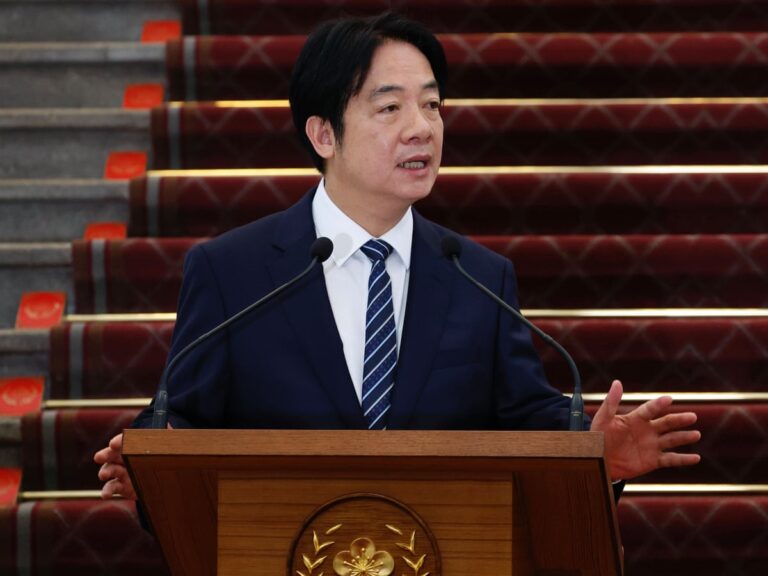
Taiwan’s president urged the opposition-controlled parliament Wednesday to stop blocking his $40 billion special defense budget, warning that failure to strengthen military capabilities amid rising Chinese threats could send a dangerous signal to the international community about the island’s resolve to defend itself.
President Lai Ching-te, speaking to reporters at the presidential office, said external threats continue escalating and force-building becomes ever more urgent, yet lawmakers persist in obstructing defense improvements. He emphasized that while political parties may compete and policies require full communication so the public can choose, national defense touches sovereignty, security, and survival and should unite rather than divide.
“I want to emphasise: political parties may compete, and policies may be fully communicated so that the public can choose,” Lai said. “But national defence, so closely tied to national security, sovereignty, and our very survival, should be an area where we unite and present a common front to the outside.”
Opposition lawmakers have blocked the special defense budget at least 10 times since December, stalling Lai’s proposal to allocate roughly $40 billion over eight years toward new missile defenses, long-range precision weapons, unmanned systems, and the T-Dome integrated air defense system designed to protect against Chinese missiles, rockets, drones and combat aircraft. The main opposition Kuomintang, whose vice chairman visited Beijing last week to meet Chinese Communist Party officials, says it supports defense spending but will not sign “blank cheques” and has a right to fully scrutinize the legislation before approval.
Fu Kun-chi, caucus leader of the KMT, said when his party first blocked the bill in December that Lai was asking lawmakers “for a blanket authorization without any knowledge of the situation,” an accusation the president flatly rejected Wednesday. “I have never asked lawmakers to pass the spending unconditionally,” Lai said, reiterating that his government was happy to provide detailed explanations on its plans and had done so repeatedly during committee hearings and public presentations.
Read Also: China Vows To Crush Taiwan Separatists, Back Reunification
The KMT countered that explanations provided lacked sufficient detail about procurement timelines, cost breakdowns for specific systems, and safeguards against waste or corruption in contracts worth billions of dollars. The party advanced its own proposal funding only certain U.S. arms purchases rather than the entire package Lai submitted, cutting the eight-year spending plan by nearly 70 percent in a move that alarmed the Defense Ministry and prompted dismay in Washington as China ramps up military activities around the self-ruled island.
U.S. Senator Roger Wicker, chairman of the Armed Services Committee and one of Taiwan’s strongest advocates in Congress, said Monday he was “disappointed” the opposition slashed Lai’s budget “so dramatically” and urged parliament to reconsider. “The original proposal funded urgently needed weapons systems,” Wicker wrote on social media. “Taiwan’s parliament should reconsider, especially with rising Chinese threats.” The American Institute in Taiwan, Washington’s de facto embassy, has publicly backed the full budget, with director Raymond Greene saying last month that Taiwan’s service members need tools to accomplish their mission and that Lai’s commitment to increasing defense spending to 5 percent of GDP by 2030 is “so critical” given the threat environment.
Lai proposed the special budget in late November after President Donald Trump demanded Taiwan raise defense spending dramatically, at one point suggesting 10 percent of GDP, a proportion well above what the United States or any major ally spends.
Taiwan currently allocates 3.3 percent of GDP to defense in its 2026 budget, having increased from 2.4 percent the previous year in response to American pressure and deteriorating security conditions as China stages near-daily military exercises involving warplanes, navy ships, and drones around the island.
The $40 billion represents what Defense Minister Wellington Koo described as an upper limit for special procurement spanning 2026 to 2033, funding precision-strike missiles, joint development and procurement between Taiwan and the United States of advanced systems, expansion of asymmetric warfare capabilities leveraging Taiwan’s geographic and technological advantages, and construction of the Taiwan Dome, a multilayered integrated defense network similar to Israel’s Iron Dome but adapted for the specific threats Chinese forces would employ in any attack across the 100-mile Taiwan Strait.
Read Also: Xi-Trump Phone Call About Taiwan Raises Tensions
Lai said Wednesday his administration wants peace but Taiwan cannot harbor illusions about China’s intentions. “Taiwan’s strengthening of national defence is not to invade any country,” he said. “We are simply safeguarding the way of life we are accustomed to.”
China views Taiwan as its own territory despite objections from Taipei’s democratically elected government and the island’s 23 million people, the vast majority of whom reject unification under Beijing’s authoritarian system. President Xi Jinping has refused to renounce force as a means to achieve what China calls “reunification” and instructed his military to be ready for operations to seize Taiwan, though U.S. intelligence assessments differ on timelines and whether Xi has issued specific deadlines for capability development versus actual invasion orders.
Chinese military activities around Taiwan have intensified dramatically since Lai took office in May 2024. Beijing refuses to speak with him, calling him a “separatist” because his Democratic Progressive Party advocates Taiwan’s distinct identity and rejects China’s claim of sovereignty. Lai says only Taiwan’s people can decide their future and has offered to talk with Chinese leaders without preconditions, proposals Beijing ignores while staging increasingly aggressive exercises that practice blockades, amphibious assaults, and seizure of offshore islands.
The legislative deadlock over defense spending comes as Lai’s DPP lost its parliamentary majority in 2024 elections, leaving the opposition KMT and smaller Taiwan People’s Party with combined control that enables them to block executive branch initiatives requiring legislative approval. The KMT blames Lai for the impasse, saying he has failed to adequately explain spending plans or address legitimate oversight concerns and instead resorts to accusing opponents of undermining national security for political advantage.