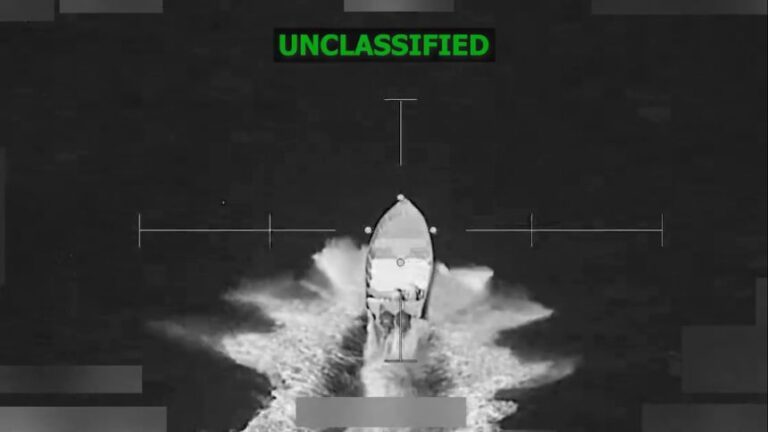
The United States military carried out its 39th lethal strike on a vessel it said was engaged in illicit narcotics trafficking in the eastern Pacific Ocean on Monday, killing two people and leaving one survivor who has become the focus of an ongoing search-and-rescue effort.
The operation, conducted by the U.S. Southern Command (SOUTHCOM), is the latest in a controversial maritime campaign launched in late 2025 and has drawn scrutiny from lawmakers, legal experts and rights groups.
SOUTHCOM said in a brief post on X, the social media platform formerly known as Twitter, that the vessel targeted on Feb. 9 was “operated by Designated Terrorist Organizations” and was “engaged in narco-trafficking operations.” The statement did not specify the name of any group alleged to be operating the boat nor provide independent verification of drug cargo aboard the vessel.
Two individuals on board were killed during the strike, while a third person survived the engagement. The U.S. Coast Guard was notified immediately afterward to initiate search-and-rescue efforts for the survivor. The Maritime Rescue Coordination Center in Ecuador is reportedly coordinating those efforts, with U.S. assistance, according to a Coast Guard spokesperson.
The incident marks one of a series of U.S. military strikes targeting small vessels that Washington says are moving narcotics along established smuggling routes in the Caribbean Sea and Eastern Pacific. Since the campaign began in September 2025, officials have said the strikes have killed around 130 people; U.S. forces have acknowledged survivors in at least five previous engagements.
Read Also: United States ‘Listeria’ Outbreak: 6 Dead, 27 Ill from Pasta
In several earlier cases, U.S. search-and-rescue operations were launched for people who survived initial strikes. In at least one incident last October, two individuals picked up by a U.S. Navy helicopter were repatriated to their home countries of Ecuador and Colombia. However, other rescue efforts were called off, sometimes after search teams failed to locate survivors.
The military’s handling of survivors has become one of the most controversial aspects of the campaign. During the first strike of the series on Sept. 2, 2025, two people initially survived a U.S. attack but were killed in a subsequent engagement. That follow-on strike drew accusations that it may have violated international humanitarian law, with critics saying it could amount to a war crime. Democratic lawmakers who viewed video footage of the incident were sharply critical. The Pentagon and some Republican members of Congress have defended the action, saying the survivors might still have posed a threat.
At the heart of the controversy is the Trump administration’s classification of the campaign as necessary to interrupt drug trafficking and protect U.S. citizens. President Donald Trump and his defense officials have described those targeted as “narco-terrorists” and have cited intelligence assessments that the vessels were transporting illicit narcotics destined for U.S. markets. However, officials have provided few details publicly about the evidence linking individual boats to cartel networks or terrorism designations.
The campaign operates under the auspices of Joint Task Force Southern Spear, a U.S. military initiative launched to expand strikes from the Caribbean into the eastern Pacific, and reflects a broader shift toward direct military action against smuggling routes at sea. SOUTHCOM, responsible for U.S. military operations in Central and South America and the Caribbean, has posted images and brief statements about the operations on social media but has offered limited on-the-record briefings.
Read Also: United States Automatic Immigrants Work Permit Extension Ends
In Congress, opposition to the strikes has been strongest among Democratic lawmakers. Critics argue the administration has failed to obtain explicit authorization from Congress for the military actions, raising constitutional questions about the scope of executive war powers. Several Democratic efforts to restrict or halt the boat strikes through legislation have been unsuccessful in both the House and Senate.
Rights groups have also challenged the legal basis for the campaign. The American Civil Liberties Union and the Center for Constitutional Rights have filed Freedom of Information Act requests seeking internal legal memos that underlie the administration’s authority to carry out lethal strikes in international waters during peacetime. These organizations contend that the legal justification, if any, should be transparent and subject to public scrutiny.
The legal framework cited by the administration draws parallels with U.S. counter-terrorism operations, an approach that has alarmed some international law experts. They argue that using military force against drug trafficking outside declared war zones raises complex questions about sovereignty, use of force, and international maritime law. Supporters in Congress and the Pentagon counter that drug cartels’ designation as terrorist organizations justifies military action against their operations, although public evidence linking specific vessels to designated groups has not been made available.
Human rights advocates, legal scholars and some international officials have called for greater transparency, independent verification of evidence, and clear rules of engagement to govern these maritime strikes. They argue that, without such safeguards, the risk of civilian casualties and diplomatic fallout could undermine broader efforts to combat drug trafficking and organized crime.