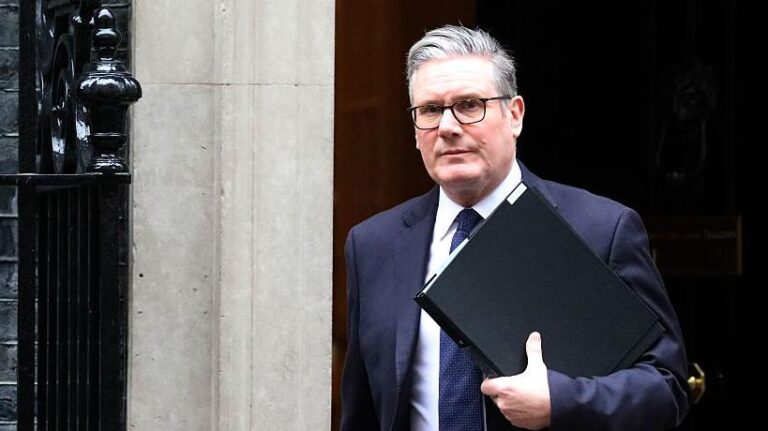
UK Prime Minister Keir Starmer rejected calls to resign on Monday, saying he would remain in office despite mounting political pressure over his government’s handling of the appointment of Peter Mandelson as Britain’s ambassador to the United States and the resulting fallout linked to the Jeffrey Epstein scandal.
Speaking to Labour lawmakers at a closed meeting in Westminster, Starmer said he would not abandon the mandate he received to lead the country. According to people present, he struck a defiant tone, telling MPs that after years seeking power he would not “walk away” from his responsibilities. The remarks came as senior figures within his party moved to contain what officials described as the most serious crisis of his 19-month premiership.
The immediate challenge intensified earlier in the day when Anas Sarwar, the leader of Scottish Labour and a close ally of Starmer during his rise to the party leadership, publicly called for the prime minister to step aside. Sarwar said Starmer had exercised poor judgment by approving Mandelson’s appointment to Washington despite being aware of Mandelson’s past associations with Epstein, the late financier and convicted sex offender.
“The distraction needs to end, and the leadership in Downing Street has to change,” Sarwar said at a press conference in Glasgow. His intervention marked the first time a senior Labour leader had directly urged Starmer to resign, breaking a public show of unity that party officials had sought to maintain.
Within hours, senior members of the cabinet moved to shore up Starmer’s position after several days of silence that had fuelled speculation about his authority. Deputy Prime Minister David Lammy, Foreign Secretary Yvette Cooper and Chancellor of the Exchequer Rachel Reeves all issued statements expressing confidence in Starmer’s leadership. Angela Rayner, a prominent figure on the party’s left, and Home Secretary Shabana Mahmood, both viewed by some lawmakers as potential future leadership contenders, also said they fully supported the prime minister.
Read Also: Kemi Badenoch Mocked In UK Parliament Over ‘Britain’ Blunder
The controversy centres on the decision to appoint Mandelson as ambassador to Washington, a role that requires extensive security and ethical vetting. Mandelson, a veteran Labour figure and former European trade commissioner, has acknowledged knowing Epstein but has denied any wrongdoing. Starmer has said Mandelson misled officials about the depth of those ties during the vetting process, an allegation Mandelson has disputed.
British police have confirmed they are searching properties connected to Mandelson as part of an inquiry into matters linked to Epstein, though they have not said whether Mandelson is a suspect. No charges have been brought, and authorities have stressed that the investigation remains ongoing.
Starmer, a former human rights lawyer who served as director of public prosecutions for England and Wales, has apologised publicly to Epstein’s victims for what he described as failures in judgment surrounding the appointment. His office has said the government will publish tens of thousands of emails, messages and internal documents related to Mandelson’s selection, a disclosure expected to place further scrutiny on Downing Street and senior ministers involved in the process.
The political damage has been compounded by a series of senior staff departures. On Monday, Starmer’s communications chief, Tim Allan, resigned just months after taking up the post, becoming the second top aide to quit in as many days. On Sunday, Morgan McSweeney, the prime minister’s chief of staff, stepped down after acknowledging that he had advised Starmer to proceed with the Mandelson appointment.
Read Also: Britain & Nigeria’s Conspiracy To Silence Kanu
McSweeney had been widely regarded as Starmer’s closest adviser and a central figure in reshaping Labour after Starmer succeeded Jeremy Corbyn as party leader in 2020. His exit removes a key strategist at a moment when the government is struggling to regain control of its narrative. Starmer has cycled through several communications chiefs since taking office, and repeated staff changes, along with policy reversals and tactical missteps, have contributed to declining approval ratings.
Opposition parties have seized on the turmoil. Conservative leader Kemi Badenoch said in a BBC radio interview that Starmer’s position had become “untenable”. Nigel Farage, leader of the hard-right Reform UK party, said the prime minister’s time in office was “drawing to the close”. Recent opinion polls have shown Labour trailing Reform UK by double-digit margins, driven in part by voter anger over immigration and trust in political institutions.
Within Labour’s parliamentary ranks, discontent has been most pronounced among lawmakers on the party’s left, many of whom never fully embraced Starmer’s centrist leadership. Several backbench MPs have suggested privately and publicly that the prime minister should follow McSweeney out of office. However, no single successor has emerged, and Labour’s internal rules set a high threshold for launching a formal leadership challenge.
Despite the immediate crisis, there is no formal mechanism forcing Starmer from office, and the next general election is not due until 2029. For now, his survival appears to depend on maintaining cabinet unity and limiting further damaging revelations from the document release tied to the Mandelson appointment.