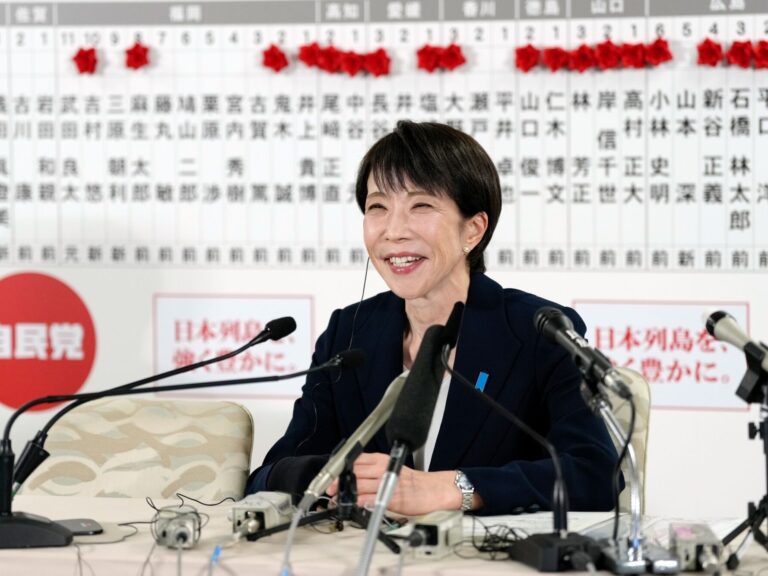
Japan’s ruling coalition secured a commanding parliamentary majority Sunday, handing Prime Minister Sanae Takaichi a historic mandate to pursue tax cuts that have unsettled investors and defense spending increases aimed at countering China’s regional influence.
Takaichi’s Liberal Democratic Party captured 316 of 465 seats in the lower house, the party’s strongest performance on record. Combined with its coalition partner, the Japan Innovation Party known as Ishin, the government now controls 352 seats, a two-thirds supermajority that allows it to override the upper chamber, where it lacks similar dominance. The result grants Takaichi, Japan’s first female prime minister, substantial legislative freedom as she pushes an agenda that includes slashing the consumption tax and expanding military capabilities. The 64-year-old conservative, who has cited former British Prime Minister Margaret Thatcher as an inspiration, called the rare winter election to capitalize on approval ratings that had climbed since she assumed leadership of the long-governing LDP late last year.
“This election involved major policy shifts, particularly a major shift in economic and fiscal policy, as well as strengthening security policy,” Takaichi said in a televised interview as vote tallies emerged. “These are policies that have drawn a great deal of opposition. If we have received the public’s support, then we truly must tackle these issues with all our strength.”
U.S. President Donald Trump congratulated Takaichi on social media, wishing her “great success in passing your Conservative, Peace Through Strength agenda.” Trump, who is scheduled to host Takaichi at the White House next month, praised her decision to call early elections. “Sanae’s bold and wise decision to call for an election paid off big time,” he wrote.
Takaichi’s rise has reinvigorated a party that had stumbled badly in recent elections. The LDP, which has governed Japan for nearly all of its postwar history, lost control of both legislative chambers over a 15-month span under her predecessor, Shigeru Ishiba. She reversed that trajectory by appealing directly to younger voters through a plain-spoken, industrious image that contrasts with the more rigid political style traditionally associated with Japanese leadership. Her popularity has spawned what local media have termed “sanakatsu,” loosely translated as “Sanae-mania.” Items associated with her public persona, including her handbag and the pink pen she uses to take notes during parliamentary sessions, have become sought-after merchandise.
Read Also: Japan Early Election Talk Grows Under PM Takaichi
Sunday’s victory positions Takaichi to accelerate plans for a consumption tax reduction, a centerpiece pledge that has drawn skepticism from economists and market analysts. She reiterated her commitment to the tax cut while emphasizing fiscal sustainability, though she offered no detailed framework for offsetting the revenue loss. “Her plans for the cut in the consumption tax leave open big question marks about funding and how she’s going to go about making the arithmetic add up,” said Chris Scicluna, head of research at Daiwa Capital Markets Europe in London.
Yoshinobu Tsutsui, head of Japan’s leading business federation Keidanren, welcomed the outcome as restoring political stability. “Japan’s economy is now at a critical juncture for achieving sustainable and strong growth,” he said in a statement.
While Takaichi’s domestic agenda has energized supporters, her foreign policy stance, oarticularly toward China, has generated friction. Weeks after taking office, she outlined scenarios under which Tokyo might respond to a Chinese attack on Taiwan, the self-governed island Beijing claims as its own. The remarks triggered the most significant diplomatic dispute between Tokyo and Beijing in more than a decade. China retaliated with measures that included advising its citizens against travel to Japan, a move that carries economic implications given the importance of Chinese tourism to Japanese retail and hospitality sectors. Beijing has portrayed Takaichi as an advocate for remilitarization, a characterization her government rejects.
Taiwan President Lai Ching-te was among the first foreign leaders to offer congratulations, expressing hope that her victory would “bring a more prosperous and secure future for Japan and its partners in the region.” The gesture underscored shared concerns about Chinese assertiveness and aligned security interests between Taipei and Tokyo, despite the absence of formal diplomatic relations.
Read Also: Sanae Takaichi Faces Criticism Over Trump Diplomacy
Defense Minister Shinjiro Koizumi said Sunday evening that Japan would pursue both strengthened defense capabilities and continued dialogue with Beijing. His comments reflected the balancing act Takaichi faces as she seeks to bolster military readiness without completely severing channels of communication with China, Japan’s largest trading partner.
David Boling, principal at the Asia Group, a firm advising clients on geopolitical risk, said Beijing would view the election outcome with concern. “Beijing will not welcome Takaichi’s victory,” he said. “China now faces the reality that she is firmly in place—and that its efforts to isolate her completely failed.”
The supermajority gives Takaichi rare legislative latitude, enabling her to advance bills even if they meet resistance in the upper house.
Financial markets have reacted warily to her proposals, with analysts questioning whether consumption tax reductions can coexist with fiscal discipline. Takaichi has not detailed which expenditures might be reduced or which revenue sources might compensate for lower tax intake. The lack of specificity has fueled unease among institutional investors and credit rating agencies. On defense, Takaichi has signaled willingness to exceed informal spending caps that have traditionally limited military budgets to around one percent of gross domestic product. Japan has already committed to doubling defense outlays over the next several years, a shift prompted by North Korean missile tests, Chinese naval activity near Japanese waters, and Russia’s war in Ukraine.
The election drew significant turnout despite winter conditions that complicated voting in northern regions. Snowstorms in Hokkaido and parts of Honshu prompted extended polling hours in some districts, though officials reported no major disruptions. Final tallies confirmed the LDP’s dominance across urban and rural constituencies, with the party gaining ground even in areas where opposition parties had previously held seats.
Opposition groups, weakened by internal divisions and lackluster voter enthusiasm, failed to present a unified alternative. The Constitutional Democratic Party, Japan’s largest opposition force, retained fewer seats than projected, while smaller parties struggled to gain traction. Analysts said the fragmented opposition enabled the LDP’s sweeping victory, even as polling suggested mixed public sentiment on specific policies.
Takaichi is expected to form her cabinet in coming days, with speculation focusing on whether she will retain key ministers or introduce new faces to signal fresh direction. Her choices will offer insight into priorities and whether she intends to consolidate power or accommodate rival factions within the LDP. The prime minister’s office has not announced a legislative calendar, but observers anticipate early action on tax policy and defense appropriations. Takaichi’s ability to deliver on campaign promises while maintaining coalition cohesion and managing international relations will determine whether her mandate translates into durable political authority.