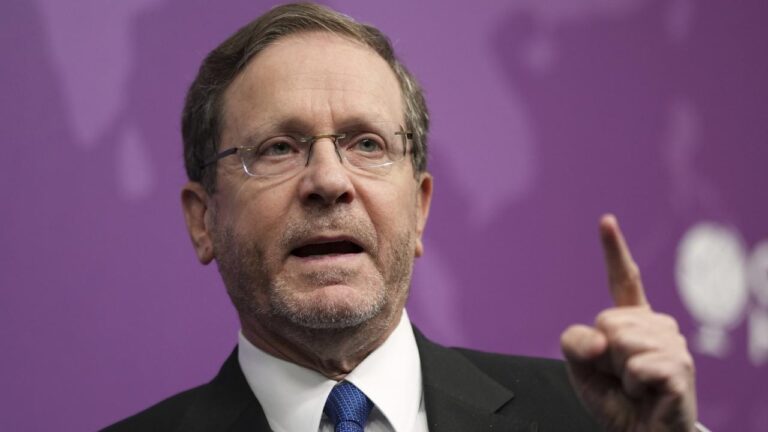
Israeli President Isaac Herzog arrived in Australia on Monday for a visit designed to show support for the country’s Jewish community following a December shooting that killed 15 people during a Hanukkah celebration, though the trip has sparked legal challenges and planned protests across multiple cities.
Herzog traveled to Sydney at the invitation of Prime Minister Anthony Albanese, extended after the December 14 attack at Bondi Beach, the deadliest such incident in Australia in decades. The shooting, which targeted a Jewish religious gathering, sent shockwaves through a nation unaccustomed to mass violence and intensified debates over antisemitism and community safety. The Israeli president’s first stop was Bondi Beach, where he laid a wreath at a memorial established for the victims. He met with survivors and relatives of those killed during the assault on the beachfront Hanukkah event, which drew hundreds of participants when gunfire erupted. “This was also an attack on all Australians,” Herzog said in remarks at the site. “They attacked the values that our democracies treasure, the sanctity of human life, the freedom of religion, tolerance, dignity and respect.”
Alex Ryvchin, co-chief executive of the Executive Council of Australian Jewry, said Herzog’s presence would “lift the spirits of a pained community.” The organization, which represents mainstream Jewish institutions, has backed the visit as an expression of international solidarity during a period of heightened anxiety among Australian Jews. But the trip has divided opinion, including within the Jewish community itself. The Jewish Council of Australia, a group critical of Israeli government policies, released an open letter Monday signed by more than 1,000 Jewish academics and community leaders urging Albanese to withdraw the invitation. The letter did not elaborate on specific objections but reflects broader disagreements over Israel’s conduct in Gaza, where ongoing military operations have resulted in thousands of civilian deaths.
Pro-Palestinian organizations have announced demonstrations in major cities, framing Herzog’s visit as an opportunity to demand accountability. The Palestine Action Group filed a legal challenge in a Sydney court contesting restrictions authorities imposed on planned protests. “A national day of protest will be held today, calling for the arrest and investigation of Isaac Herzog, who has been found by the UN Commission of Inquiry to have incited genocide in Gaza,” the group said in a statement. The reference relates to findings by a United Nations-established body that examined statements by Israeli officials during the Gaza conflict. The Commission of Inquiry has not issued formal charges, and Herzog has not been subject to arrest warrants from international tribunals. However, the rhetoric has fueled demands from activist groups for criminal proceedings.
Read Also: Iran Slams Israel’s “Doctrine of Domination” Amid Nuclear Talks
Sydney authorities designated Herzog’s visit a major event, deploying thousands of police officers to manage anticipated crowds and potential confrontations. Officers have been granted rarely used powers under public order legislation, including authority to separate and relocate groups, restrict access to designated zones, order dispersals, and conduct vehicle searches without warrants.
Police urged demonstrators to assemble at a central Sydney park for safety reasons, but protest organizers said they intend to gather at the city’s historic Town Hall instead, a more prominent location closer to official proceedings. The potential for clashes between supporters and opponents of the visit has prompted heightened security coordination across government agencies.
Herzog’s itinerary includes stops in multiple Australian cities, though specific details have not been publicly disclosed for security reasons. The multi-day visit is expected to feature meetings with government officials, Jewish community leaders, and survivors of the Bondi Beach attack.
The December 14 shooting unfolded during an outdoor Hanukkah menorah lighting ceremony attended by families and children. Witnesses described chaos as gunfire erupted, sending attendees fleeing across the beach and into nearby streets. Emergency services responded within minutes, but the rapid succession of shots left little time for intervention. Authorities have not publicly identified a suspect or disclosed a motive, though investigations are ongoing. Australian officials have characterized the attack as targeted based on the victims’ religious identity, prompting nationwide discussions about rising antisemitism and the adequacy of protective measures for minority communities.
Jewish organizations in Australia reported increased incidents of harassment, vandalism, and threats in recent years, a trend mirrored in other Western democracies. The Bondi Beach shooting intensified calls for enhanced security at synagogues, schools, and public gatherings, with some community leaders requesting permanent police presence at major events.
Herzog’s visit comes as Israel faces international scrutiny over its military campaign in Gaza, launched after Hamas attacks in October 2023. The conflict has generated sharp divisions globally, including in Australia, where public opinion polls show mixed views on Israeli actions and the humanitarian crisis in Gaza. Albanese’s government has walked a careful line, condemning antisemitism while also calling for greater protection of Palestinian civilians and supporting a two-state solution. The prime minister has faced criticism from both sides, pro-Israel groups accusing him of insufficient support and pro-Palestinian advocates demanding stronger condemnation of Israeli policies.
Read Also: Teen Charged After Online Death Threats To Isaac Herzog
The legal challenge filed by the Palestine Action Group centers on whether restrictions imposed by Sydney police violate constitutional protections for peaceful assembly. Organizers argue that limiting protest locations and granting broad dispersal powers infringes on free expression rights. A court hearing was scheduled for Monday, though no immediate ruling was expected. Civil liberties advocates have expressed concern about the scope of police powers activated for the visit, warning that expansive authority to move crowds and conduct searches could set precedents for future demonstrations. Authorities defended the measures as necessary given credible intelligence about potential disruptions and public safety risks.
Herzog, who holds a largely ceremonial role in Israel’s parliamentary system, has nonetheless become a focal point for debates over Israeli policy. Critics point to public statements he made during the early stages of the Gaza conflict, which some interpreted as endorsing collective punishment or justifying disproportionate force. Herzog has denied inciting violence and characterized his remarks as defending Israel’s right to self-defense.
The UN Commission of Inquiry cited in the Palestine Action Group’s statement is part of a broader investigative mechanism established to examine alleged violations by both Israeli forces and Palestinian armed groups. Its findings are non-binding and do not trigger automatic legal consequences, though they contribute to documentation used by international bodies and advocacy organizations.
Australia hosts a Jewish population estimated at around 120,000, concentrated primarily in Sydney and Melbourne. Community leaders say the Bondi Beach attack marked a turning point, transforming abstract fears into concrete trauma and prompting some families to reconsider participation in public religious events. Security at Jewish institutions has been reinforced, with metal detectors, armed guards, and coordinated police patrols becoming standard at synagogues and community centers. Educational programs addressing antisemitism have expanded in schools, and interfaith initiatives have sought to build alliances with Muslim and other minority groups facing similar threats.
Herzog’s visit also carries diplomatic significance, showing ties between Israel and Australia despite occasional policy disagreements. Canberra and Jerusalem maintain close security and trade relationships, though Australia has periodically diverged from Israeli positions at the United Nations, including votes supporting Palestinian statehood resolutions.