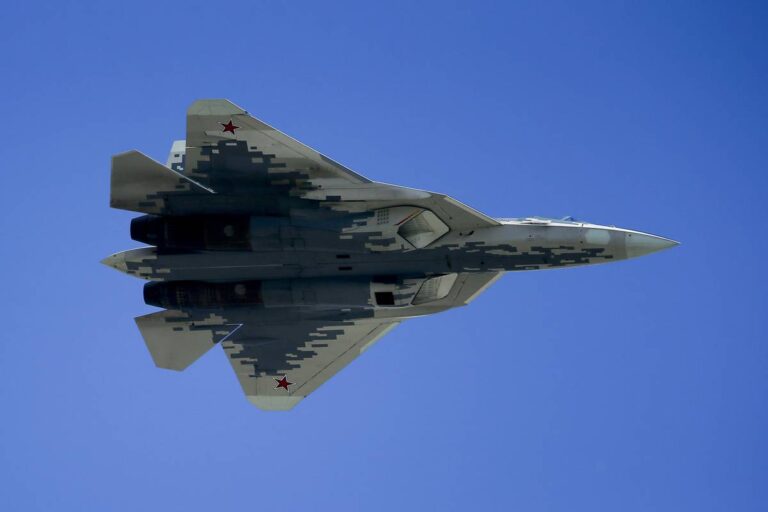
Russia has entered discussions with several Middle Eastern countries to explore the possibility of jointly developing and manufacturing fifth-generation aircraft, the Russian Federal Service for Military-Technical Cooperation (FSMTC) announced at the World Defense Show 2026 in Riyadh on Sunday.
The talks, which are still in preliminary stages, focus on the design and production of advanced warplanes, alongside the integration of the latest weapon systems. Officials stressed that these initiatives are long-term and technically complex, requiring careful planning and coordination between all parties involved.
FSMTC representatives noted that the conversations are ongoing and that both sides are considering the parameters of potential collaboration, including the distribution of competencies and responsibilities. “It’s worth noting that long-term projects that require a detailed elaboration, being complex technology wise, are being discussed,” the agency said.
While no formal agreements have been signed, the discussions signal Moscow’s intent to expand military-industrial partnerships in the region and to leverage expertise from allied countries to advance aerospace capabilities.
Fifth-generation aircraft represent a significant leap in aviation technology, combining stealth, advanced avionics, supermaneuverability, and networked capabilities. Joint production efforts could potentially strengthen the military capabilities of partner nations while providing Russia with access to new markets and regional influence. Analysts note that such collaborations may also reflect geopolitical calculations, as both Russia and Middle Eastern states seek to diversify defense alliances amid shifting global power dynamics.
According to FSMTC, the discussions remain exploratory, and it is too early to specify timelines for project launches or operational deployment. Officials emphasized that careful planning is essential given the technological sophistication required, including research and development, production logistics, and coordination across multiple jurisdictions. Both sides appear committed to evaluating feasibility before formal agreements or contracts are signed.
The announcement comes amid a broader effort by Russia to expand defense ties outside its traditional partners. Moscow has increasingly sought collaborations with Middle Eastern countries in recent years, ranging from the sale of advanced fighter jets to air defense systems and joint military exercises.
Experts suggest that joint production projects could strengthen long-term defense cooperation while creating opportunities for technology transfer, industrial growth, and strategic alignment in the region.
The potential partnership would also serve as a strategic counterbalance to Western influence in the Middle East. Several countries in the region have previously relied on U.S.-made aircraft and systems, but growing interest in alternative suppliers reflects an effort to diversify defense procurement and reduce dependency. Russia’s willingness to enter joint development projects signals a new phase in defense relations, moving from traditional sales toward collaborative manufacturing and shared technological advancement.
Read Also: China Biotech Factory Explosion Kills Eight in Shanxi
FSMTC representatives clarified that discussions currently focus on the conceptual and technical aspects of cooperation. “With the sides currently discussing the parameters of potential cooperation and distribution of competencies, it is too early to say exactly when these projects can be launched,” the agency said.
Both parties appear interested in long-term collaboration that not only enhances military capability but also fosters innovation, industrial development, and workforce training.
Observers note that joint production of fifth-generation aircraft would require significant investment, advanced manufacturing infrastructure, and close coordination on research and testing. This type of collaboration is relatively rare globally, making any potential agreement a notable development for Russia and the region. If successfully implemented, it could set a precedent for future joint ventures in aerospace and defense technology.
While the initiative is in its early stages, the announcement highlights Russia’s ambition to expand its global defense partnerships and share expertise with key allies. For Middle Eastern countries, involvement in advanced aircraft production would enhance indigenous capabilities and position them as technology players in a competitive global defense market. Both sides will need to navigate technical, regulatory, and political challenges to realize such a complex venture.
Read Also: Ukraine Says Trump Key to Peace as Leader Talks Urged
As discussions continue, experts anticipate that Russia and its regional partners will gradually outline specific roles, technology sharing arrangements, and potential production sites.
Analysts believe that this could eventually lead to a landmark agreement shaping the future of aerospace and defense collaboration between Russia and Middle Eastern nations.