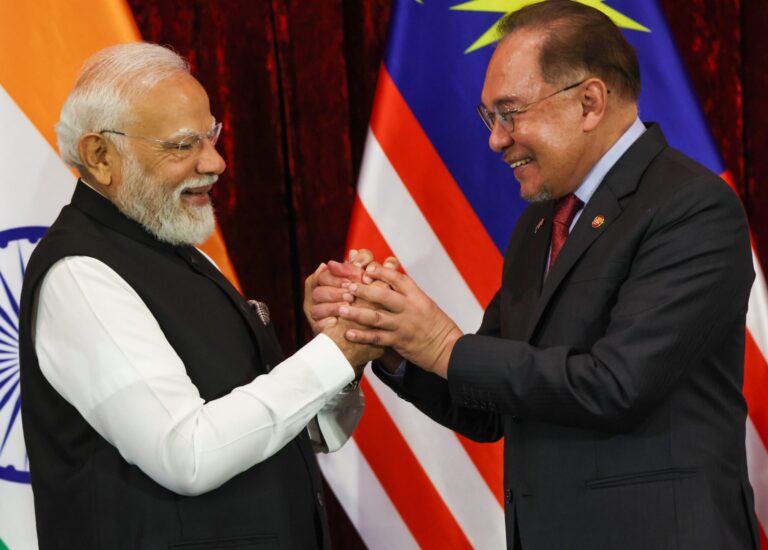
India and Malaysia took significant steps to strengthen their India Malaysia strategic partnership on Sunday, as Prime Minister Narendra Modi and Malaysian Prime Minister Anwar Ibrahim pledged deeper cooperation in trade, semiconductors, defence, and local-currency commerce during talks in the Malaysian administrative capital. The two leaders also oversaw the signing of multiple cooperation agreements designed to solidify economic and security ties between the two major Asian democracies.
Modi’s two-day official visit, his first to Malaysia since both nations elevated their relationship to a Comprehensive Strategic Partnership in August 2024, shows a shared commitment to expanding diplomatic and economic engagement amid evolving regional dynamics in Southeast Asia.
Anwar described the partnership as robust and multifaceted, encompassing long-standing ties since both countries established diplomatic relations in 1957 and reflecting deep people-to-people linkages. “We consider this meeting … as very vital, strategic and critical to advance and enhance relations between India and Malaysia,” he told reporters after the bilateral meeting. Modi highlighted that his visit reflects the “trust” between the two nations, pointing to expanding trade and cultural ties as central pillars of cooperation. In remarks to the Indian diaspora in Kuala Lumpur earlier Saturday, he said India is seen as a “trusted partner for growth,” and emphasized the importance of people-to-people connections cemented by shared heritage and community links.
India and Malaysia have enjoyed a steady increase in bilateral trade, which reached roughly $18.6 billion in 2025. Malaysian officials and Indian diplomats are seeking to push that figure higher as both economies pursue closer integration.
Read Also: New Zealand, India Seal Free Trade Deal To Boost Growth Pact
Anwar specifically noted that efforts would continue to promote the use of local currencies for cross-border transactions, a move intended to reduce reliance on hard currencies like the U.S. dollar and strengthen financial connectivity between the two markets.
Both leaders also expressed shared interest in expanding collaboration in technology and industry. Among the 11 cooperation agreements exchanged were deals related to semiconductor development, one of the most strategically important sectors in the global technology landscape, along with agreements covering disaster management, peacekeeping cooperation and other areas of mutual interest.
Beyond economic cooperation, defence and security also figured prominently in the discussions. Modi and Anwar agreed to enhance collaboration on shared concerns, including peacekeeping operations, national security, and defence industry linkages, further signaling trust in strategic dialogue between the two capitals. According to Malay Mail reporting on the visit, additional memoranda of understanding (MoUs) touched on standards of training and certification for seafarers, technical and vocational education and training, and collaborative frameworks to combat corruption — all elements that reflect converging interests in governance and capacity building.
Modi’s visit also carried symbolic cultural significance. Addressing the Indian community in Kuala Lumpur, he praised the role of the Indian diaspora as a foundational bridge in the India–Malaysia relationship. He highlighted initiatives such as establishing a Thiruvalluvar Centre and strengthening scholarships and cultural exchanges to enhance bilateral people-to-people ties. Anwar also acknowledged the deep historical connections between the two nations, remarking on the long-standing presence of Indian culture in Malaysia and the mutual appreciation for shared traditions. Such remarks reinforced that strategic engagements extend beyond commerce and defence into the social fabric that binds the countries.
Read Also: India Budget Reforms Test Fiscal Discipline In 2026
This visit comes at a time when both India and Malaysia are seeking more diversified partnerships in Asia amid shifting geopolitical currents.
India, which has advanced multiple free trade and strategic dialogues with partners including the European Union and United States, continues to position itself as an anchor of cooperation in the Indo-Pacific region.
Malaysia, meanwhile, has increasingly pursued balanced engagement with regional powers while maintaining its identity as a key member of the Association of Southeast Asian Nations (ASEAN). Anwar’s government has emphasized strategic autonomy and broad diplomatic engagement, even as it deepens ties with India and other partners.
As time goes by, India and Malaysia are expected to build on the agreements made during this visit by beginning the operation of the cooperation frameworks signed this week. Both governments will likely establish task forces and working groups to implement semiconductor partnerships, disaster management protocols, and local currency trade initiatives agreed upon by Modi and Anwar.
As Modi concluded his visit, he reiterated that the India–Malaysia partnership represents not only a bilateral success but also a model for expanded cooperation in Asia, a sentiment that both governments hope will translate into tangible benefits for their citizens and regional stability in the coming years.