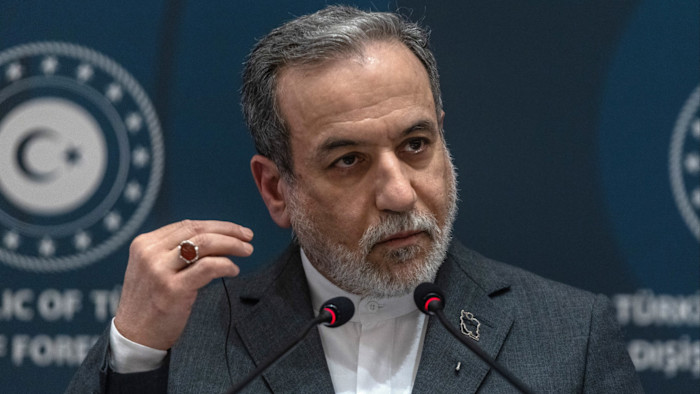
Iran’s Foreign Minister Abbas Araghchi on Saturday accused Israel of operating under what he described as a “doctrine of domination,” arguing that the regional order allows Israel to expand its military power unchecked while pressuring neighboring states, including Iran, to weaken their own defensive capabilities.
Araghchi’s remarks came just one day after renewed indirect nuclear talks between Iran and the United States in Oman, signaling the sharp political tensions surrounding diplomacy aimed at preventing further escalation after last year’s brief but intense war between Iran and Israel.
Speaking at the Al Jazeera Forum conference in Doha, Araghchi did not directly reference the talks with Washington but delivered a sweeping critique of Israel’s military posture and the broader security framework in the Middle East.
The comments underscore the deep mistrust shaping the fragile restart of nuclear negotiations, which collapsed last year after Israel launched a major bombing campaign against Iranian targets. Although both Tehran and Washington have described the latest round of talks as constructive, Araghchi’s speech highlighted the political limits facing Iranian negotiators amid ongoing regional hostilities.
His statements also reflect Iran’s longstanding position that Israel’s military dominance—supported by the United States—distorts security expectations in the region, particularly when Iran faces international pressure over its nuclear program.
Addressing regional policymakers, journalists, and analysts, Araghchi said Israel’s military policies were rooted in an expansionist strategy that required weakening surrounding states across multiple dimensions. “Israel’s expansionist project requires that neighboring countries be weakened, militarily, technologically, economically, and socially,” Araghchi said, according to remarks broadcast by Al Jazeera.
Under this system, he added, Israel faces no meaningful constraints on its military buildup. “Under this project, Israel is free to expand its military arsenal without limits,” he said. “Yet other countries are demanded to disarm. Others are pressured to reduce defensive capacity. Others are punished for scientific progress.”
Read Also: U.S.-Iran Talks Resume Amid Rising Regional Tensions
The remarks come against the backdrop of the 12-day conflict last June, when Israel launched its most extensive direct military strikes on Iranian territory to date. According to reporting by Reuters and the BBC, Israeli attacks targeted senior Iranian military commanders, nuclear scientists, and facilities linked to Iran’s nuclear and missile programs, as well as residential areas.
The United States later joined the campaign, striking what it described as key Iranian nuclear infrastructure, marking a rare instance of direct U.S. military action against Iran inside the country.
Iran responded with missile and drone strikes on Israel and carried out a retaliatory attack on the largest U.S. military base in the Middle East, located in Qatar. While casualties were limited compared with previous regional wars, the confrontation raised fears of a wider conflict involving U.S. allies and Iranian-backed groups.
Against that volatile backdrop, Iran and the United States resumed indirect nuclear talks on Friday in Muscat, Oman, with Araghchi leading the Iranian delegation and Steve Witkoff, the U.S. Middle East envoy, representing Washington.
Neither side disclosed detailed proposals, but both characterized the atmosphere as constructive. Araghchi later said the talks had been “very positive,” while U.S. President Donald Trump described them as “very good,” adding that further negotiations had been agreed upon.
According to diplomats familiar with the process, the Muscat meeting focused on reviving constraints on Iran’s nuclear program in exchange for potential sanctions relief, though significant gaps remain.
The United States has signaled that it wants discussions to go beyond Iran’s nuclear activities to include ballistic missile development and Iran’s support for militant groups across the region, including Hezbollah in Lebanon and armed factions in Iraq and Yemen.
Read Also: Putin Raises Iran Concerns In Talks With UAE President
Israeli officials have publicly urged Washington to expand the scope of negotiations, arguing that Iran’s missile capabilities and regional alliances pose an existential threat to Israel.
Tehran, however, has repeatedly rejected those demands. Iranian officials insist that missile development is non-negotiable and that Iran’s regional relationships are defensive alliances, not bargaining chips.
Araghchi reiterated that stance implicitly in Doha, warning against selective disarmament frameworks that target Iran while leaving Israel’s military capacity untouched.
The renewed talks come amid heightened military pressure. In recent weeks, the United States deployed an aircraft carrier strike group to the region, a move Washington described as defensive but which Iranian officials viewed as coercive.
The deployment followed Iran’s deadly crackdown on anti-government protests last month, which drew international condemnation and renewed U.S. sanctions. According to AP and AFP, the protests marked one of the most significant waves of unrest in Iran in recent years, prompting Western governments to increase diplomatic and economic pressure.
U.S. officials have argued that military readiness is necessary to deter further escalation, while Iran has accused Washington of negotiating under threat.
Israel has not formally responded to Araghchi’s remarks, but Israeli leaders have consistently defended their military posture as essential to national survival. Israel maintains a policy of strategic ambiguity regarding its nuclear capabilities and is widely believed to possess nuclear weapons, though it neither confirms nor denies this.
Israeli officials argue that Iran’s nuclear program, missile development, and regional alliances justify preemptive action. Israel is not a signatory to the Nuclear Non-Proliferation Treaty (NPT), while Iran is a signatory but disputes allegations that it seeks nuclear weapons.
Despite the sharp rhetoric, both Tehran and Washington have indicated that diplomacy remains preferable to confrontation. Analysts say the decision to resume talks reflects a mutual desire to avoid another military escalation, even as political distrust remains high.
Whether negotiations can survive regional tensions—particularly continued Israeli-Iranian hostilities—remains uncertain. For now, the Muscat talks mark a tentative reopening of dialogue in a region where military action has increasingly overshadowed diplomacy.