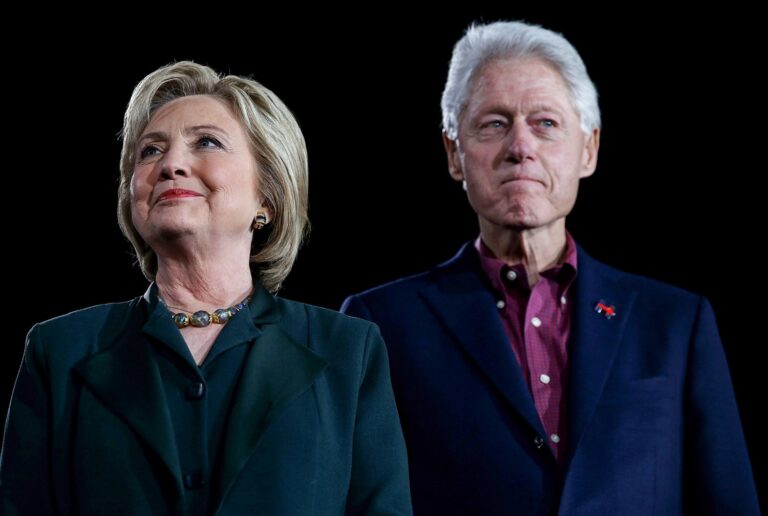
Former U.S. President Bill Clinton and former Secretary of State Hillary Clinton have called for their upcoming congressional testimony regarding their past connections to convicted sex trafficker Jeffrey Epstein to be held in public, arguing that closed-door proceedings risk politicizing the issue and undermining transparency.
Both Clintons were recently subpoenaed by the House Oversight and Accountability Committee, which is investigating Epstein’s relationships with prominent political, business, and social figures, as well as how U.S. authorities handled information related to his crimes before his death in federal custody in 2019.
The committee, chaired by Republicans, initially scheduled the Clintons’ testimony as private depositions, a move the couple says would allow partisan narratives to flourish without public scrutiny. In response, they have agreed to testify — but only if the proceedings are open.
The dispute over how the testimony should be conducted underscores broader tensions surrounding the Epstein investigation, which has resurfaced amid the recent release of millions of Justice Department records related to the case.
Democratic lawmakers argue that the inquiry is being used to target political opponents of President Donald Trump, rather than to conduct genuine oversight. Trump, who socialized with Epstein in the 1990s and early 2000s, has not been summoned to testify, despite being mentioned in past reporting and public records.
House Republicans deny any partisan motive, saying the investigation aims to establish how Epstein cultivated relationships with influential individuals and whether government agencies failed to act decisively on credible allegations.
In a statement posted Friday on X, Bill Clinton said he would cooperate with Congress but criticized the idea of testifying behind closed doors.
“Let’s stop the games and do this the right way — in a public hearing,” the former president wrote, adding that a closed deposition would resemble a “kangaroo court.”
Clinton’s remarks reflect concern that private testimony could be selectively leaked or framed without full context, a frequent criticism leveled at closed congressional depositions.
Read Also: Jack Lang Under Pressure Over Epstein Ties
A spokesperson for the House Oversight Committee declined to comment on whether it would reconsider the format of the testimony.
Hillary Clinton echoed her husband’s stance, saying the couple had already provided all relevant information to committee investigators. “We’ve told the committee what we know,” the former secretary of state said Thursday. “If you want this fight, let’s have it in public.”
Hillary Clinton, who ran unsuccessfully against Trump in the 2016 presidential election, has long been a focal point of Republican investigations, including past probes into her use of a private email server and the Benghazi attacks.
Her allies argue that the renewed scrutiny reflects a pattern of politically motivated investigations rather than new evidence of wrongdoing.
Jeffrey Epstein, a wealthy financier with extensive social and political connections, was arrested in July 2019 on federal sex trafficking charges involving underage girls. He died weeks later in a Manhattan jail cell, in what the Justice Department ruled a suicide.
Epstein’s death sparked widespread controversy and conspiracy theories, as well as renewed calls for accountability over how he received a lenient plea deal in 2008 that allowed him to avoid federal prosecution despite mounting evidence of abuse.
In the years since, journalists, lawmakers, and victims’ advocates have sought greater disclosure of records related to Epstein’s activities and associations.
Last week, the U.S. Justice Department released a massive trove of Epstein-related materials — more than three million documents, photos, and videos — as part of ongoing litigation and transparency efforts.
The documents include travel logs, contact lists, witness statements, and internal communications. While Bill Clinton’s name appears multiple times, largely in connection with travel records and social references, no evidence has emerged linking either Clinton to criminal conduct, according to reviews by multiple media outlets, including Reuters and the Associated Press.
Legal experts note that appearing in Epstein-related documents does not imply wrongdoing, as the financier cultivated relationships with hundreds of high-profile individuals across politics, academia, business, and entertainment.
Bill Clinton has previously acknowledged flying aboard Epstein’s private plane on several occasions in the early 2000s, saying the trips were connected to humanitarian work linked to the Clinton Foundation, including initiatives focused on HIV/AIDS and disaster relief.
Read Also: Epstein Files Release Sparks Outrage Over Redactions
The former president has consistently said he never visited Epstein’s private island in the U.S. Virgin Islands and was unaware of Epstein’s criminal activities at the time.
Trump has acknowledged knowing Epstein socially but has denied involvement in any wrongdoing and has said he cut off contact years before Epstein’s arrest. Despite this, Democrats argue that the oversight committee’s focus on the Clintons — while excluding Trump from testimony — raises questions about the inquiry’s scope and balance.
It remains unclear whether the House Oversight Committee will agree to convert the Clintons’ testimony into a public hearing. Under House rules, committee leadership has broad discretion over whether depositions are open or closed.
If the committee insists on private testimony, the Clintons could still comply while continuing to criticize the process — or potentially challenge the format publicly.