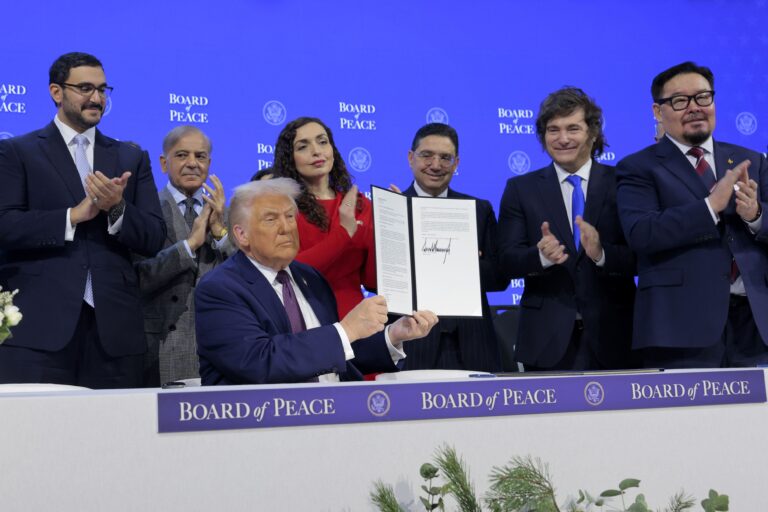
The White House is preparing to host the inaugural leaders’ meeting of President Donald Trump’s “Board of Peace” on February 19, 2026, in Washington, officials and diplomats told Axios in reporting that signals a U.S.-led effort to steer Gaza reconstruction and broader conflict resolution efforts.
The gathering is expected to take place at the U.S. Institute of Peace and will coincide with a White House visit by Israeli Prime Minister Benjamin Netanyahu, who is scheduled to meet Trump the day before, on February 18.
The meeting is in early planning stages, and details could still shift, sources say. In addition to serving as a diplomatic meeting of global leaders participating in the initiative, the event is intended to function as a fundraising conference for Gaza’s reconstruction, part of Trump’s broader peace strategy.
Trump formally launched the Board of Peace in late 2025 as part of his comprehensive plan to stabilize the Gaza Strip following years of devastating conflict. The initiative was later referenced in United Nations Security Council Resolution 2803, adopted in November 2025, which endorsed the board’s role in supporting Gaza’s reconstruction and authorized a temporary international stabilization force to help secure the territory.
The board is envisioned as a multilateral body, chaired by Trump, that will guide governance, demilitarization, reconstruction, and economic recovery efforts in Gaza — responsibilities that historically fall within the U.N. framework. Its formal charter describes the organization’s mission as promoting stability and restoring governance in conflict-affected areas.
A founding executive board has been formed with members drawn from diplomacy, investment, and governance sectors; it includes figures such as U.S. Secretary of State Marco Rubio, former British Prime Minister Tony Blair, Jared Kushner, and World Bank President Ajay Banga. Each member is reportedly tasked with overseeing portfolios ranging from reconstruction to capital mobilization.
Read Also: Trump Board Of Peace Gains Seven Nations Amid Gaza Talks
The Board of Peace initiative stems from a fragile ceasefire agreement between Israel and Hamas that began in October 2025 under a U.S.-brokered framework. While the truce halted large-scale warfare, ceasefire violations have continued, and violence across the Gaza Strip persists. According to Palestinian health authorities, more than 550 Palestinians and at least four Israeli soldiers have been reported killed since the truce started.
The broader war between Israel and Hamas, which escalated in late 2023 after Hamas-led militants attacked Israel, has had catastrophic humanitarian consequences in Gaza. U.N. and other international agencies estimate that tens of thousands of Palestinians have lost their lives, with significant destruction of infrastructure and mass displacement of civilians. Reuters and the BBC have reported extensively on Gaza’s humanitarian crisis and infrastructure collapse. (See related coverage by Reuters on Gaza humanitarian situation.)
The concept of the Board of Peace has drawn a mixed reaction internationally. Some of Washington’s Middle Eastern allies have engaged with the initiative, but many traditional Western partners have either declined to participate or expressed caution, citing concerns about mandate, structure, and implications for existing international peacekeeping frameworks.
Some diplomatic sources explain that while countries such as Egypt, the United Arab Emirates, Saudi Arabia, and Qatar have engaged with the board, most European Union members have not formally joined, reflecting skepticism about the organization’s relationship with the United Nations and its governance mechanisms.
Several Western diplomats have also been reported as reluctant to commit to membership until objectives and governing procedures are clearly spelled out. In addition, census counts of invited countries suggest participation has been limited relative to the number approached.
Under the ceasefire plan adopted by the U.N. Security Council, the board is envisioned not only as a mechanism for rebuilding Gaza’s infrastructure but also as the framework for temporary governance until a stable local administrative structure can be established. It is tasked with coordinating international efforts to demilitarize militant groups, facilitate the delivery of humanitarian aid, and oversee the gradual transfer of civil governance responsibilities to local authorities.
Read Also: Pakistan Joins Trump Gaza Peace Board In Ceasefire Push
Yet some rights advocates and analysts have criticized the initiative for concentrating authority in a body led by a single foreign leader and for bypassing established international institutions. Critics argue that a board chaired by a national head of state, rather than by a neutral international entity, raises questions about sovereignty, accountability, and representativeness.
Questions have also been raised about the absence of explicit Palestinian representation in the Board of Peace’s leadership, despite the centrality of Gaza’s population to any long-term peace and reconstruction efforts. Human rights organizations have contended that inclusive governance frameworks are essential to sustainable peace but have noted that the Board’s structure appears to elevate external actors over local voices.
One of the key aims of the upcoming Washington meeting is to mobilize financial support for Gaza’s reconstruction, which the United Nations estimates could exceed tens of billions of dollars. Under the Board of Peace framework, donor commitments are expected to be pooled to rebuild housing, restore essential services, and support economic revitalization.
However, recent reporting suggests that donor enthusiasm has been uneven, with some governments reluctant to pledge funds without clear progress on security conditions — particularly demilitarization commitments by militant groups — and well-defined governance arrangements for Gaza.
Netanyahu, slated to meet Trump ahead of the Board of Peace leaders meeting, has reiterated Israel’s position that Hamas must be disarmed and Gaza fully demilitarized as a condition for long-term peace and stability. An article in The Jerusalem Post quoted Netanyahu insisting that disarmament is essential to ensure Gaza does not revert to violence.
Hamas, for its part, has rejected aspects of the international peace plan, including provisions it views as constraining Palestinian autonomy. Statements circulated by the militant group argued that international mechanisms tasked with disarming resistance factions could strip Gaza of neutrality and undermine Palestinian self-determination. Reports of these responses were covered in independent news media following the U.N. Security Council vote.
As preparations for the February 19 Board of Peace meeting continue, Trump’s initiative remains one of the most consequential and debated elements of current efforts to end the decades-long Israeli–Palestinian conflict.