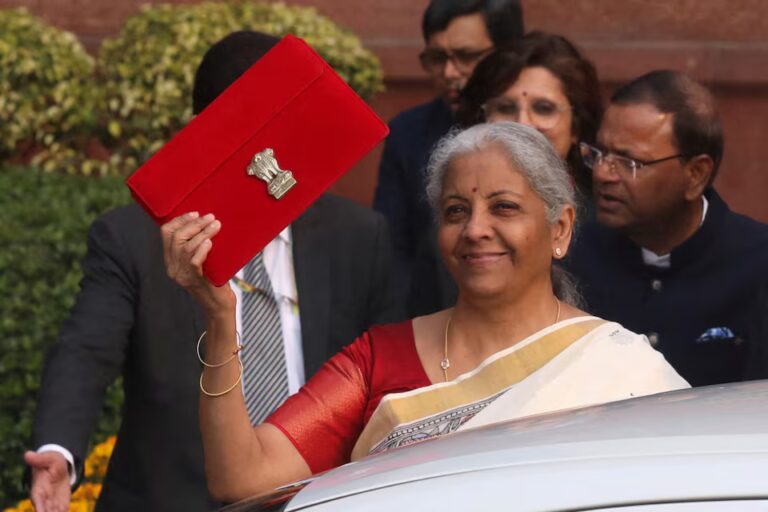
India’s government is set to present its annual federal budget on Sunday, with Prime Minister Narendra Modi’s administration aiming to reinforce domestic reforms while keeping public finances in check amid global economic uncertainty.
Finance Minister Nirmala Sitharaman will deliver the budget for the fiscal year beginning in April during a parliamentary address scheduled for 11 a.m. local time. The plan comes as India faces pressure from rising geopolitical tensions and steep United States tariffs on some exports, even as growth remains among the strongest globally.
The budget is expected to continue Modi’s push for long term structural changes designed to support investment and consumption. At the same time, the government is under pressure to restrain spending after recent tax cuts reduced revenue by about 1.5 trillion rupees, or roughly 16 billion dollars, during the current fiscal year.
Read Also: India US Tariff Talks Continuous After Modi Trump Call
India has set a fiscal deficit target of 4.4 percent of gross domestic product for the twelve months ending in March. Analysts say meeting that goal will require careful calibration of new policy measures and borrowing plans.
Speaking ahead of the budget, Modi framed the government’s strategy as one focused on stability and predictability. “The nation is moving away from long term problems to tread the path of long term solutions,” he said on Thursday, shortly before the release of the government’s annual economic survey. “Long term solutions provide predictability that fosters trust in the world.”
The survey forecast economic growth of between 6.8 percent and 7.2 percent for the coming fiscal year, underscoring India’s relative resilience compared with other major economies.
Read Also: Trump Says Modi Agrees To Reduce Russian Oil Imports
In recent months, New Delhi has rolled out a series of measures aimed at reviving private investment and domestic demand. These include cuts to income and consumption taxes, revisions to labour laws, and steps to open parts of the tightly controlled nuclear power sector to greater participation.
More policy announcements are expected in Sunday’s budget, particularly around manufacturing and defence. Modi’s government is planning a third major effort to expand manufacturing’s share of the economy after two earlier initiatives fell short of expectations. Officials are also expected to ease rules governing investment in defence production, part of a broader effort to reduce reliance on imports.
According to government estimates, gross borrowing for the fiscal year starting in April is likely to rise to between 16 trillion and 16.8 trillion rupees, up from about 14.6 trillion rupees this year. The increase reflects higher funding needs even as the administration pledges to keep deficits on a downward path.
External risks remain a major concern as the budget is unveiled. The United States has imposed tariffs of up to 50 percent on some Indian goods, complicating export prospects and adding strain to trade ties with Washington.
In response, India has been stepping up efforts to diversify its trade relationships. New Delhi recently advanced negotiations on a major trade agreement with the European Union, which officials see as a way to soften the impact of U.S. tariffs and provide exporters with more stable access to overseas markets.
Sitharaman’s budget will be closely watched by investors, businesses, and international partners for signals on how India plans to navigate a more volatile global environment while sustaining growth at home.