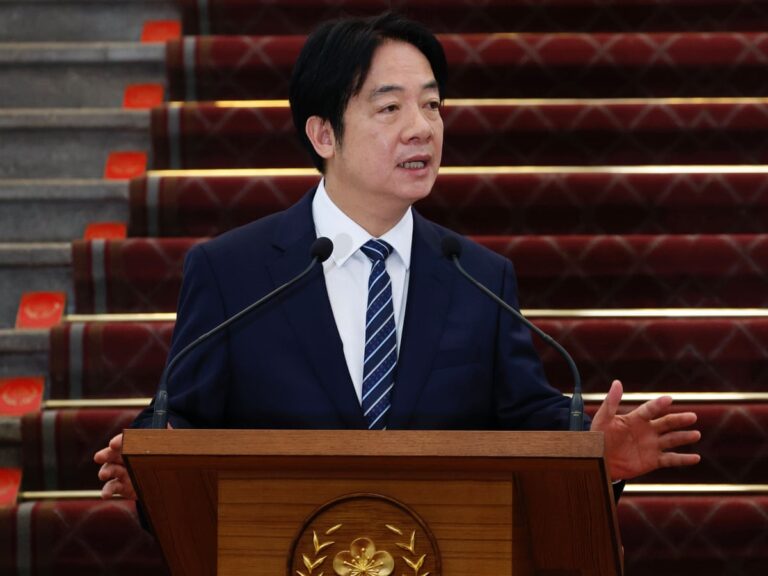
Taiwan President Lai Ching said any effort to alter the island’s status through force or pressure would fail to deliver lasting peace, according to a letter he sent to Pope Leo and released by Taiwan’s presidential office on Friday.
The message was written in response to the Pope’s World Day of Peace address on January 1 and comes as tensions remain high between Taiwan and China, which claims the democratically governed island as its territory.
The Vatican remains one of only 12 states that maintain formal diplomatic relations with Taiwan and is the sole European country to do so. While the Holy See has sought warmer relations with Beijing in recent years, including agreements on the appointment of Catholic bishops, it has not severed ties with Taipei.
In his letter, Lai described democracy, peace, and prosperity as core principles shaping Taiwan’s domestic path and its engagement with the international community. He said Taiwan has consistently chosen restraint despite what he described as sustained military and political pressure from authoritarian governments in the region. “I firmly believe that any attempt to change Taiwan’s status quo through force or coercion cannot bring true peace,” Lai wrote, without naming China directly.
Read Also: Chinese Drone Enters Taiwan Airspace Over Pratas Islands
China’s military conducts near daily operations around Taiwan, which officials in Taipei describe as a campaign of intimidation. Beijing staged its most recent large scale exercises around the island in late December, according to Taiwan’s defense ministry.
China has refused formal dialogue with Lai since he took office, branding him a separatist. Lai has repeatedly said that Taiwan’s future can only be decided by its people.
Lai also used the letter to challenge what he called attempts to reinterpret historical documents and international resolutions in ways that undermine Taiwan’s sovereignty.
He pointed to World War Two declarations and the 1971 United Nations resolution that transferred China’s seat from Taipei to Beijing. Lai argued that these texts are being misused to support claims that Taiwan is part of the People’s Republic of China.
Read Also: Taiwan Offers Talks With Ukraine After Missile Parts Allegation
Beijing maintains that documents such as the Cairo Declaration and the United Nations resolution provide legal backing for its claim over Taiwan. Taiwan’s government rejects that position, noting that the resolution does not mention Taiwan and that the People’s Republic of China was founded after World War Two ended.
Taiwan’s official name remains the Republic of China, the government that fought alongside Allied powers during World War Two. The government relocated to Taiwan in 1949 after losing a civil war to communist forces led by Mao Zedong, who established the People’s Republic of China on the mainland.