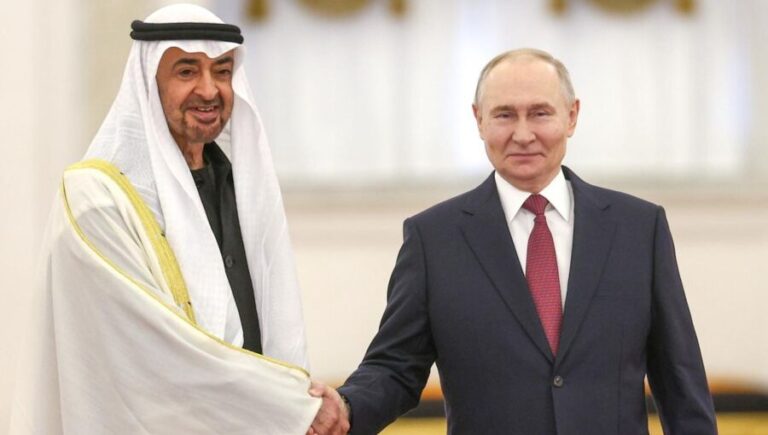
Russian President Vladimir Putin told United Arab Emirates President Mohammed bin Zayed Al Nahyan on Thursday that Moscow is closely following developments in Iran and wants to exchange views on the situation during talks at the Kremlin. The comments place Putin Iran talks UAE at the center of renewed diplomatic attention as tensions rise around Tehran’s nuclear program.
The meeting comes at a sensitive moment for the Middle East, with Washington stepping up pressure on Iran and regional powers watching closely for signs of escalation or dialogue.
Speaking at the start of the meeting, Putin said Russia was monitoring events in Iran and viewed the issue as important enough to raise directly with the UAE leader, whose country has become an increasingly active diplomatic broker. The UAE has in recent months hosted discussions aimed at easing international tensions, including peace talks linked to the war in Ukraine.
Read Also: Breaking: Iran, Saudi Arabia Leaders Tout Unity For Peace
The Kremlin has positioned itself as a supporter of diplomatic solutions in the Middle East, particularly where conflict could disrupt regional stability and global energy markets.
Earlier on Thursday, Kremlin spokesman Dmitry Peskov said the possibility of negotiations between the United States and Iran should not be ruled out. He warned that military action would carry serious risks.
“Any use of force against Tehran could create chaos in the region and lead to dangerous consequences,” Peskov said, according to Russian state media. His remarks underlined Moscow’s concern that confrontation could spiral beyond control.
Peskov was responding to comments made a day earlier by US President Donald Trump, who urged Iran to return to negotiations over its nuclear activities or face the prospect of a US strike. The White House has argued that renewed pressure is necessary to prevent Iran from developing nuclear weapons.
Read Also: Trump Iran Military Options Signal Major Policy Shift
Russia maintains working relations with both Iran and key Gulf states, including the UAE. Analysts say Moscow sees value in keeping communication channels open with all sides as tensions fluctuate.
According to Reuters and the BBC, the UAE has sought to balance its close security ties with Washington while maintaining dialogue with Tehran and other regional actors. That role has given Abu Dhabi growing influence as a go between during periods of crisis.
The Kremlin has not released details of any specific proposals discussed during Thursday’s meeting. However, officials indicated that regional security and diplomatic options would remain on the agenda.
As pressure mounts on Iran and international rhetoric sharpens, Moscow’s engagement with Gulf partners suggests Russia is preparing for a prolonged period of uncertainty, while still pushing for talks over confrontation.