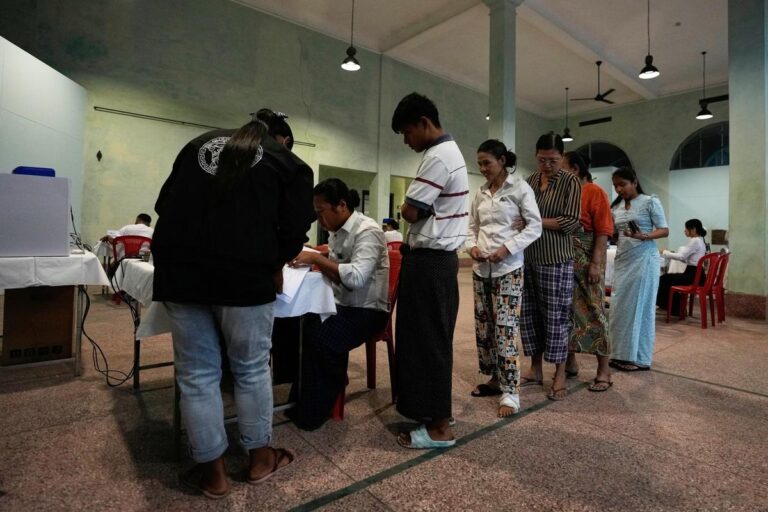
Myanmar’s military government is pressing ahead with elections in parts of the country this week, with voters in 60 townships set to cast ballots, including in the major cities of Yangon and Mandalay, despite an ongoing civil war and widespread international criticism.
The vote comes as the ruling junta says it intends to hand over power to a new civilian administration by April, framing the polls as a step toward political transition nearly four years after the military seized control.
However, the elections are being held in a nation fractured by violence, with fighting continuing in several regions during the campaign period.
The United Nations, Western governments, and human rights organizations have dismissed the elections as lacking credibility, arguing they are designed to entrench military rule rather than restore democratic governance.
Malaysia, which chaired the Association of Southeast Asian Nations (ASEAN) last year, said on Tuesday that the bloc rejected an offer from Myanmar to send election observers and would not endorse the vote.
Read Also: Myanmar Election Enters Second Phase
The refusal underscores growing regional unease over the junta’s political roadmap and the legitimacy of the electoral process.
Myanmar’s military overthrew the elected civilian government in a dawn coup on February 1, 2021, arresting leaders including Nobel Peace Prize laureate Aung San Suu Kyi. The 80-year-old remains in detention.
Her party, the National League for Democracy (NLD), along with several other opposition groups, has since been dissolved by the junta — a move that critics say has effectively eliminated meaningful political competition.
That has left the military-backed Union Solidarity and Development Party (USDP) in a dominant position.
According to the election commission, the USDP has already secured 193 of 209 seats in the lower house and 52 of 78 seats in the upper house, consolidating its grip on the legislature.
Read Also: Myanmar Post-Coup Election Results Show Junta Party Lead
Earlier voting and campaign activity were disrupted in multiple areas, including Myanmar’s border regions of Rakhine, Shan, and Kayin states, where air strikes and clashes have occurred near civilian zones.
“Rather than resolving a crisis now in its fifth year, the vote is more likely to reinforce the military’s hold on power,” said Kaho Yu, Principal Asia Analyst at risk intelligence firm Verisk Maplecroft. He added that the polls offer “little prospect of restoring domestic legitimacy or improving the country’s standing with Western partners.”
The junta has insisted that the elections are part of a broader plan to restore stability and form a new government. But with key opposition forces barred, major regions affected by conflict, and international backing largely absent, the path toward political normalization remains deeply uncertain.