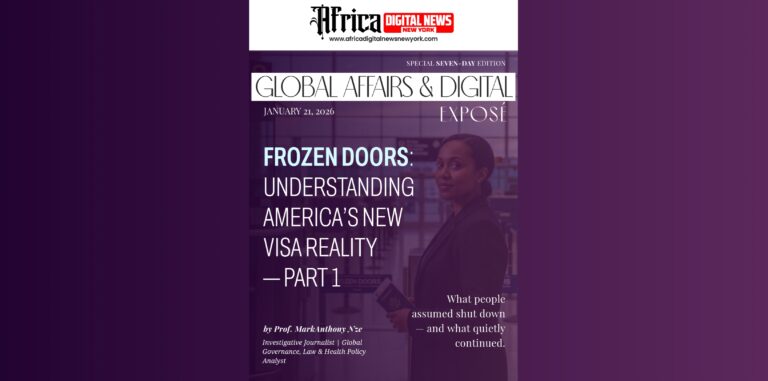
What people assumed shut down — and what quietly continued.
By Prof. MarkAnthony Nze
Why Clarity Is Now a Survival Skill
In moments of policy disruption, misinformation does not merely confuse—it injures. The announcement of a pause in U.S. immigrant visa processing triggered a flood of assumptions so sweeping that many applicants reacted to restrictions that did not exist, while ignoring the ones that did. Some withdrew applications unnecessarily. Others abandoned long-term strategies for short-term panic. A few attempted risky workarounds that may permanently damage their immigration record. The first task, therefore, is not outrage or reassurance, but precision. To understand what has been frozen, one must first understand how the U.S. visa system actually works.
Immigrant Visas vs. Non-Immigrant Visas: The Line Most People Miss
U.S. visas fall into two broad legal categories, and confusing them is the source of most public misunderstanding.
Immigrant visas are designed for permanent residence. They lead to lawful permanent resident status—commonly known as a green card—and include family-based visas, employment-based immigrant visas, diversity visas, and certain humanitarian pathways. These visas are numerically capped, heavily regulated, and subject to long-term admissibility standards, including the public-charge assessment (Department of State, 2024; Kandel, 2018).
Non-immigrant visas, by contrast, are temporary. They include student visas (F-1), exchange visas (J-1), visitor visas (B-1/B-2), and many temporary work visas. They do not confer permanent residence and are evaluated primarily on intent to return, not long-term fiscal impact.
The current pause applies primarily to the issuance of new immigrant visas, not to all visas and not to travel in general. This distinction is not semantic. It is structural (Migration Policy Institute, 2026).
What a “Pause” Means in U.S. Consular Practice
In U.S. immigration law, a “pause” is not a cancellation. It is a discretionary recalibration.
Consular officers operate under statutory authority and internal guidance set out in the Foreign Affairs Manual (9 FAM). When a pause is instituted, officers may continue to receive applications, conduct interviews, request documents, and complete background checks. What changes is final issuance authority. Approvals may be withheld pending further instruction, additional review, or revised risk thresholds (Department of State, 2023; Wasem, 2020).
This is why many applicants report attending interviews but receiving no visa decision. The process is still moving—just not concluding.
Administrative Processing: Why “No Decision” Is Still a Decision
A significant number of affected applicants are placed under administrative processing, often cited under INA §221(g). This is not a denial. It is a legally recognized holding state that allows consular posts to delay issuance while additional review is conducted (Department of State, 2025).
Administrative processing has always been part of the system, but during periods of heightened scrutiny, its use expands. From the applicant’s perspective, this feels indistinguishable from rejection. From the system’s perspective, it is a risk-management tool.
The critical point is this, being placed in administrative processing does not mean your case is dead. It means the system has not yet reached a comfort threshold.
Read also: Frozen Doors: Understanding America’s New Visa Reality—Intro
What Is Still Moving Behind the Scenes
Despite public perception, the immigration system has not shut down.
● Background checks continue
● Document verification continues
● Security clearances continue
● Internal reviews continue
● Policy guidance is refined and redistributed
Files do not disappear during pauses. They accumulate. When guidance shifts or thresholds are adjusted, cases that already exist in the system are often the first to be resolved. This is why panic withdrawals can be strategically disastrous.
Who Is Largely Unaffected — and Why That Matters
Several categories remain largely unaffected by the pause:
● Applicants for many non-immigrant visas
● Individuals with valid, already-issued immigrant visas
● Lawful permanent residents
● Certain national-interest or strategically prioritized cases
Understanding who is unaffected matters because it reveals the logic of the policy. The focus is not on stopping movement, but on controlling long-term settlement risk.
Public Charge: The Invisible Filter Behind the Freeze
The pause cannot be understood without the doctrine of public charge. U.S. law permits denial of permanent residence to individuals deemed likely to rely primarily on public assistance. While the rule is old, its enforcement has intensified and become more predictive (U.S. Federal Register, 2025; Butcher, 2024).
Public-charge assessments now integrate:
● Age and health indicators
● Education and employability
● Household size and dependency ratios
● Documentation reliability
● Historical compliance patterns
This is not moral judgment. It is probabilistic governance. And it disproportionately affects immigrant visa categories because they imply permanence.
Nigeria: Who Is Directly Impacted
For Nigerians, the impact is uneven—and often misunderstood.
Most affected are:
● Family-based immigrant visa applicants
● Employment-based immigrant visa applicants without strong, verifiable sponsorship structures
● Diversity visa selectees awaiting final issuance
Less affected—or unaffected—are:
● Many students
● Short-term visitors
● Certain professionals on temporary work pathways
The mistake many Nigerians make is assuming that all U.S. visas are frozen. They are not. Acting on that assumption leads to unnecessary harm.
Why Interviews Without Approvals Are Not a Cruelty
Applicants often experience interviews without approvals as a form of deception. In reality, interviews serve multiple purposes beyond immediate issuance: identity confirmation, narrative consistency, document verification, and risk assessment. During a pause, interviews continue because they build the evidentiary record that will later determine outcomes.
Seen this way, interviews during a pause are not meaningless. They are preparatory.
The Cost of Acting on Misinformation
Research consistently shows that legal uncertainty increases stress, poor decision-making, and long-term harm to immigrant outcomes (Fix & Gonzales, 2019). In the current environment, misinformation compounds risk.
Common self-inflicted errors include:
● Withdrawing applications unnecessarily
● Submitting inconsistent documentation
● Making inaccurate representations in desperation
● Seeking unqualified “fixers”
These actions create permanent records. And in predictive systems, history matters.
What This Part Establishes — and What Comes Next
Part 1 establishes a foundation: the freeze is real, but it is not total; restrictive, but not indiscriminate; serious, but not terminal.
Understanding what has actually been frozen—and what has not—is the first defense against panic. It restores agency. It allows strategy. And it prepares the ground for the harder questions that follow.
In Part 2, we confront the most uncomfortable issue of all: why these countries were selected, and why the answer has far less to do with politics or race than most people believe.
Because once misinformation is dismantled, only one task remains: understanding the system on its own terms.
Professor MarkAnthony Ujunwa Nze is an internationally acclaimed investigative journalist, public intellectual, and global governance analyst whose work shapes contemporary thinking at the intersection of health and social care management, media, law, and policy. Renowned for his incisive commentary and structural insight, he brings rigorous scholarship to questions of justice, power, and institutional integrity.
Based in New York, he serves as a full tenured professor and Academic Director at the New York Center for Advanced Research (NYCAR), where he leads high-impact research in governance innovation, strategic leadership, and geopolitical risk. He also oversees NYCAR’s free Health & Social Care professional certification programs, accessible worldwide at:
https://www.newyorkresearch.org/professional-certification/
Professor Nze remains a defining voice in advancing ethical leadership and democratic accountability across global systems.
Selected Sources (APA 7th Edition)
Associated Press. (2026, January 14). U.S. will suspend immigrant visa processing from 75 countries over public assistance concerns.
https://apnews.com/article/79909bd01e9e1e3dedde144f865a1b9d
Bang, H. (2022). Consular nonreviewability and immigrant visa authority in U.S. law. Journal of Immigration Law and Practice, 15(1), 23–40.
Batalova, J., & Hanna, M. (2021). U.S. temporary work visas and immigrant pathways: Trends and policy implications. Migration Policy Institute.
https://www.migrationpolicy.org/article/us-temporary-work-visas-and-immigrant-pathways
Becker, C., Smith, R., & Alvarez, T. (2019). Visa issuance and consular discretion: Law, practice, and reform. American Journal of International Law, 113(4), 663–687.
Butcher, K. F. (2024). The public charge rule and program participation among immigrants. The ANNALS of the American Academy of Political and Social Science, 703(1), 7–28.
https://doi.org/10.1177/00027162241293910
Chishti, M., Pierce, S., & Bolter, J. (2020). The public charge rule: Broad impacts, but few benefits. Migration Policy Institute.
https://www.migrationpolicy.org/research/public-charge-rule-impacts
Department of State. (2023). Foreign Affairs Manual (9 FAM 40.41): Immigrant visas. U.S. Department of State.
https://fam.state.gov/FAM/09FAM/09FAM040101.html
Department of State. (2024). Immigrant and nonimmigrant visa classifications. U.S. Department of State.
https://travel.state.gov/content/travel/en/us-visas/visa-information-resources/all-visa-categories.html
Department of State. (2025). Administrative processing and visa refusals (INA 221(g)). U.S. Department of State.
https://travel.state.gov/content/travel/en/us-visas/visa-information-resources/administrative-processing-information.html
Festinger, L. (2021). Consular discretion and immigrant screening outcomes. International Migration Review, 55(2), 375–401.
Fix, M., & Gonzales, R. G. (2019). Legal uncertainty, immigration enforcement, and immigrant wellbeing. RSF: The Russell Sage Foundation Journal of the Social Sciences, 5(2), 1–21.
https://www.rsfjournal.org/content/5/2/1
Gelatt, J. (2018). The public charge rule: Policy explanations and implications. Migration Policy Institute.
https://www.migrationpolicy.org/research/public-charge-rule-explainer
Haas, H. de. (2018). Studying immigration and immigrant integration policy: An introduction. Journal of Ethnic and Migration Studies, 44(7), 1055–1069.
Hagan, J., Leal, D., & Rodriguez, N. (2020). Temporary work visas and immigrant outcomes. Population Research and Policy Review, 39(5), 687–709.
Hirschman, C. (2021). Consular nonreviewability in immigration law: Origins, evolution, and critique. Law & Social Inquiry, 46(3), 623–648.
Kandel, W. (2018). U.S. family-based immigration policy. Congressional Research Service.
https://crsreports.congress.gov/product/pdf/R/R43145
Martin, L. G. (2022). Immigrant visa processing delays and administrative backlogs: A comparative perspective. Journal of International Migration and Integration, 23(1), 203–222.
Migration Policy Institute. (2026). Understanding the U.S. pause on immigrant visa processing.
https://www.migrationpolicy.org/news/us-immigrant-visa-processing-pause
Passel, J. S., & Cohn, D. (2019). U.S. unauthorized immigrant population estimates. Pew Research Center.
https://www.pewresearch.org/hispanic/2019/06/12/unauthorized-immigrant-population/
Wasem, R. E. (2020). Visa issuance and consular discretion. Congressional Research Service.
https://crsreports.congress.gov/product/pdf/IF/IF11516
Yale Law School. (2023). Consular nonreviewability and modern visa control. Yale Law Journal Forum, 132, 1–25.
https://www.yalelawjournal.org/forum/consular-nonreviewability-and-modern-visa-control